
Giant swallowtail
Papilio cresphontes
Description
How to identify
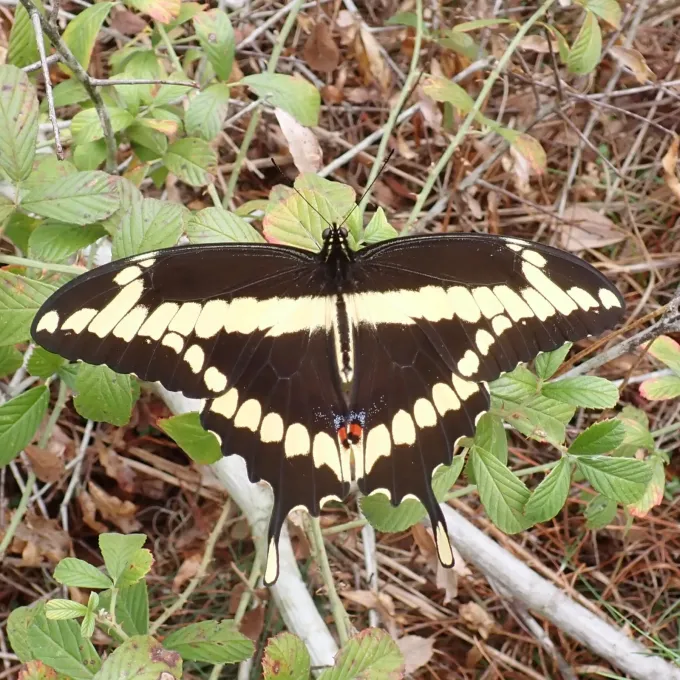
The giant swallowtail (Papilio cresphontes) is a large butterfly belonging to the Papilionidae family. It is easily recognized by its dark brown or black wings with a prominent diagonal yellow stripe.
The larvae, known as orange dogs, have a clever disguise. In their early stages, they look remarkably like bird droppings, which discourages predators from eating them.
As they mature, the larvae turn into large, green-and-brown caterpillars that blend in with the leaves and twigs of their host plants.
A key identifying feature of the caterpillar is the osmeterium, a fleshy, Y-shaped orange-red gland located behind the head that is everted when the larva feels threatened.
These butterflies are common in North and Central America, thriving in regions where citrus trees are grown in abundance.
What it damages
The giant swallowtail larvae primarily feed on plants in the Rutaceae family, making them a well-known pest in commercial and residential citrus groves.
The larvae consume the foliage of lemon, orange, grapefruit, and lime trees. In severe infestations, they can defoliate significant portions of the canopy.
Young trees are at the greatest risk, as the loss of leaves can severely stunt growth and reduce the plant's overall health and vigor.
While mature trees are generally resilient to moderate defoliation, persistent feeding by numerous larvae can reduce fruit yields and tree productivity.
The damage is strictly foliar, characterized by chewed leaf margins and, in extreme cases, the consumption of entire leaves except for the tougher midribs.
When it appears
The lifecycle of the giant swallowtail consists of several generations per year, depending on the climatic conditions of the region.
Adult butterflies emerge in the spring to lay eggs singly on the upper surfaces of host plant leaves. Eggs typically hatch within about a week.
The larval stage is the period of intense feeding and growth, lasting several weeks as the caterpillar progresses through multiple instars (molting stages).
Pupation occurs on the tree branches. The chrysalis is uniquely shaped and colored to resemble a broken or dead twig, providing excellent camouflage.
In colder climates, the species overwinters as a chrysalis, ensuring the population remains dormant until the return of favorable spring temperatures.
Signs of infestation
Signs of infestation include ragged or missing leaf edges. Because the caterpillars are voracious eaters, you will notice missing foliage sections very quickly.
Accumulation of dark, pellet-like frass (excrement) on the ground underneath the affected tree is a clear indicator of larval activity in the canopy.
Careful inspection of the branches will often reveal the larvae, which, despite their size, can be elusive due to their excellent camouflage against the bark and leaves.
If you touch a caterpillar and it displays its bright, pungent orange osmeterium, you have confirmed the presence of this specific pest.
- Ragged and chewed leaf margins.
- Accumulation of larval waste (frass) under the tree.
- Presence of caterpillars with a foul-smelling osmeterium gland.
Control measures
For home gardens, manual removal is the most practical and environmentally friendly method for controlling giant swallowtail larvae.
If an infestation is widespread, applying biological insecticides containing Bacillus thuringiensis (Bt) is highly effective at targeting the caterpillars without harming beneficial insects.
Chemical intervention should be used sparingly, usually restricted to nursery settings or severe outbreaks, following local safety guidelines for pesticide application.
Encouraging natural predators, such as birds, parasitic wasps, and predaceous beetles, helps maintain the swallowtail population at manageable levels.
Regular scouting of the citrus trees, especially during the spring and summer months, allows for early detection and prevents significant damage to your crop.
Taxonomy
- Latin name
- Papilio cresphontes
- Order
- Lepidoptera (butterflies)
- Family
- Papilionidae
- EPPO code
- PAPICR
Discussion
No discussions yet — be the first.