
Giant swallowtail (Papilio anchisiades)
Papilio anchisiades
Description
How to identify
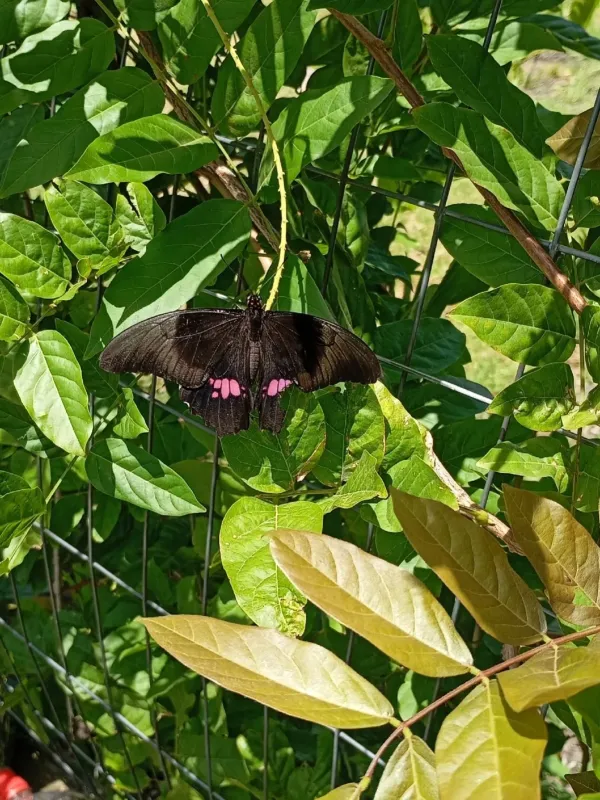
Papilio anchisiades is a prominent species of swallowtail butterfly (family Papilionidae), recognized by its large size and dark wing patterns featuring striking red or pink spots.
The adult butterflies possess a wingspan typically ranging from 80 to 100 mm, with females generally being larger and more robust than their male counterparts.
Their dark coloration serves as an effective camouflage, allowing these butterflies to blend seamlessly into the shadows of dense forest edges and orchard canopies.
The larvae go through several developmental stages, evolving from a bird-dropping mimicry phase to a green, cryptic stage, which helps them avoid avian predators.
The pupae are exceptionally well-camouflaged, resembling twigs or bark fragments, which makes them very difficult to detect during the overwintering or dormant phase.
What it damages
The primary hosts for Papilio anchisiades larvae are plants within the Rutaceae family, with a strong preference for commercial citrus species such as lemon and orange trees.
The larvae act as aggressive defoliators, feeding on young foliage and tender shoots, which can severely compromise the health of young saplings and ornamental trees.
In high-density infestations, these caterpillars can strip a tree of its leaves, leading to reduced photosynthetic capacity and significant stress on the plant.
Younger larvae tend to feed gregariously, meaning they gather in large groups, which leads to localized but intensive damage to specific branches within the tree canopy.
Heavy damage can result in terminal bud destruction, causing stunted growth and poor fruit development in agricultural settings.
When it appears
As a neotropical species, Papilio anchisiades maintains a nearly continuous breeding cycle, provided that temperatures and host plant availability remain stable.
The peak emergence of adults and the highest density of feeding larvae usually coincide with the flush of new growth on citrus trees throughout the growing season.
Eggs are laid in clusters on the leaves, which ensures that the newly emerged larvae start feeding in groups, making their initial damage quite noticeable to growers.
The life cycle from egg to adult is relatively short, often taking between four to six weeks, allowing for multiple overlapping generations per year.
Because generations often overlap, it is common to find multiple life stages of the pest on a single plant, requiring consistent monitoring throughout the year.
Signs of infestation
One of the most reliable signs of an infestation is the presence of skeletonized leaves and jagged edges on the foliage, often accompanied by visible frass (excrement) pellets under the tree.
Observations of young caterpillars feeding in groups on the underside of leaves serve as a primary indicator of early-stage infestation.
The presence of bark-like pupae attached to the stems of citrus trees is a definitive sign that a mature generation of the pest is present in the area.
Defoliated twigs and damaged growth tips on citrus branches clearly signify a high level of larval activity that necessitates immediate management action.
A lack of healthy new leaf growth on otherwise vigorous trees often points to localized feeding pressure from the swallowtail larvae.
Control measures
For home gardens and smaller orchards, physical removal of the gregarious larvae remains the most effective and eco-friendly method of control.
In commercial orchards, biological control using Bacillus thuringiensis (Bt) sprays is highly effective and poses minimal risk to non-target pollinators and beneficial insects.
Encouraging the presence of natural predators, such as parasitic wasps and predatory ants, can significantly suppress the larval population without the need for synthetic chemicals.
Proper orchard sanitation, including the removal of nearby wild Rutaceae host plants, helps to break the life cycle and reduce future infestation pressures.
- Regular scouting for larval clusters on the underside of leaves
- Application of bio-rational insecticides during the early larval stages
- Enhancing biodiversity to support natural parasitoids and predators
Taxonomy
- Latin name
- Papilio anchisiades
- Order
- Lepidoptera (butterflies)
- Family
- Papilionidae
- EPPO code
- PAPIAC
Discussion
No discussions yet — be the first.