
Cuban cockroach
Panchlora nivea
Description
How to identify
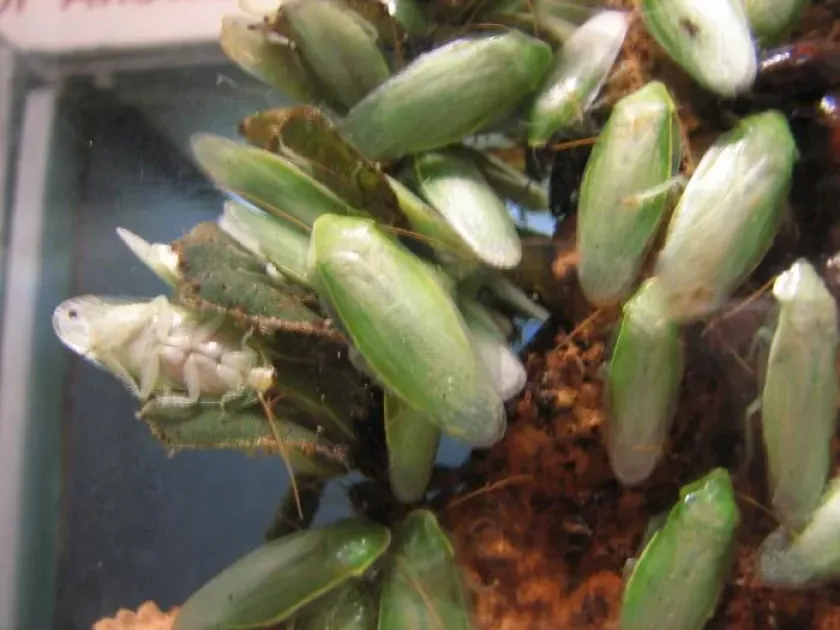
The Cuban cockroach, scientifically known as Panchlora nivea, is an insect characterized by a vibrant green color in its adult stage. Adult individuals typically reach a length of 18–24 mm and possess wings that lie flat against their bodies.
Nymphs of this species differ significantly in appearance from adults, typically displaying a brownish color which allows them to effectively camouflage themselves within soil debris or plant mulch.
A distinctive feature of the species is the high mobility and flight capability of adults, which facilitates the rapid spread of the population to new areas within favorable climatic zones.
Both males and females exhibit similar morphology, although females are generally larger and more robust. In their natural habitat, they prefer humid and shaded areas with dense vegetation.
The insect belongs to the order Blattodea and the family Blaberidae. Unlike synanthropic species, this cockroach is well-adapted to outdoor life in tropical forest environments.
What it damages
The Cuban cockroach is a polyphagous insect that feeds on a wide range of organic materials. In an agronomic context, it most frequently causes damage to young shoots and leaves of ornamental plants.
In greenhouses and nurseries, the pest can damage seedlings by nibbling on tender plant parts, leading to stunted growth and secondary infections at the feeding sites.
Beyond cultivated plants, the insect feeds on decaying organic matter, fallen leaves, and humus, which is why it is frequently found in areas with excessive mulching.
Mass reproduction of this pest in nurseries can lead to significant economic losses, as damaged leaves lose their aesthetic value and become susceptible to necrosis.
- Ornamental shrubs
- Greenhouse flowers
- Young fruit and berry shoots
- Vegetable seedlings
When it appears
The activity of the Cuban cockroach is directly dependent on temperature and humidity levels. In tropical conditions, it reproduces year-round, ensuring a continuous development cycle.
In more temperate climate zones, the period of highest activity occurs during the warm season, when average daily temperatures exceed 20–25 degrees Celsius.
Insects are most active during the evening and night hours when they emerge to forage. During the day, they remain in shelters such as under tree bark, in soil cracks, or within dense plant foliage.
The development cycle includes an egg stage (within an ootheca), several nymphal instars, and adulthood. The female carries the ootheca internally until nymphs emerge, which protects the offspring from unfavorable conditions.
During the winter, as temperatures drop, pest activity decreases; however, in heated indoor facilities, they continue to function and reproduce without interruption.
Signs of infestation
The primary sign of the pest's presence is characteristic damage to leaf blades, such as jagged edges or small puncture holes resulting from nocturnal feeding.
Visual inspection of plants at night using a flashlight allows for the detection of green adult specimens moving rapidly along stems and foliage.
Finding exuviae (cast-off chitinous shells) on the soil surface or leaves is also an indirect indication of an active and developing cockroach population.
The presence of nymphs in soil or mulch indicates that the pest has successfully completed its reproduction cycle and the local population is established.
In greenhouse settings, signs of infestation include specific fecal droppings appearing as tiny black specks on leaves and structural components.
Control measures
For the management of Cuban cockroaches, maintaining sanitary standards is the first line of defense: removing excessive mulch and plant debris where insects find shelter.
The use of attractant-based traps or sticky boards allows for effective monitoring of population levels and suppression of the pest without the need for harsh chemicals.
In cases of high infestation, the use of contact-stomach insecticides is permissible, but applications must be conducted strictly during evening hours when the pest is most active.
Biological control methods include encouraging natural predators such as birds, predatory insects, and spiders, which hunt nymphs and adults in outdoor garden environments.
In greenhouse operations, it is crucial to maintain optimal humidity levels and perform regular substrate disinfection to prevent the creation of conditions favorable for cockroach reproduction.
Taxonomy
- Latin name
- Panchlora nivea
- Order
- Orthoptera (locusts)
- Family
- Gryllidae
- EPPO code
- PANCNI
Discussion
No discussions yet — be the first.