
Green banana cockroach
Panchlora
Description
How to identify
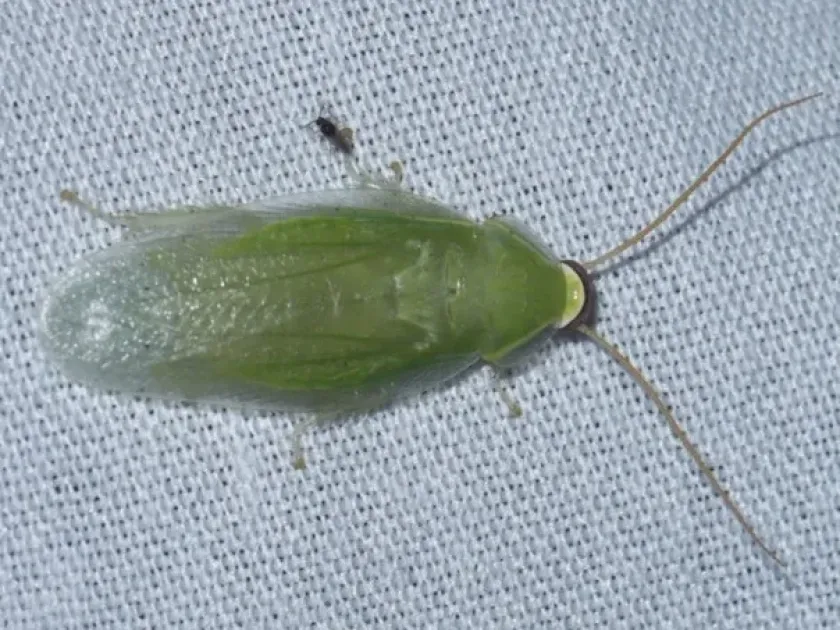
The green banana cockroach (Panchlora nivea) is an insect belonging to the family Blaberidae, order Blattodea. Adult individuals have a characteristic bright green or lime color, allowing them to camouflage perfectly on plant foliage.
The body of an adult is flat, measuring between 18 and 24 mm in length. Females are generally larger than males, possessing broader abdomens and fully developed wings that cover the entire body. The wings have a delicate texture and a slightly translucent appearance.
Nymphs of this species appear different; they are brown or dark gray and dwell primarily in the soil or beneath layers of organic debris. During their growth process, they go through several molting stages, gradually acquiring their vibrant green coloration.
This is a heat-loving tropical species that prefers high humidity levels. In their natural environment, they are primarily nocturnal, which makes them difficult to detect during the initial stages of a plant collection infestation.
Unlike urban synanthropic species, this cockroach rarely remains in residential areas for long, preferring humid greenhouses or conservatories where conditions closely mimic tropical forest environments.
What it damages
The primary food source for these insects consists of organic matter; however, under conditions of high population density or lack of food, they will feed on living plant tissues.
The most significant damage is inflicted on young, tender shoots and leaves of exotic crops often kept in greenhouses. Cockroaches chew irregular holes in leaf blades, leading to a loss of aesthetic value and causing the plant to become stunted.
Beyond mechanical damage, the insect's activities can facilitate the transmission of fungal and bacterial pathogens between plants. In damaged areas, tissues often begin to dry out or decay.
The pest poses a risk to fruit and berry crops grown in protected environments, as they can damage not only the leaves but also young buds and fruits, negatively impacting overall crop yield.
Although they are generalist feeders, they pose the greatest threat to collections of ornamental plants with broad, soft leaves that are easily deformed when the insect feeds on them.
Signs of infestation
The first sign of an infestation is the appearance of characteristic damage to leaf edges, which looks like ragged margins or holes, resembling the feeding patterns of leaf-eating caterpillars.
The presence of excrement, appearing as tiny black specks on the leaf surface or on windowsills, is a direct indicator of cockroach presence in the area, especially during nighttime.
Frequent discovery of empty cast skins (exuviae) within the potting substrate or on the undersides of leaves confirms that the population is successfully reproducing and that nymphs are actively developing.
Adults can be spotted when turning on lights suddenly at night; they quickly scatter in search of cover, attempting to hide deep within foliage or beneath pots.
When inspecting root systems and the soil surface, one may observe the active movement of nymphs, which are highly agile and quickly burrow into the substrate when detection is attempted.
Control measures
To combat this pest, it is recommended to employ a comprehensive approach combining physical methods with the use of appropriate insecticidal treatments.
A highly effective method is regular nighttime inspection of plants and the manual collection of individuals, which significantly reduces population numbers during the early stages of infestation.
Insecticides based on pyrethroids are effective against adults; however, it is crucial to remember that nymphs live in the soil, necessitating the treatment of the substrate with suitable systemic products.
A vital part of prevention is maintaining strict quarantine protocols for new plants and limiting insect access from the outside by installing fine-mesh screens on greenhouse ventilation openings.
It is also recommended to maintain cleanliness within the greenhouse, promptly removing fallen leaves and organic residues that serve as the primary source of food and shelter for nymphs of this species.
Taxonomy
- Latin name
- Panchlora
- Order
- Orthoptera (locusts)
- Family
- Gryllidae
- EPPO code
- PANCSP
Discussion
No discussions yet — be the first.