
Fall cankerworm
Paleacrita
Description
How to identify
The fall cankerworm (Paleacrita vernata) belongs to the Geometridae family within the order Lepidoptera, known for its distinct larval movement.
Adult males are winged, featuring grayish-brown wings with dark markings that provide excellent camouflage against tree bark during the day.
Adult females are completely wingless and possess a stout, hairy body, often appearing spider-like as they ascend tree trunks to lay eggs.
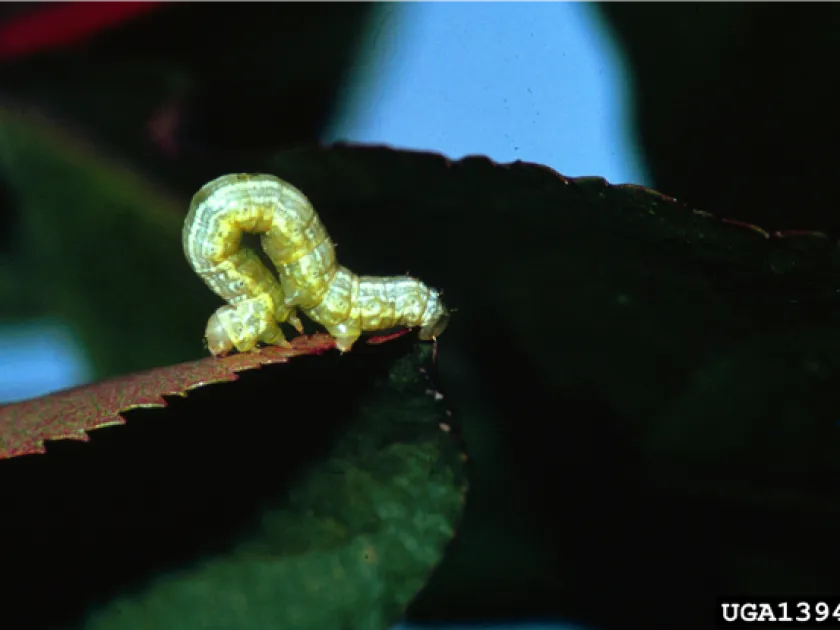
Larvae, commonly known as inchworms, possess only two pairs of prolegs, forcing them to arch their bodies as they move in a loop-like motion.
The coloration of the larvae varies, typically ranging from light green to dark brown, often featuring pale longitudinal stripes along the length of their bodies.
What it damages
This pest is a significant polyphage, causing extensive damage to a wide range of broad-leaved deciduous trees in both urban and rural environments.
Preferred hosts include fruit trees such as apple, cherry, and pear, as well as landscape favorites like elm, maple, linden, and oak species.
Larvae primarily consume buds and young foliage, causing severe defoliation that can leave an entire tree stripped of its leaves by late spring.
When mass outbreaks occur, the combined loss of foliage reduces the tree's energy storage, significantly hindering its growth and future blossom potential.
Repeated annual defoliation by these insects can weaken trees, making them susceptible to secondary infestations by bark beetles and various fungal pathogens.
When it appears
The fall cankerworm is univoltine, completing one full life cycle per year, closely synchronized with the phenology of its host tree species.
Pupation occurs in the soil, where the insects remain as pupae within protective cocoons throughout the winter, shielded from environmental extremes.
Adult emergence typically begins very early, often during the first warm spells of late winter or early spring, even before trees fully leaf out.
After mating, wingless females climb host trees and deposit egg masses in clusters, usually located in bark crevices or near developing leaf buds.
Larvae hatch in synchronization with bud break, feeding voraciously on new growth for several weeks before dropping to the soil to begin their pupal stage.
Signs of infestation
The presence of fall cankerworms is often first noticed when small, loop-shaped larvae are seen hanging from trees on thin strands of silk.
Early feeding damage appears as small holes in new leaves, which quickly progress to extensive skeletonization where only the veins of the leaves remain.
Silken webbing around the buds and leaves is a hallmark sign, as the larvae use these threads to navigate and secure themselves during feeding.
Observing wingless females trekking up tree trunks during early spring is a clear indicator that a new generation of larvae will soon appear.
In cases of severe infestation, the tree's canopy may appear stunted or brown, indicating that the larvae have consumed the majority of the available foliage.
Control measures
Applying sticky bands around tree trunks in early spring is an effective cultural practice to prevent wingless females from ascending the tree to lay eggs.
Soil cultivation beneath host trees can disrupt the pupal stage in the soil, effectively reducing the number of adults that emerge the following spring.
Chemical control with systemic or contact insecticides is recommended when larval feeding is first detected, ensuring treatment occurs before significant damage.
Biological control methods, such as utilizingBacillus thuringiensis (Bt), offer an environmentally friendly option that targets larvae while sparing beneficial species.
- Monitor bark in early spring for female activity.
- Encourage natural predators like birds and parasitic wasps.
- Implement dormant oil sprays if egg masses are clearly visible.
Taxonomy
- Latin name
- Paleacrita
- Order
- Lepidoptera (butterflies)
- Family
- Geometridae
- EPPO code
- PALCSP
Discussion
No discussions yet — be the first.