
Purple-edged copper
Palaeochrysophanus hippothoe
Description
How to identify
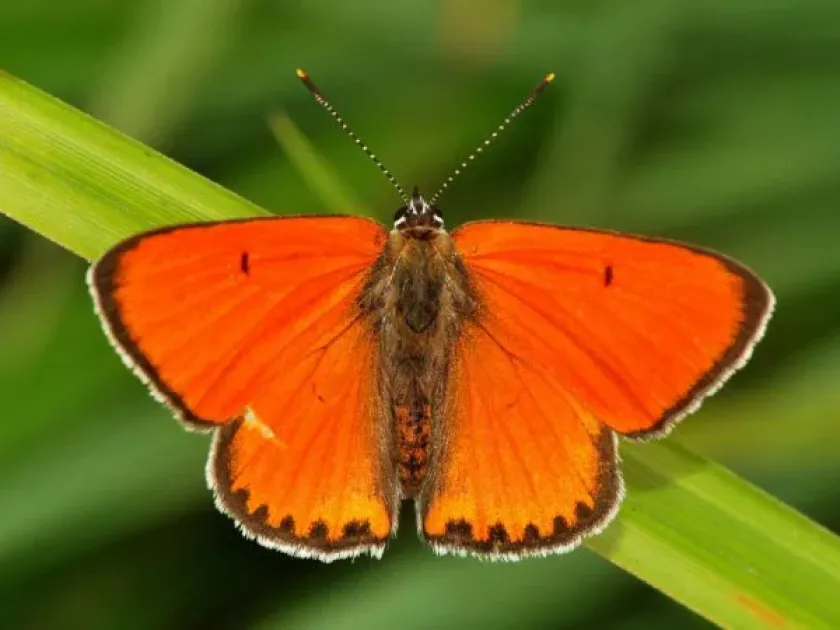
The purple-edged copper (Palaeochrysophanus hippothoe) is a butterfly belonging to the Lycaenidae family, known for its distinct sexual dimorphism.
Males feature vibrant orange wings with a metallic sheen and broad black margins, making them easily identifiable in the field.
Females are characterized by brownish-black forewings with orange markings, providing camouflage against the backdrop of meadow vegetation.
The larvae are typically slug-like in appearance, green in color, and often feature subtle longitudinal stripes to blend in with foliage.
With a wingspan ranging from 30 to 35 mm, the adults are active flyers, often seen visiting flowers or resting on host plants during sunny days.
What it damages
The larvae primarily feed on plants from the Polygonaceae family, with species like sorrel and dock serving as their main hosts.
Agricultural damage occurs when these plants, acting as weeds, harbor the larvae, leading to defoliation and weakened plant growth.
Feeding larvae skeletonize the leaves, which can reduce the vigor of the vegetation in pastures or forage areas significantly.
While large-scale outbreaks are uncommon, localized populations can cause notable aesthetic and productive damage to affected fields.
Continuous feeding slows the development of host plants, which is particularly detrimental during their peak growing and flowering stages.
When it appears
This species is univoltine, meaning it has one generation per year, with adult butterflies active between June and August.
The species overwinters as young larvae, hidden in the leaf litter or at the base of stems, awaiting favorable spring conditions.
As temperatures rise in late spring, the larvae resume feeding, growing rapidly to prepare for the pupal stage.
Pupation typically occurs in early summer, followed by the emergence of adults that begin the reproductive cycle shortly after.
The timing of the lifecycle is closely synchronized with the growth of its food plants, ensuring resources are available for the next generation.
Signs of infestation
The primary sign of infestation is irregular holes or scalloped edges on the leaves of host plants like common sorrel.
Tiny white, flattened eggs can be found on the undersides of leaves during the peak of the butterfly's flight season.
Larval activity is often confirmed by the presence of frass (droppings) on the leaf surfaces, indicating recent or ongoing feeding.
Severe infestation may lead to the total skeletonization of the leaf, leaving only the primary veins intact on the affected plant.
Observing adult butterflies hovering over weed-heavy areas is a reliable indicator of a potential population buildup in the vicinity.
Control measures
Effective management begins with controlling host weeds such as sorrel and dock within and around the perimeter of the crop fields.
Regular mowing of field margins and fallow lands prevents the accumulation of larvae and reduces the habitat available for reproduction.
In cases of high infestation, bio-insecticides targeting lepidopteran larvae are an effective and environmentally friendly control option.
Proper soil cultivation practices can disrupt the overwintering sites of the larvae, significantly reducing the population for the next season.
Chemical intervention should be considered a last resort and only applied if the economic threshold is exceeded in specific crop zones.
Taxonomy
- Latin name
- Palaeochrysophanus hippothoe
- Order
- Lepidoptera (butterflies)
- Family
- Lycaenidae
- EPPO code
- PALKHI
Discussion
No discussions yet — be the first.