
Grass prawn
Palaemon adspersus
Description
How to identify
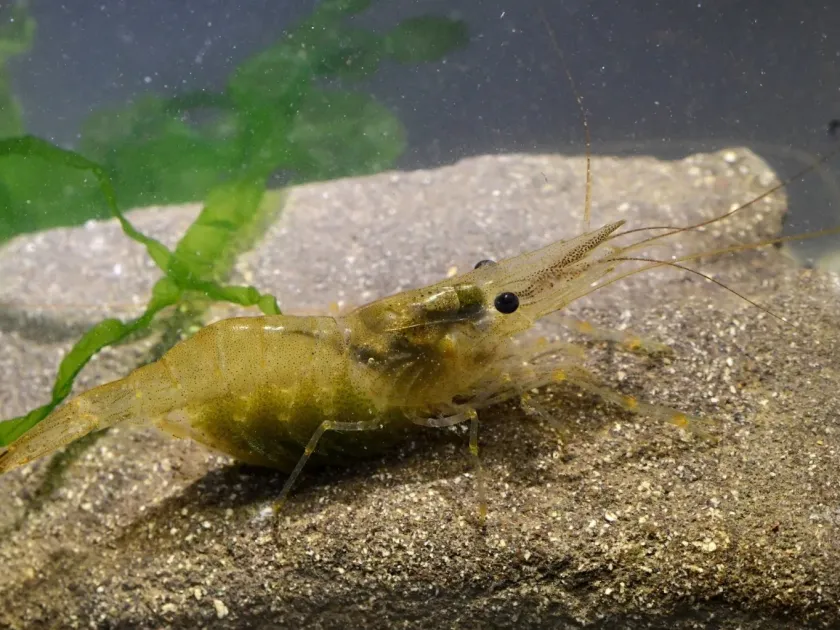
The grass prawn (Palaemon adspersus) belongs to the order Decapoda and the family Palaemonidae. It is a small, semi-transparent crustacean reaching 60–80 mm in length, characterized by a serrated rostrum.
The body is divided into a cephalothorax and a segmented abdomen equipped with swimming legs. It resembles other shrimp species but has a distinct shell pattern and specific claw structure on its first two pairs of walking legs.
Its coloration ranges from nearly transparent to greenish-brown, providing excellent camouflage among aquatic vegetation. This makes early detection of populations in agricultural fields challenging.
The biology of the species is linked to coastal zones, brackish waters, and lagoons. In intensive rice farming, they can invade irrigation systems, finding favorable conditions for reproduction and feeding.
The life cycle includes a planktonic larval stage that undergoes several metamorphoses before settling on a substrate to adopt a benthic lifestyle. In warm seasons, the population can reproduce rapidly.
What it damages
The primary damage is caused to rice crops during the early vegetation stages. Grass prawns actively feed on young shoots and tender roots, leading to thinning of the crop.
Beyond mechanical tissue damage, the activity of these crustaceans leads to the agitation of bottom sediments. This reduces light penetration and slows down photosynthesis in young rice sprouts.
In hydroponic farms or closed aquaponic systems, prawns can cut stems of ornamental or vegetable crops living in the water. They are considered a biotic stressor for delicate plants.
The pest can also compromise irrigation infrastructure by infiltrating filtration systems and clogging water intake units with their shells and organic debris.
In regions with high soil and water salinity, the activity of this species becomes a critical factor that reduces overall field yield and increases maintenance costs for pumping equipment.
When it appears
The mass appearance of prawns in agro-systems occurs during the spring-summer season when water temperatures reach optimal levels (above 15 degrees Celsius).
The peak of damage coincides with the flooding of rice fields and the first weeks of seedling growth, when plants are most vulnerable to mechanical injury.
By autumn, as temperatures drop and fields dry out, the population either migrates to main canals or enters a state of diapause in deep water sections.
Short-term fluctuations in irrigation water levels can trigger sudden prawn migrations, making their appearance in specific field areas unpredictable and patchy.
Monitoring population density should be conducted from the moment water is introduced into the fields until the active tillering phase of rice to detect migrations from natural water sources.
Signs of infestation
The primary sign of the pest's presence is the occurrence of cut or eaten leaves of young rice plants in the absence of visible surface insect activity.
During visual inspections of field water, one might notice characteristic splashes or movement within the water column, as well as aggregations of small crustaceans near water inlets.
Murky water in areas without mechanical bottom disturbance often indicates the active life cycle of large crustacean colonies.
Finding fragments of molted shells on the water surface is an indirect sign of a growing population and the completion of molting cycles.
Increased mortality of young seedlings in prawn aggregation areas creates bare patches in the field that are not linked to seed quality or plant diseases.
Control measures
An effective protection method involves using mechanical filters at the intake of irrigation canals, which prevent larvae and adults from entering the system.
Applying agricultural practices, such as short-term field drainage during critical pest development phases, significantly reduces population density without chemical use.
Biological control can include supporting populations of natural predators, such as waterfowl or specialized fish species that feed on small crustaceans.
In cases of severe infestation, the use of selective preparations safe for the ecosystem is permitted, provided that strict environmental regulations for water basins are followed.
- Installing fine-mesh nets at intake sluices.
- Regular monitoring of water composition in canals.
- Timely removal of aquatic vegetation that serves as shelter.
- Controlling water salinity levels to create unfavorable conditions.
- Using localized trapping methods in areas of concentration.
Taxonomy
- Latin name
- Palaemon adspersus
- Family
- Palaemonidae
- EPPO code
- PALMSQ
Discussion
No discussions yet — be the first.