
Common prawn
Leander serratus
Description
How to identify
The common prawn (Leander serratus) is a decapod crustacean that, while naturally marine, can infiltrate agricultural water systems, irrigation channels, and aquaculture ponds.
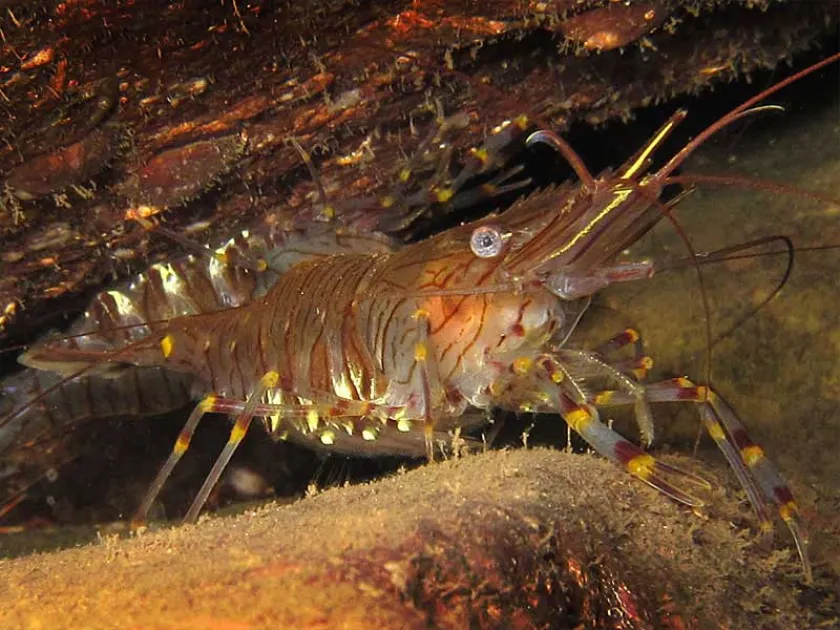
It is characterized by a transparent body, which provides excellent camouflage, and a prominent serrated rostrum extending from the forehead.
Adult individuals can grow up to 10-12 centimeters in length and are highly mobile, allowing them to traverse various aquatic environments.
Identification is best achieved through nighttime observations using light traps, as these crustaceans are predominantly nocturnal feeders.
The presence of sharp, serrated claws and their specific swimming pattern distinguish them from other small aquatic organisms in the ecosystem.
What it damages
In aquaculture environments, the common prawn acts as a significant predator, consuming fry and fish larvae, which directly reduces production yields.
When present in rice paddies or flooded crop fields, they can clip the tender stems of young plants, causing growth retardation or total crop loss.
Their burrowing activities can compromise the integrity of irrigation infrastructure, leading to water leakage and increased maintenance costs for farmers.
By competing for food resources, they degrade the overall ecosystem health in aquaculture ponds, affecting the growth rates of desired species.
Furthermore, they act as potential vectors for various water-borne pathogens that can cause secondary infections in both plants and fish.
When it appears
Activity levels of the common prawn are highest during the warm spring and summer months when metabolic rates increase significantly.
Mass migration into shallower waters usually occurs during the early season, coinciding with the critical stages of agricultural crop development.
As water temperatures drop during autumn, the prawns typically retreat to deeper, more stable environments to overwinter.
Monitoring efforts should be intensified during the late spring to ensure that populations do not reach destructive levels in the irrigation networks.
The duration of the active season is highly dependent on local water temperatures and the specific climate of the farming region.
Signs of infestation
The most noticeable sign of infestation is the appearance of damaged or severed plant shoots at the water surface level in irrigated fields.
Finding shed crustacean exoskeletons floating on the water surface is a definitive indicator of an active population inhabiting the area.
In fish farms, an unexplained decline in juvenile fish populations, combined with physical injuries on survivors, strongly suggests prawn predation.
Water turbidity changes and the presence of movement near the edges of ponds are behavioral signs that alert farmers to their presence.
Using bait-based traps is the most reliable way to confirm the density of the prawn population before implementing intensive control measures.
Control measures
The primary control strategy involves installing fine-mesh screens at all water inlets to prevent the migration of prawns into agricultural zones.
Periodic draining and drying of ponds and irrigation channels is an essential cultural practice that disrupts the crustacean's life cycle.
Biological control, such as introducing natural predators of prawns, can be highly effective in maintaining balanced populations in closed systems.
- Installation of fine-mesh filtration systems.
- Systematic monitoring using specialized traps.
- Regular sanitation and vegetation clearing of canals.
When chemical controls are necessary, they must be applied with extreme caution to ensure safety for the target fish or crop species.
An integrated approach, focusing on exclusion and environment management, remains the most sustainable method for controlling common prawn populations.
Taxonomy
- Latin name
- Leander serratus
- Family
- Palaemonidae
- EPPO code
- LEARSE
Discussion
No discussions yet — be the first.