
Coffee looper
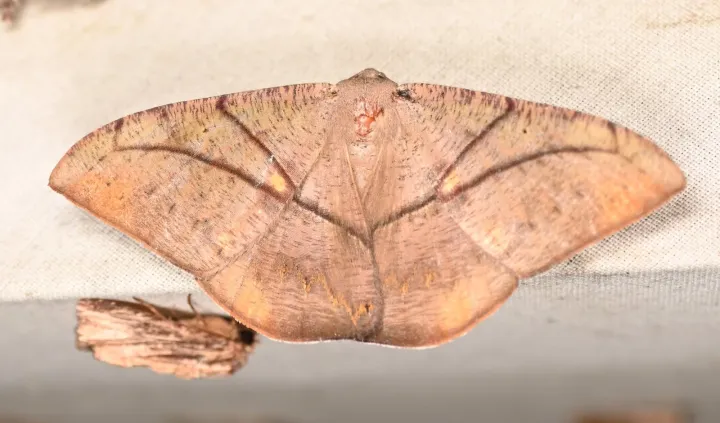
Oxydia trychiata
Description
How to identify
The coffee looper, Oxydia trychiata, is a moth species belonging to the family Geometridae. Adult moths have a wingspan of approximately 45–60 mm, with coloration that mimics dry leaves, providing excellent camouflage.
The larvae, known as loopers, move with a distinctive inching gait. They exhibit a wide range of colors, from green to dark brown, allowing them to blend seamlessly with the twigs and foliage of their host plants.
Pupation typically occurs in the soil or within folded leaves, secured by a silken cocoon. The adult moths are primarily nocturnal, which makes them difficult to monitor during daylight hours without special equipment.
Eggs are typically laid in small clusters on the underside of leaves, which makes early detection challenging for field scouts. The first sign of an infestation is often the sudden appearance of young larvae.
Light traps are the most effective method for monitoring the population of adult moths on a coffee plantation throughout the season, providing data on the potential timing of egg-laying peaks.
What it damages
The primary host for Oxydia trychiata is the Arabica coffee plant Coffea arabica. In Latin America, this pest is considered a major defoliator that can cause significant economic losses.
The larvae feed on leaf tissue, and in high populations, they can strip entire branches. This extensive defoliation disrupts the plant's ability to photosynthesize, directly impacting yield and overall plant health.
In addition to foliage, the larvae can damage tender young shoots. This hinders the vegetative development of the coffee tree and can cause long-term stunting of young seedlings.
Because the pest can adapt to various alternative host plants, it maintains a persistent presence in the surrounding environment. This makes eradication extremely difficult in regions with high biodiversity.
Damaged leaves are prone to secondary infections by various pathogens, which enter through the wound sites, further compounding the damage caused by the caterpillar's feeding activity.
When it appears
The lifecycle of Oxydia trychiata is deeply influenced by regional rainfall patterns and humidity levels. In tropical environments, the pest can reproduce year-round if temperature conditions are stable.
Outbreaks often occur following rainy periods, which trigger active foliage growth and provide an abundant food supply. These environmental conditions are optimal for larval development and high survival rates.
A full generation cycle typically spans between 40 to 60 days. In mature coffee plantations, it is common to find multiple overlapping generations, meaning all developmental stages can be present at once.
In higher altitude coffee zones, cooler nighttime temperatures may slightly slow down the development of the larvae. Monitoring programs must be adjusted accordingly to account for these environmental variations.
Because of the continuous nature of the lifecycle, there is no single "season" for control. Instead, persistent monitoring is required throughout the entire year to prevent sudden population explosions.
Signs of infestation
The most prominent sign is the skeletonized appearance of leaves, where only the hard veins remain. This damage pattern is highly characteristic of the looper's feeding habits in the upper canopy.
The accumulation of larval droppings (frass) under the trees is a clear indicator of a significant infestation in the canopy above. Scouts often use this to identify hotspots within the plantation.
The presence of silken threads, used by the larvae to anchor themselves or to fold leaves, is another visual cue. These webs can sometimes be seen connecting leaves together in the middle and upper canopy.
At rest, the caterpillars hold their bodies rigid, looking exactly like a small twig or petiole. This defense mechanism makes manual inspection time-consuming and often requires close observation.
Premature leaf drop is a late-stage sign of infestation. If significant defoliation is visible from a distance, the pest population has likely already reached levels that cause substantial economic damage.
Control measures
The cornerstone of management is regular scouting to establish the economic threshold. Insecticides should only be applied when the number of larvae per branch justifies the cost of control.
Biological control using Bacillus thuringiensis (Bt) based products is highly effective against young larvae. This approach minimizes harm to beneficial insects and is preferred in sustainable coffee farming.
Chemical control with contact insecticides should be used as a last resort. It is vital to rotate different chemical classes to prevent the development of insecticide resistance within the looper population.
Natural enemies, including parasitic wasps and predatory insects, provide significant suppression of the population. Minimizing the use of broad-spectrum pesticides helps to conserve these natural allies.
Cultural practices, such as maintaining appropriate canopy shade and weed control, can help manage the plantation microclimate, reducing the humidity levels that favor the rapid reproduction of the pest.
Taxonomy
- Latin name
- Oxydia trychiata
- Order
- Lepidoptera (butterflies)
- Family
- Geometridae
- EPPO code
- OXYDTR
Discussion
No discussions yet — be the first.