
Argali
Ovis ammon
Description
How to identify
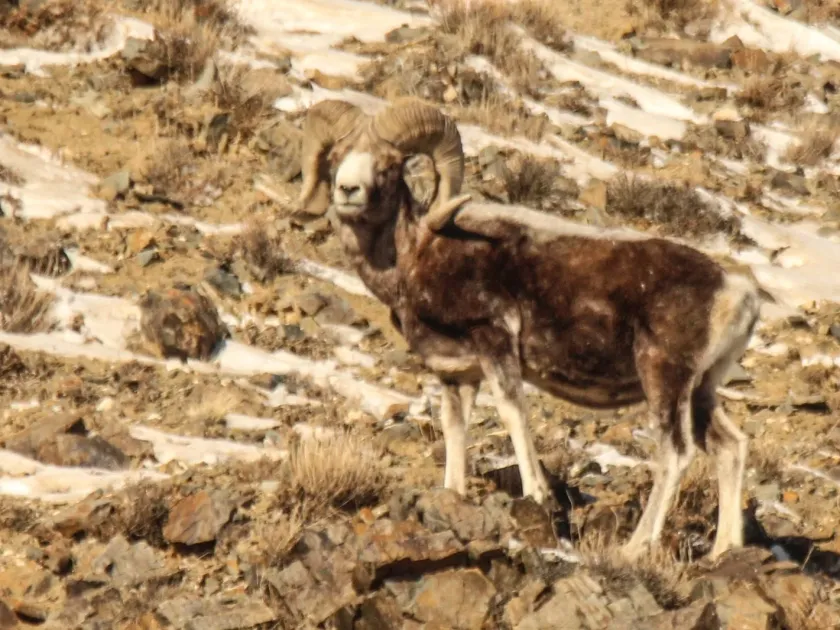
The argali (Ovis ammon) is a large wild sheep species, the largest of its kind, belonging to the family Bovidae. The species is characterized by the massive, spirally curled horns of the males and a robust build, adapted for survival in high-altitude mountain environments across Central and Northern Asia.
In terms of systematic biology, argali exhibit a strong reliance on seasonal migratory patterns, moving between alpine pastures and lower valleys. Their physical appearance, including sandy to dark-brown pelage, serves as camouflage in rocky terrains, but their size makes them highly visible when they encroach on flat farmlands.
These animals are highly social, living in large herds that require significant caloric intake. Their physiology allows them to thrive on hardy mountain grasses, but when natural forage is scarce, they readily transition to cultivated cereals and tender young forage crops found in agricultural zones.
Reproductive biology typically involves autumn rutting and spring lambing, which coincides with the early growth stages of agricultural crops. This timing frequently brings them into conflict with farming activities during the most sensitive periods of plant development.
Argali possess keen senses and remarkable mobility, allowing them to traverse difficult terrain and bypass conventional barriers. Their presence near farms is often driven by environmental pressures rather than territorial behavior, making them periodic visitors rather than permanent inhabitants of crop zones.
What it damages
The primary agricultural damage caused by argali is the intensive overgrazing of cereal crops such as wheat, barley, and oats. Large herds can graze through hectares of young sprouts in a single night, severely limiting the plant's ability to recover and yield a harvest.
Beyond direct grazing, mechanical trampling by hooves causes significant soil compaction and root damage. This destruction leads to thinning of the crop stand and can induce secondary issues such as erosion or increased weed proliferation in the disturbed, bare soil.
Argali also pose a threat to agroforestry and orchard systems. In the foothills, they have been observed stripping bark from young fruit trees and shrubs, which can lead to stunted growth or total mortality of the trees, resulting in long-term financial loss for farmers.
The presence of argali can lead to the introduction of non-native plant species through seeds carried in their coats. These weeds can become established in fields, requiring additional chemical or mechanical intervention that increases operational costs.
Furthermore, the cumulative impact of grazing often leads to nonuniform crop maturation, complicating harvest operations and reducing the overall quality and uniformity of the final agricultural produce.
When it appears
Seasonal patterns are dictated by vertical migration, as argali move to lower elevations during late winter and early spring. This coincides with the emergence of spring crops, making this period the most vulnerable for agricultural enterprises.
Summer activity typically shifts toward higher alpine meadows, yet during years of drought, argali may stay closer to irrigated valley bottoms. Their return to lower agricultural fields is most pronounced during the autumn months as they seek stubble fields to feed after the main harvest.
Winter months represent the highest risk for crop storage and winter-sown crops. When deep snow covers their natural food sources in the mountains, argali are forced to congregate on accessible farmland, where they may persist for extended periods.
Environmental fluctuations, such as unusually harsh winters, can trigger earlier descent patterns. Farmers must anticipate these movements, as the timing of argali arrival in the valleys can vary significantly from year to year based on meteorological shifts.
Agricultural managers should monitor weather data closely. A trend toward early snow accumulation is a direct predictor of increased argali activity in cultivated fields near mountain ranges.
Signs of infestation
Distinctive hoof prints are the most reliable indicator of argali presence. Their prints are larger, deeper, and more sharply defined than those of domestic sheep, reflecting their significant body mass and powerful leg muscles.
The presence of large, oval-shaped pellet droppings is a clear signal that a herd has been feeding or resting in a specific area. These deposits are often found in clusters, marking primary grazing spots.
Damage to crops is characteristically ragged. Unlike the clean cuts made by harvesting machinery or insects, argali grazing leaves plant stems torn and crushed. Visible patches of trampled vegetation are common in the herd's path.
Damaged fencing is another telltale sign. Argali are strong enough to break through flimsy wire and skilled enough to jump over fences that are too low. Finding patches of thick, coarse wool caught on fence wire is a definitive confirmation of their visit.
Disturbed domestic livestock behavior is an indirect indicator. Nearby sheep or cattle often show signs of agitation, such as increased vocalization or grouping, due to the presence of large wild herbivores in their territory.
Control measures
The most effective physical defense is the installation of high, reinforced fencing. A perimeter fence of at least 2 meters in height, constructed with heavy-duty woven wire, is necessary to deter adult argali from entering crop fields.
Acoustic and visual deterrents, such as motion-activated strobe lights or bioacoustic devices playing predator calls, can be utilized to discourage herds. However, it is essential to rotate these deterrent types to prevent the animals from habituating to them.
Chemical repellents applied around the field borders can create an unpleasant sensory barrier. These products often mimic the scent of predators or utilize essential oils to discourage entry, though they require reapplication after rain.
A strategic agrotechnical approach involves planting border zones with species that argali find unpalatable. This can act as a natural deterrent, encouraging herds to move past the fields without stopping to feed.
Collaboration with local conservation authorities is critical for managing populations. In many cases, establishing safe feeding grounds in wild areas away from farmland can successfully divert migration routes, minimizing the impact on agricultural output.
Taxonomy
- Latin name
- Ovis ammon
- Family
- Bovidae
- EPPO code
- OVISAO
Discussion
No discussions yet — be the first.