
Apricot longhorn beetle
Osphranteria lata
Description
How to identify
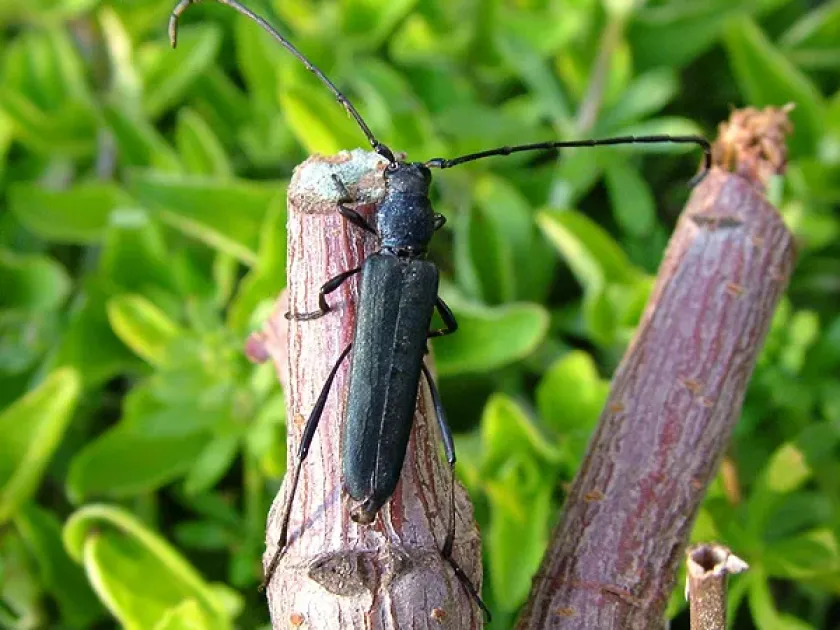
The apricot longhorn beetle (Osphranteria lata) is a wood-boring insect belonging to the family Cerambycidae, commonly known as longhorn beetles. These beetles are characterized by their elongated bodies and remarkably long antennae.
Adult beetles typically feature a dark, brownish-black color. Their size usually ranges from 15 to 25 mm. The antennae of males are notably long, often exceeding the body length, which aids in identification during the flight season.
The larvae are typically legless, cream-colored, and possess a robust, hardened head with strong mandibles designed to tunnel through dense wood. They live deep within the trunks and branches of host trees.
The life cycle of this pest can span from one to two years. Transformation into the pupal stage occurs within the wood, after which the new adult emerges, creating circular exit holes.
Adult beetles are nocturnal or crepuscular, often observed flying during warm summer months, actively seeking out suitable host trees to mate and lay eggs on the bark.
What it damages
The primary host for this pest is the apricot tree, but it also infests other stone fruits including peaches, plums, cherries, and almonds, posing a significant threat to orchards.
Larval activity causes the most destruction. By boring deep galleries through the wood, larvae sever the vascular system, disrupting the flow of water and nutrients throughout the tree branches.
Severe infestations often lead to branch dieback and, if the trunk is girdled by the larval tunnels, the eventual death of the entire tree within a few growing seasons.
These galleries weaken the structural integrity of the tree, making it susceptible to wind breakage. Furthermore, they facilitate the entry of secondary pathogens, including various fungal and bacterial infections.
Young orchards are particularly vulnerable, as the damage to the main stem can result in total loss of the planting, making economic recovery difficult for growers.
Signs of infestation
An early indicator of an infestation is the presence of small, circular exit holes on the trunk or large branches, often accompanied by piles of frass or wood dust accumulating at the base of the tree.
Gumming (gummosis) on the bark surface is a frequent symptom, as the tree attempts to seal off the damaged tissues and combat the larval boring activity inside the wood.
During the growing season, gardeners may notice premature yellowing and wilting of leaves on individual branches, which indicates an interruption in the transport of water and nutrients.
In cases of advanced infestation, sections of the bark may loosen or fall off, exposing the underlying galleries and the intricate network of tunnels created by the larvae.
Listening carefully during quiet periods may reveal slight rasping or cracking sounds from within the trunk, indicating active larval feeding within the wooden structure.
Control measures
Effective management begins with strict sanitation, involving the regular inspection and removal of heavily infested or dead branches, which should be destroyed by burning to prevent the spread of larvae.
Chemical control focuses on applying systemic or contact insecticides during the adult flight season to intercept the beetles before they successfully lay eggs on the trees.
Cultural practices are vital: maintaining orchard vigor through proper irrigation and balanced fertilization helps trees build natural resistance against boring pests.
Trunk protection, such as white-washing or covering with insecticidal barriers, can discourage females from laying eggs on the bark of susceptible stone fruit trees.
- Regular orchard scouting and removal of infested wood.
- Use of pheromone traps to monitor adult beetle emergence.
- Application of appropriate insecticides during peak flight times.
- Keeping trees healthy to mitigate the impact of infestation.
Taxonomy
- Latin name
- Osphranteria lata
- Order
- Coleoptera (beetles)
- Family
- Cerambycidae
- EPPO code
- OSPHLA
Discussion
No discussions yet — be the first.