
Four-spotted planthopper
Ormenis quadripunctata
Description
How to identify
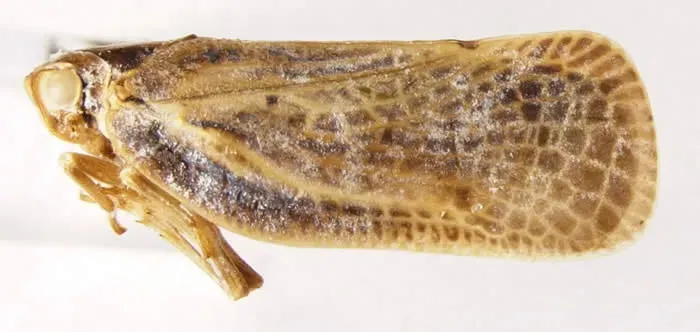
The Four-spotted planthopper (Ormenis quadripunctata) belongs to the Flatidae family. Adults are small, resembling moths due to their wings being folded flat against their bodies in a roof-like shape.
Their coloration ranges from grey to brown, providing excellent camouflage against bark. The most distinctive feature is the presence of two to four small dark spots on each forewing.
Nymphs are easily recognized by the white, waxy, fluff-like filaments covering their bodies. This waxy secretion serves as protection against both environmental stressors and predators.
Adults are highly agile and jump quickly when disturbed. Measuring roughly 7–10 mm in length, they are most active during the warmer months of the year.
Females lay their eggs in slits cut into the bark of various woody plants. These eggs remain in the woody tissue throughout the winter, protected from freezing temperatures.
What it damages
As a polyphagous insect, this planthopper feeds on a wide range of host plants, including many ornamental shrubs, fruit trees, and various garden flowers.
They feed by sucking sap from the phloem of host plants. This constant nutrient extraction weakens the plant, leading to stunted growth and reduced vigor, especially in younger specimens.
Secondary damage occurs due to the secretion of honeydew, which encourages the growth of sooty mold. This fungal layer blocks sunlight and significantly impairs the plant's ability to photosynthesize.
Severe infestations often result in leaf curling, yellowing, and premature flower or fruit drop. In ornamental nurseries, this pest can ruin the aesthetic value of the foliage.
While an individual insect may not cause immediate death, large populations can lead to the decline of entire branches or weakened plants over time.
When it appears
The lifecycle follows a seasonal pattern beginning with overwintering eggs. When spring temperatures stabilize, nymphs emerge and start feeding on succulent young shoots.
The nymphal stage lasts for several weeks. During this period, they are stationary feeders, often clustered on stems where they can be seen covered in their characteristic waxy filaments.
Adult planthoppers typically emerge by mid-summer. This is the peak period for migration and mating, as they spread to new hosts and increase their population density.
Egg-laying takes place in late summer and early autumn. Adults remain active until the first hard frosts, which eventually terminate the active phase of their lifecycle.
Environmental factors like spring humidity are critical. Wetter conditions often increase the survival rate of the nymphs, leading to a higher population density later in the season.
Signs of infestation
The most prominent sign of an infestation is the presence of white, cotton-like masses on stems or the undersides of leaves, which are the secretions left by the nymphs.
Sticky honeydew on leaf surfaces is a strong indicator of feeding activity. This sticky substance frequently attracts ants, which may cultivate the planthoppers for their secretions.
When examining plants, you may notice yellowish or chlorotic spots on leaves where the insects have pierced the tissue to feed on plant sap.
Stunted or distorted shoot tips are common indicators of a heavy infestation. The plants may appear generally weak and less vibrant compared to healthy neighboring specimens.
A simple test for presence is to lightly shake the branches of a suspected plant; if Four-spotted planthoppers are present, they will immediately jump or scatter in flight.
Control measures
Cultural control involves pruning and destroying infested twigs or branches where eggs have been deposited, which helps reduce the population for the following year.
Keeping the area free of weeds is essential, as these insects often utilize non-crop vegetation as reservoirs before moving onto desirable garden plants.
Chemical control using systemic insecticides is most effective when applied during the nymphal stage before the insects develop their protective waxy layer.
Biological control can be achieved by encouraging natural predators, such as spiders or ladybirds, which feed on various stages of the planthopper's life cycle.
Regular monitoring of plants during the early summer months allows for the early detection of localized outbreaks, enabling spot treatments rather than area-wide spraying.
Taxonomy
- Latin name
- Ormenis quadripunctata
- Order
- Hemiptera (bugs, aphids, leafhoppers)
- Family
- Flatidae
- EPPO code
- ORMEQU
Discussion
No discussions yet — be the first.