
Minute pirate bug
Orius vicinus
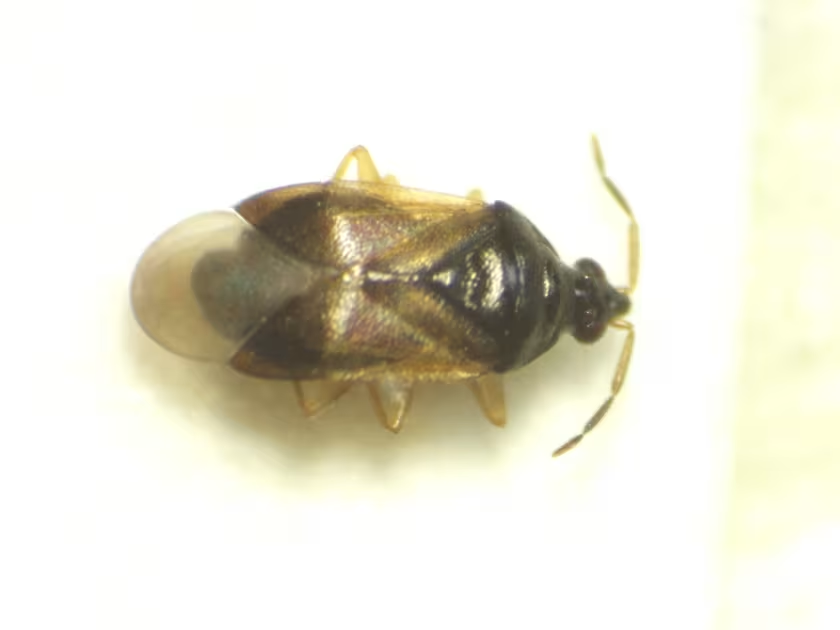
Description
How to identify
The minute pirate bug (Orius vicinus) belongs to the Anthocoridae family of the order Hemiptera. These are very small insects, with adults typically measuring between 2 and 3 mm in length.
The body of an adult bug is oval or elongated, with colors ranging from dark brown to almost black. Orius vicinus usually has well-developed wings, allowing them to move actively in search of food.
The nymphs go through five stages of development. They differ from adults in that they lack developed wings, are smaller in size, and have a lighter, yellowish-orange or brownish body color.
A key morphological feature is the sharp piercing-sucking mouthpart (rostrum), which is adapted for puncturing plant tissues and the bodies of prey.
Although this species is primarily considered a predator capable of controlling thrips and mites, it can exhibit phytophagy when animal prey is scarce, causing damage to tender plant tissues.
What it damages
This species of bug poses a potential threat to a wide range of agricultural and ornamental crops grown both in open fields and in greenhouse conditions.
Key crops that may be susceptible to damage include vegetable plants such as peppers, cucumbers, and tomatoes, as well as various berry and flower crops.
Damage is most often observed on young shoots, buds, and flowers. When populations are high, the bugs puncture plant tissues to feed on moisture and plant juices.
As a result of their feeding, necrotic spots, leaf deformation, and flower drop can occur on young plant parts, which reduces the overall quality of the harvest.
It is important to note that the pest status of Orius vicinus as a phytophage occurs primarily under conditions of high population density when alternative protein sources are unavailable.
When it appears
The activity of minute pirate bugs begins in early spring, as soon as air temperatures are sufficient to awaken the insects and encourage plant growth.
The life cycle of this insect is closely linked to temperature. During warm periods, one generation can develop in 2 to 3 weeks depending on climate conditions.
In favorable greenhouse conditions, several consecutive generations can develop per season, creating a persistent risk of plant damage throughout the growing period.
Overwintering occurs mainly in the adult stage in sheltered areas, such as plant debris, under tree bark, or in the top layer of soil, where they can withstand cold temperatures.
As autumn approaches, with decreasing daylight and temperature, the bugs enter a state of diapause, preparing to hibernate in protected places until the next season begins.
Signs of infestation
The main sign of the bug's presence in a field is the visual identification of adults and nymphs on the underside of leaves, inside flowers, or in leaf axils.
Damage appears as tiny, barely visible punctures surrounded by chlorotic or necrotic tissue, which can expand in size over time.
When flower buds are affected, one may observe premature wilting and deformation, leading to a loss of fruit set and reduced crop yields.
The presence of nymphs at different stages of development in the same colony indicates an active population increase and requires closer monitoring by the agronomist.
An indirect sign of infestation is discoloration of the leaf blade and the appearance of spotting, which is often mistakenly identified as a fungal disease or nutrient deficiency.
Control measures
To control the population of Orius vicinus, it is recommended to implement agrotechnical methods that create unfavorable conditions for their reproduction.
- Regular removal of weeds that serve as reservoirs for the pest during the off-season.
- Timely cleaning and disposal of plant debris after the harvest is completed.
- Installation of insect-proof netting on greenhouse vents to restrict pest migration from the outside.
Biological control methods involve encouraging natural predators that can regulate bug populations within the agroecosystem.
Chemical control should only be applied when the economic threshold of damage is exceeded. It is recommended to use systemic or contact insecticides approved for use on specific crops.
Taxonomy
- Latin name
- Orius vicinus
- Order
- Hemiptera (bugs, aphids, leafhoppers)
- Family
- Anthocoridae
- EPPO code
- ORIUVI
Discussion
No discussions yet — be the first.