
Anthocoris bug
Anthocoris
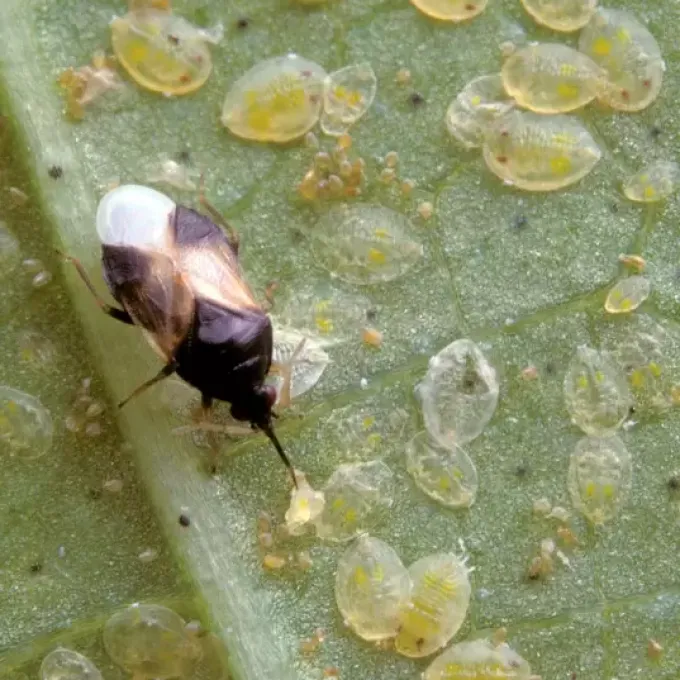
Description
How to identify
The genus Anthocoris belongs to the family Anthocoridae (minute pirate bugs) within the order Hemiptera. These are small insects, typically measuring 2–5 mm in length, with an oval to elongated body shape.
Adults possess well-developed wings, allowing for rapid movement across foliage in search of prey. They are equipped with a short, robust rostrum (beak) used to pierce and feed on their victims.
Nymphs resemble the adults but lack wings and often exhibit a distinct orange-brown or reddish color, making them identifiable as they navigate young plant shoots.
Eggs are typically laid within plant tissues, meaning they are rarely visible to the naked eye during standard field inspections or routine crop scouting.
While the majority of species are predatory, some exhibit zoophytophagy, meaning they may feed on plant sap if their primary insect prey populations are insufficient for survival.
What it damages
Anthocoris bugs are generally classified as beneficial predators rather than primary pests. They consume a wide range of soft-bodied arthropods, including aphids, thrips, mites, and insect eggs.
However, under conditions of drought or severe prey scarcity, these bugs may resort to feeding on plant fluids, potentially causing minor damage to young leaves, buds, and fruits.
They are commonly found on fruit trees, berries, and various grain crops, where they actively seek out and suppress major pest populations throughout the growing season.
Visible damage is typically insignificant and manifests as small, localized punctures. This impact is negligible compared to the massive reduction of harmful pests they facilitate.
Their role in agricultural ecosystems is largely positive, as they serve as natural biological control agents, reducing the reliance on chemical pesticides for pest management.
When it appears
Adults overwinter in protected locations such as crevices in tree bark, leaf litter, or dry plant debris, which allows them to survive cold winter temperatures successfully.
In spring, as temperatures rise consistently, the bugs emerge from hibernation and begin hunting for early-season pests on budding leaves and developing flower clusters.
They complete multiple generations per year, with population peaks usually coinciding with the highest abundance of aphids or thrips in the field.
With the arrival of autumn and shorter day lengths, the bugs migrate toward their overwintering sites, entering a state of diapause to prepare for the coming winter.
The speed of their development is temperature-dependent; during hot summer weather, a full generation cycle can be completed in as little as 3–4 weeks.
Signs of infestation
The most reliable sign of their presence is the direct observation of the bugs themselves as they actively hunt within aphid or thrips colonies on infested plants.
Minor tissue damage, if observed, appears as small necrotic spots where the bugs have probed the plant surface to extract fluids during periods of prey shortage.
A significant indicator of their activity is a rapid decline in the density of harmful pest colonies, which often occurs without any external human intervention or spraying.
Nymphs crawling over stems and foliage serve as a clear sign of a healthy, self-regulating insect population, effectively managing pest pressure within the crop.
Monitoring using yellow sticky traps or the beat-sheet method is an effective way for agronomists to assess the density of these beneficial predators in the field.
Control measures
Specific control measures against Anthocoris are generally unnecessary and discouraged, as these insects act as crucial biological allies in pest management.
To preserve these populations, growers should avoid broad-spectrum insecticides, which often kill beneficial predators alongside the intended pest targets.
Implementing integrated pest management (IPM) strategies, including the use of selective pesticides, is essential to protect these valuable natural enemies.
Maintaining a diverse environment, such as planting nectar-producing flora around fields, helps sustain the Anthocoris population and improves their overall predatory efficiency.
Timing pesticide applications to minimize disruption to beneficial insect cycles ensures that these natural predators remain active throughout the critical crop growth stages.
Taxonomy
- Latin name
- Anthocoris
- Order
- Hemiptera (bugs, aphids, leafhoppers)
- Family
- Anthocoridae
- EPPO code
- ANTOSP
Discussion
No discussions yet — be the first.