
Amphiareus obscuriceps
Amphiareus obscuriceps
Description
How to identify
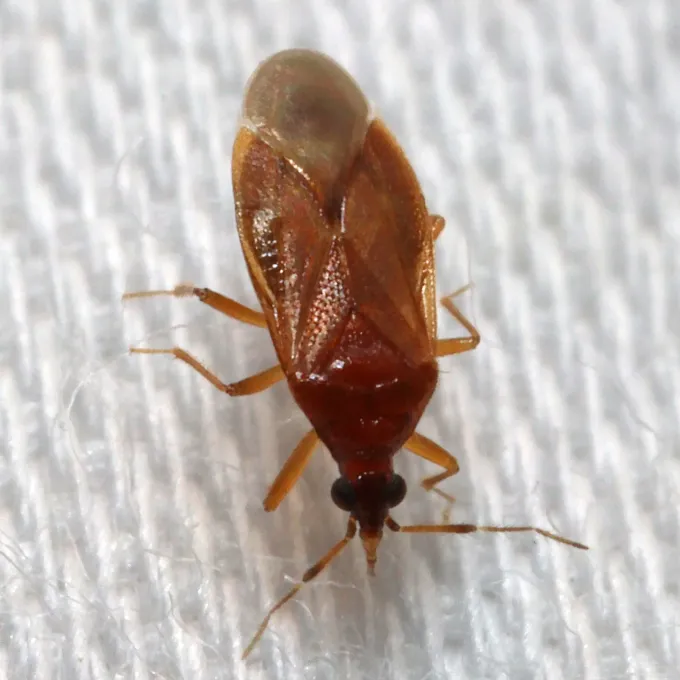
Amphiareus obscuriceps belongs to the Anthocoridae family (minute pirate bugs) within the order Hemiptera. Adult specimens are typically small, usually not exceeding 3–4 millimeters in length.
The insect's body has an elongated shape and is colored in dark, almost black or dark brown tones, which gave the species its name. The head and pronotum are characterized by darker pigmentation compared to the rest of the body.
The bugs have well-developed wings, allowing adults to actively travel significant distances in search of food sources or suitable overwintering sites.
The larvae undergo several developmental stages (instars), during which they gradually change their appearance, gradually resembling the morphology of the adult insect.
The species is primarily known as an entomophagous insect, but in specific agroecosystems with a shortage of natural prey, it may exhibit behaviors that are harmful to cultivated plants.
What it damages
The primary diet of Amphiareus obscuriceps consists of small arthropods, such as thrips, aphids, and mites; however, it is frequently found in cereal and legume crops.
Damage occurs when the population density of the bug is high in the fields, causing insects to feed on the tender tissues of young shoots, inflorescences, and kernels, especially during the milk-ripening stage.
Crops most susceptible to its impact include wheat, barley, and other cereals, where the bug can reside in leaf axils and the ear of the plant.
Secondary damage is associated with the fact that damaged plant tissues become vulnerable to pathogenic fungi and bacteria entering through micro-wounds.
Despite its beneficial role in suppressing pest populations, mass outbreaks of Amphiareus obscuriceps in intensive farming require close monitoring and control by agronomists.
When it appears
The appearance of active Amphiareus obscuriceps individuals in fields is typically recorded with the arrival of consistently warm temperatures, usually starting from late spring to early summer.
Peak population density in agroecosystems is observed during the flowering and grain-filling periods of cereal crops, which coincides with the development cycle of their main prey.
In autumn, the insects begin active migration to overwintering sites, such as plant residues, forest belts, and soil crevices.
The biological cycle includes several generations per season, and female fecundity is directly dependent on the availability of protein-rich food in the form of other insects.
They predominantly overwinter as fertilized females or adults, which resume their life cycle in the spring once favorable weather conditions are reached.
Signs of infestation
The main sign of the bug's presence is the discovery of adults or larvae while inspecting the ears or the underside of leaves in cereal crops.
A characteristic sign is the presence of pinpoint necrotic lesions on the grains, caused by the piercing-sucking mouthparts of the bug while feeding on plant juices.
There may be traces of empty egg shells and larval exuviae left by the insects in leaf axils or on the surface of inflorescences.
During heavy infestations, general stunting of the ear, grain deformation, and reduced grain weight can be observed during the maturation process.
Visual monitoring should be conducted during morning or evening hours when the bugs are most active and easier to spot against the vegetation.
Control measures
Protection strategies are based on agronomic practices aimed at reducing the bug's breeding and overwintering sites, including thorough cleaning of plant debris after harvest.
An important element is the implementation of crop rotation and maintaining spatial isolation of crops from fields that showed high pest density in the previous season.
Chemical treatment with insecticides is recommended only when the economic threshold is exceeded, as the bug also performs a useful function as a predator.
The use of selective insecticides is advised to minimize harm to the beneficial entomofauna, including the predatory bugs themselves.
- Spatial crop isolation
- Weed management
- Use of biological preparations in early stages
- Monitoring with yellow sticky traps
Taxonomy
- Latin name
- Amphiareus obscuriceps
- Order
- Hemiptera (bugs, aphids, leafhoppers)
- Family
- Anthocoridae
- EPPO code
- AMFIOB
Discussion
No discussions yet — be the first.