
Minute pirate bug
Orius persequens
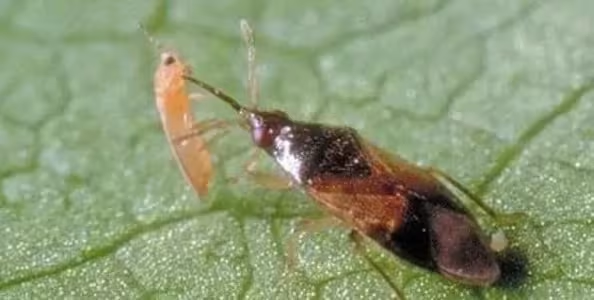
Description
How to identify
The minute pirate bug (Latin: Orius persequens) belongs to the family Anthocoridae, known as minute pirate bugs, within the order Hemiptera. Adults are tiny insects, typically measuring between 2 to 3 mm in length, with a characteristic oval, slightly flattened body shape.
The coloration of adults ranges from dark brown to black, often featuring distinct pale markings on their wings. They possess a well-developed proboscis, which is their primary tool for feeding on both animal prey and plant tissues.
The eggs of these bugs are extremely small and white, usually laid individually within plant tissues, making them very difficult to detect during standard field inspections.
Nymphs undergo five developmental stages (instars), gradually changing their appearance and coloration from yellowish-orange to reddish-brown as they approach adulthood.
While primarily known as beneficial predators, Orius persequens can exhibit phytophagous behavior, causing damage to vegetative parts of plants when their natural insect prey is scarce.
What it damages
Damage caused by the minute pirate bug is most evident when large populations infest berry, vegetable, and ornamental crops, such as raspberries, strawberries, cucumbers, and peppers.
While feeding, these bugs pierce the epidermis of leaves or tender shoots, causing structural damage to cells and leading to localized deformation of the affected plant tissues.
Feeding on young ovaries or flower buds often results in local necrosis, which may cause premature flower drop and significantly reduce the final crop yield.
Damage to growth points is particularly concerning, as it can trigger stem curling, stunted plant growth, and a loss of marketability for the harvested produce.
In greenhouse environments, the pest pressure can increase substantially due to the ability of the bug to complete multiple generations quickly within a confined area.
When it appears
Adults typically overwinter in plant debris, under leaf litter, or in tree bark crevices, where they enter a state of diapause to survive cold temperatures.
The first emergence of adults in agricultural areas occurs in early spring, as soon as temperatures rise enough to support their active movement and search for food sources.
Population peaks are generally observed in the second half of summer, coinciding with the peak ripening period for various berry and vegetable crops.
In warmer climates or protected greenhouse settings, the minute pirate bug can complete five to six generations within a single growing season, posing a continuous threat to crops.
As daylight hours decrease and temperatures drop toward the end of the season, their activity wanes, and they begin seeking sheltered locations for winter survival.
Signs of infestation
The first visible signs of infestation are small pinprick-like holes on the leaves, which are often surrounded by pale or brownish necrotic spots.
Inspection of flower clusters may reveal distorted blossoms and the presence of secretions left behind by the bugs while damaging the delicate floral structures.
High population densities lead to the mass yellowing and drying of young leaves, which may curl up, further hindering the normal development of the plant.
Small dark spots of excrement found on the undersides of leaves frequently indicate the specific locations where adults or nymphs have been feeding or resting.
- Damage to apical meristems and growth points
- Premature flower or bud abortion
- Deformation of developing fruits
- Curling and wilting of young leaves
Control measures
Biological control methods are preferred, as Orius persequens often exists alongside other beneficial insects that are highly sensitive to synthetic chemical treatments.
Effective preventive measures include maintaining clean field conditions by removing weeds, which often serve as primary reservoirs for the pest before they move to crops.
The use of systemic insecticides should be considered only when economic thresholds are exceeded, as chemical applications can severely disrupt the local ecological balance.
Yellow or blue sticky traps serve as both an effective monitoring tool for tracking population numbers and a method to reduce the number of adults in greenhouse environments.
Thorough post-harvest cleanup of field residues in the autumn significantly reduces available wintering sites, preventing high population levels from recurring the following year.
Taxonomy
- Latin name
- Orius persequens
- Order
- Hemiptera (bugs, aphids, leafhoppers)
- Family
- Anthocoridae
- EPPO code
- ORIUPE
Discussion
No discussions yet — be the first.