
Minute pirate bug
Orius minutus
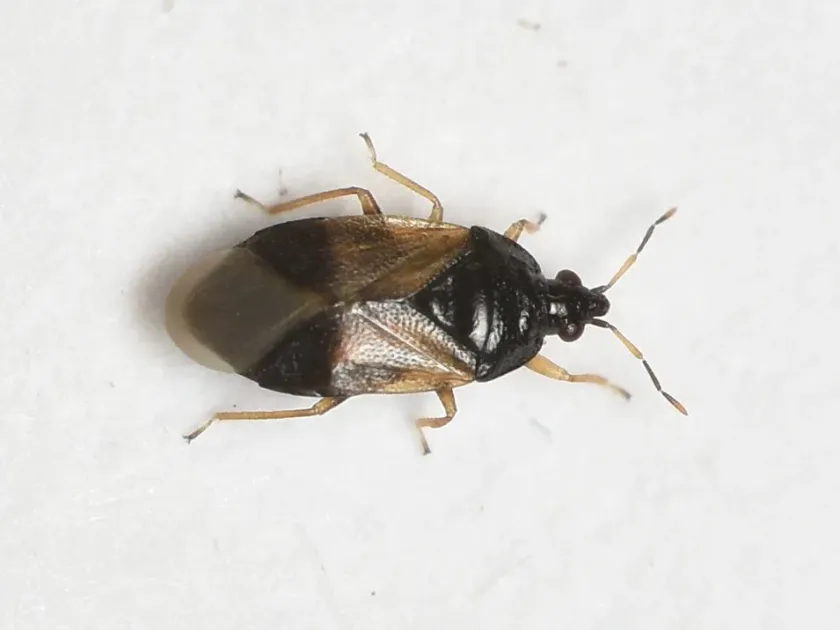
Description
How to identify
The minute pirate bug (Orius minutus) is a small insect belonging to the family Anthocoridae, within the order Hemiptera. These tiny creatures typically measure between 2 and 3 millimeters in length.
Adults possess an oval, somewhat flattened body that is black or dark brown in color, with shiny hemelytra. They have large, prominent compound eyes that allow for efficient hunting of small prey.
The antennae are four-segmented, which is a key identification feature for distinguishing them from other similar small bugs in agricultural settings.
Nymphs of Orius minutus are usually yellowish-brown and lack wings, appearing slightly more rounded than the slender adults. Despite their small size, they are aggressive hunters from the earliest nymphal stages.
Although they are beneficial, their presence on plant blooms often leads gardeners to mistakenly label them as pests, which is a significant error in agricultural practice.
What it damages
The minute pirate bug is primarily a beneficial predator rather than a plant pest. Its diet consists of mites, thrips, aphids, and small insect eggs, making it a critical asset for biological control.
While they may occasionally pierce plant tissue to feed on sap when prey density is low, this behavior causes no meaningful damage and poses no economic risk to the crop yield.
They are commonly found on a wide range of vegetable crops, fruit trees, and ornamental plants, where they diligently hunt for soft-bodied pest populations.
Recognizing the beneficial role of Orius minutus is essential for any integrated pest management (IPM) program. They serve as a natural barrier against several harmful infestations.
Any minor markings on leaves caused by their moisture-seeking behavior are trivial compared to the protection they provide by eliminating massive numbers of harmful pests.
When it appears
The lifecycle of Orius minutus is heavily dependent on ambient temperature, with development occurring most rapidly during the warm summer months.
Adults overwinter in protected areas, such as leaf litter, tree bark, or dry vegetation, emerging as soon as temperatures rise in the early spring to seek their first prey.
Populations typically peak in mid-summer, following the lifecycle patterns of their primary food sources, such as thrips and aphid colonies in the field.
Depending on the climatic zone, the bug can produce several generations per season, allowing it to quickly recover its population density after significant pest outbreaks.
As autumn temperatures begin to decline, the bugs prepare for hibernation, gradually decreasing their activity and retreating into secluded spots for the cold season.
Signs of infestation
The presence of minute pirate bugs is characterized by their active movement within flower clusters, where they move quickly to intercept smaller insects.
Observation with a magnifying lens often reveals the bug's predatory behavior, such as holding its prey with its front legs while extracting fluids, a hallmark of a beneficial predator.
Unlike pests, these bugs leave no droppings, sticky residues, or widespread necrotic spots on leaves, which keeps the plant aesthetic and healthy.
A sudden decline in aphid or mite populations in specific areas of the crop is often the most reliable indicator that Orius minutus is present and active.
They do not build nests or webs, meaning their physical appearance on the crop is the only sign of their occupation, which is generally positive for the farmer.
Control measures
There is no need for control measures against the minute pirate bug because it is a valuable ally in farming and horticulture. Their conservation should be a priority.
The most effective strategy is the implementation of selective pesticide use. By choosing products that are non-toxic to beneficial insects, growers can ensure Orius minutus remains in the ecosystem.
Promoting a healthy ecosystem through the planting of nectar-rich floral borders can provide supplementary food for these predators during periods of prey scarcity.
Maintaining natural wild zones near crop fields serves as a refuge for the bugs, facilitating their migration back to the crops whenever a pest outbreak occurs.
Education on the identification and the ecological value of Orius minutus helps to avoid unnecessary chemical treatments and fosters sustainable agricultural practices.
Taxonomy
- Latin name
- Orius minutus
- Order
- Hemiptera (bugs, aphids, leafhoppers)
- Family
- Anthocoridae
- EPPO code
- ORIUMI
Discussion
No discussions yet — be the first.