
Minute pirate bug
Orius laevigatus
Description
How to identify
The Orius laevigatus, commonly known as the minute pirate bug, belongs to the Anthocoridae family. These insects are valued in agronomy as highly effective predators used to suppress various crop pests.
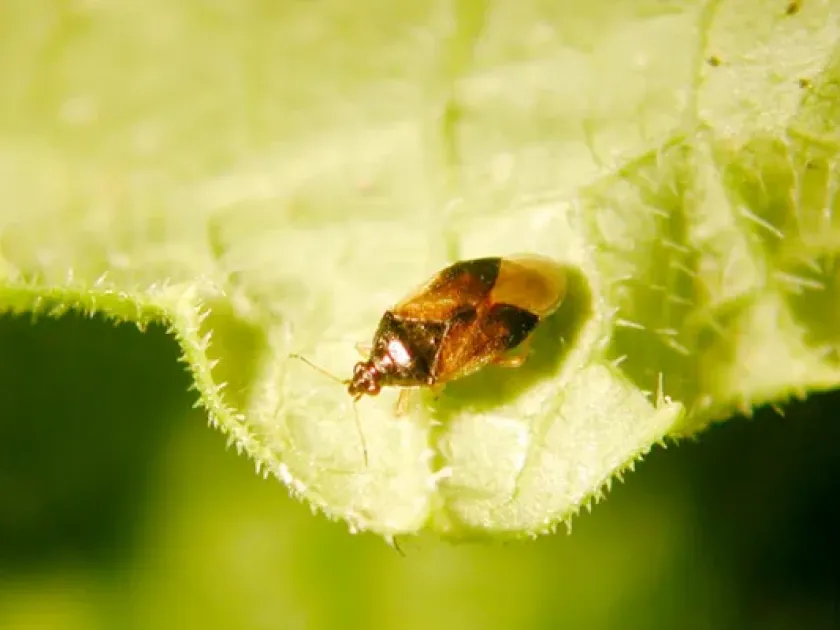
The adult bug is small, usually measuring between 2.5 and 3 mm in length. Its body is oval-shaped and typically black or dark brown, often with distinctive white markings on the wings that give it a unique appearance during flight.
Its development consists of five larval stages, or instars. Larvae are wingless and have a reddish-brown or yellowish color. They are very active and start hunting almost immediately after hatching from the egg.
The bug possesses a short, sturdy rostrum (beak) adapted for piercing prey and sucking out vital fluids. Excellent eyesight allows the predator to detect and capture small moving prey effectively in complex leaf environments.
Its life cycle is temperature-dependent. At optimal temperatures (around 20–25°C), the bugs develop rapidly, which allows them to build up large populations in a short period to protect vegetable crops.
What it damages
It is important to clarify that this insect is not a pest. It is a highly beneficial predator (entomophagous insect) widely used in integrated pest management (IPM) to protect plants from damage.
Its primary prey includes various species of thrips, including the notorious Western flower thrips. Both larvae and adult bugs are aggressive hunters, significantly reducing pest numbers on vegetables and flowers.
Beyond thrips, the minute pirate bug feeds on spider mites, aphids, whiteflies, and the eggs of various lepidopteran pests. This polyphagous behavior makes it a versatile tool for crop protection.
When prey is scarce, adult bugs can survive on plant sap or pollen. While this ensures the survival of the population during low-pest periods, it does not cause any economic damage to the crops.
Using this predator reduces the need for synthetic chemical pesticides, making it easier for growers to meet food safety standards and support sustainable agricultural practices.
When it appears
Activity starts in early spring when temperatures rise above 12–15°C. In controlled greenhouse environments, the population can remain active and reproductive throughout the year, provided there is enough food.
The highest predator activity usually coincides with the flowering period of the crop. They tend to congregate in blossoms, where thrips often gather, providing excellent protection for the plant's reproductive structures.
During the summer months, the bug population can expand rapidly, effectively controlling pest outbreaks before they reach levels that could negatively affect plant growth or yield.
As the season ends and daylight decreases, the bugs look for sheltered areas like leaf litter or greenhouse cracks to enter diapause and survive the winter months.
Farmers often release the bugs in small batches at the beginning of the growing season to establish a self-sustaining population that can manage pest numbers proactively.
Signs of infestation
Detecting the presence of these beneficial bugs can be done by observing signs of successful predation. You may see discarded remains of thrips larvae on leaves.
- Visual sighting of adult bugs in flowers.
- Noticeable reduction in silvery patches on leaves caused by thrips feeding.
- Decline in aphid colonies on the growing points of plants.
- Overall health improvement and stabilization of the crop.
- Active movement of small, dark bugs on leaves and flower petals.
Control measures
No control measures are needed for this species as it is a beneficial organism. Instead, the focus should be on conservation and population management to maximize its predatory impact.
Avoid using broad-spectrum insecticides, especially those with long residual effects, as they can inadvertently kill the beneficial bug population. Always check the toxicity profiles of any chemicals used.
If chemical intervention is unavoidable, use selective products or biological options that are compatible with Orius laevigatus to keep the predator population alive and functioning.
Maintaining a stable greenhouse environment, especially humidity levels, helps the bugs thrive. Proper environmental control is an essential part of the IPM strategy.
Planting banker plants, such as Alyssum, near crops provides a refuge and an alternative food source (pollen) for the bugs, helping to sustain their population throughout the season.
Taxonomy
- Latin name
- Orius laevigatus
- Order
- Hemiptera (bugs, aphids, leafhoppers)
- Family
- Anthocoridae
- EPPO code
- ORIULA
Discussion
No discussions yet — be the first.