
Minute pirate bug
Orius insidiosus
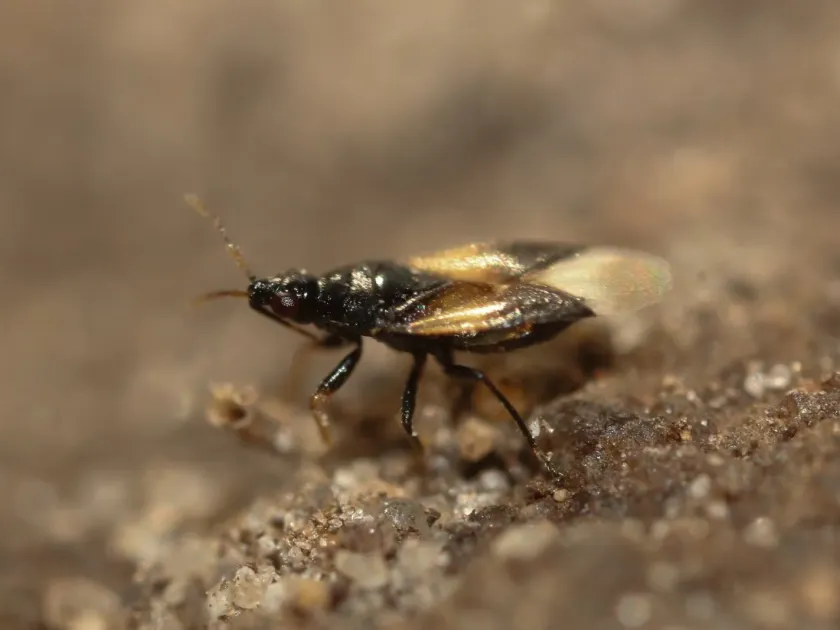
Description
How to identify
The minute pirate bug (Orius insidiosus) is a small, predatory insect belonging to the family Anthocoridae, known for its role in biological pest control.
Adults are tiny, measuring about 2 to 3 millimeters long, with a distinct oval-shaped body and black coloration featuring white wing patches.
Nymphs, which are the immature stages, vary in color from yellowish-orange to reddish and lack the wings found on the adult specimens.
The insect possesses a sharp, piercing-sucking beak that is primarily used to consume prey but can occasionally probe plant tissues.
They are known for being extremely active and agile, allowing them to traverse complex plant structures to hunt for food effectively.
What it damages
The minute pirate bug is widely recognized as a beneficial predator rather than a plant pest, causing no economic damage to agricultural crops.
Their diet consists primarily of small soft-bodied insects such as thrips, spider mites, aphids, and the eggs of various lepidopteran pests.
Although they may probe plants for moisture during dry conditions, these small marks have no impact on the growth or development of the vegetation.
They are an essential component of integrated pest management in greenhouse vegetable production, particularly for controlling western flower thrips.
By keeping pest populations below economic thresholds, they help maintain the overall health and productivity of the infested crops.
When it appears
The life cycle of Orius insidiosus is rapid and highly dependent on ambient temperatures and the abundance of available prey species.
Female bugs deposit their eggs within the soft tissues of plants, such as leaf petioles, which provides protection during the incubation phase.
The complete development from egg to adult takes approximately three weeks at a constant temperature of around 25 degrees Celsius.
They produce several generations per growing season, which allows them to track the population cycles of their prey throughout the summer.
In cooler climates, these insects enter diapause as adults, overwintering in protected sites like leaf litter, tree bark, or perennial plant debris.
Signs of infestation
Signs of their activity are manifested by a significant reduction in the populations of thrips and mites within the plant canopy.
Direct observation shows the bugs patrolling the underside of leaves or hiding deep within flower blossoms to ambush their prey.
One can identify the presence of these predators by finding evidence of empty, collapsed insect egg shells on the leaf surfaces.
In high-infestation areas, the activity of the minute pirate bug leads to a visible decline in the damage usually caused by thrips, such as leaf scarring.
Monitoring boards in greenhouses will often capture these bugs alongside the pests, confirming their presence in the immediate vicinity of the crop.
Control measures
Protection strategies for the minute pirate bug focus on conserving their populations by reducing the use of harmful chemical insecticides.
Broad-spectrum pesticides are lethal to these beneficial insects; therefore, growers should prefer selective, low-toxicity chemical options.
It is vital to incorporate biological control agents into the spray program to prevent the destruction of predatory bug colonies.
In commercial greenhouse environments, growers often purchase and release supplemental populations of Orius to manage sudden outbreaks.
- Avoid the use of toxic, broad-spectrum chemical sprays.
- Maintain a high humidity level within the greenhouse environment.
- Plant floral resources to provide alternative nectar if prey is scarce.
- Practice regular monitoring to assess predator-prey ratios.
- Use selective biorational pesticides only when absolutely necessary.
Taxonomy
- Latin name
- Orius insidiosus
- Order
- Hemiptera (bugs, aphids, leafhoppers)
- Family
- Anthocoridae
- EPPO code
- ORIUIN
Discussion
No discussions yet — be the first.