
Tiny Pirate Bug
Orius frumenti
Description
How to identify
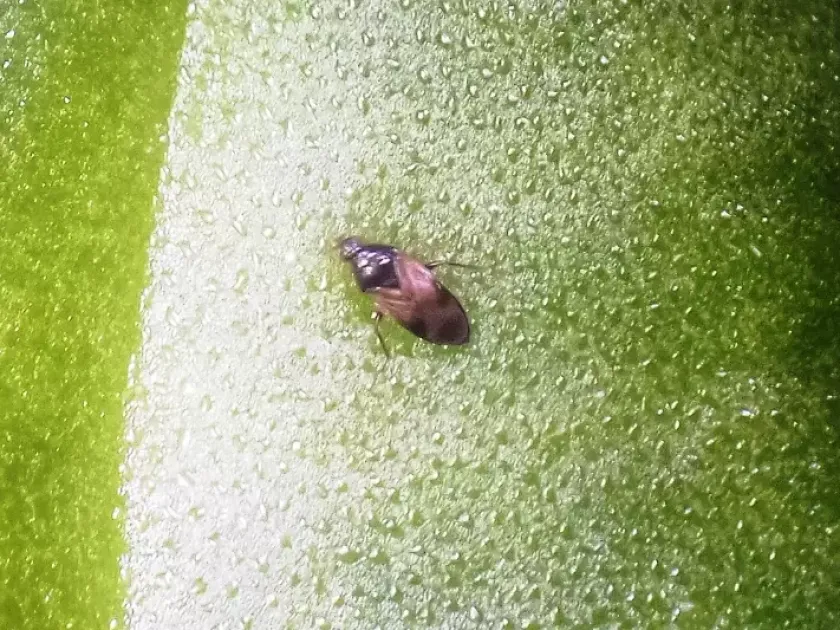
The tiny pirate bug (Orius frumenti) belongs to the family Anthocoridae within the order Hemiptera. These insects are exceptionally small, typically measuring between 2 and 3 millimeters, making them difficult to spot without magnification tools.
Adults are characterized by an oval body shape and a coloration ranging from dark brown to black. They possess well-developed wings, allowing them to travel efficiently between plants and colonize new fields when resources become available.
Nymphs undergo several developmental stages, changing in color from yellowish to reddish-orange as they mature. Despite lacking functional wings during their nymphal stages, they are highly mobile and remain active on the host plants.
The taxonomic position of Orius frumenti allows it to thrive in diverse environments, ranging from wild flora to managed agricultural settings. Understanding its biology is essential for accurate identification.
Distinguishing Orius frumenti from other beneficial members of the Orius genus is crucial, as some species are major predators, while others may cause damage to crops under specific conditions.
What it damages
This pest attacks a wide variety of agricultural crops, including cereals, legumes, corn, and various vegetables. Significant damage typically occurs during the flowering and fruit-setting phases of the host plants.
The bugs feed by piercing plant tissues with their mouthparts and extracting cell sap. When infestations are heavy, this feeding behavior leads to localized necrosis, deformed blossoms, and the premature dropping of buds.
Damage to generative organs is particularly severe. Injured flowers may fail to pollinate effectively, resulting in sterile grains or stunted, misshapen fruits that significantly reduce the overall market yield.
The entry points created by the bugs' feeding activity often serve as secondary infection sites for pathogens such as fungi and bacteria, which further compromise the plant's health and structural integrity.
High populations of Orius frumenti can lead to noticeable stress in a crop, causing slowed growth and lower overall vigor, which necessitates proactive monitoring to prevent economic loss.
When it appears
The seasonal activity of Orius frumenti is highly dependent on temperature and the phenological stages of the crops. Adults typically overwinter in plant debris, under tree bark, or in the top layers of the soil.
Spring emergence occurs when temperatures reach approximately 12–15 degrees Celsius. Initially, they colonize early-flowering weeds before migrating to agricultural crops as the season progresses.
During the peak of summer, high temperatures accelerate their lifecycle, leading to a rapid increase in population density. This period often coincides with the most sensitive growth stages of many summer crops.
Multiple generations can develop throughout a single growing season. The duration of each developmental stage depends on environmental factors, particularly the availability of host plants and ambient humidity levels.
As autumn approaches and temperatures drop, adults begin to seek overwintering sites, gradually decreasing their activity on the crops as they prepare for the winter period.
Signs of infestation
The primary sign of infestation is the presence of tiny, light-colored or brownish puncture marks on tender leaves, stems, and flower petals, which remain after the bugs have finished feeding.
Visual inspection of blossoms may reveal the presence of adults, which are often skittish and hide upon disturbance. The use of a shaking method over a light-colored surface is an effective way to estimate population density.
Affected flowers frequently exhibit wilting or premature abscission, caused by the localized destruction of vascular tissues due to the bug’s feeding activity.
In corn, signs of activity include damage to the silks and husks, which can lead to poor pollination and the development of ears with incomplete or missing grain kernels.
Heavy infestations are marked by curled leaf edges and a generalized stunted appearance of the plants, which becomes especially obvious when compared to unaffected areas of the same field.
Control measures
Management of the tiny pirate bug requires an integrated approach, balancing physical and chemical control measures based on monitoring data and economic thresholds.
Good agricultural practices, such as effective weed control, are essential to remove alternative food sources that support the pest early in the season. Deep plowing can also help reduce the number of insects surviving the winter.
Chemical control should be implemented only when necessary. Selective insecticides are preferred to maximize pest control while minimizing harm to beneficial insects and natural predators present in the field.
- Regular field scouting and monitoring
- Installation of yellow sticky traps for population estimation
- Crop rotation to break the pest’s lifecycle
- Targeted application of insecticides during peak infestation periods
When chemical applications are required, choose products with short residual activity and apply them outside of peak pollinator activity hours to ensure the safety of honey bees and other beneficial insects.
Taxonomy
- Latin name
- Orius frumenti
- Order
- Hemiptera (bugs, aphids, leafhoppers)
- Family
- Anthocoridae
- EPPO code
- ORIUFR
Discussion
No discussions yet — be the first.