
Mountain goat
Oreamnos americanus
Description
How to identify
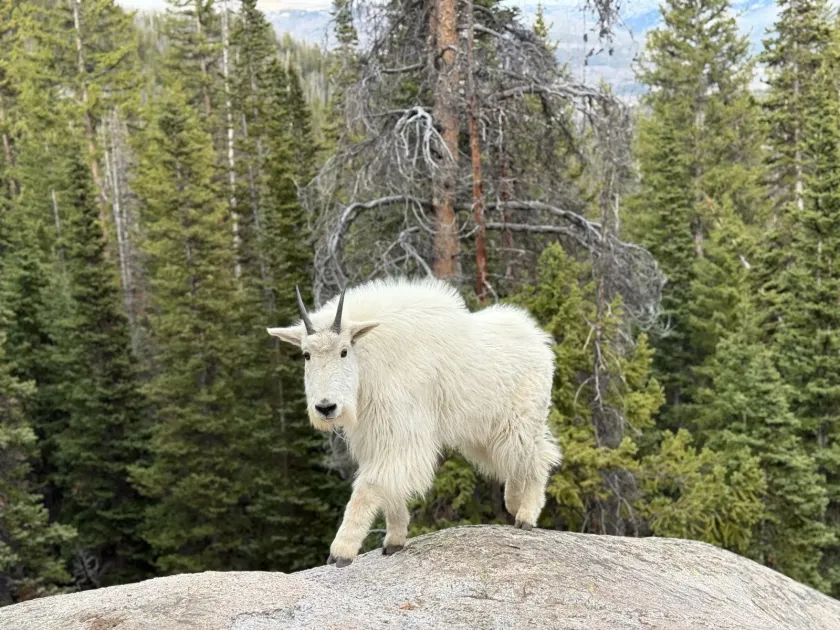
The mountain goat (Oreamnos americanus) is a large hoofed mammal native to the high-altitude regions of North America, characterized by its thick white coat.
Despite their common name, they are not true goats but part of the Bovidae family, featuring sharp black horns that are used for defense and social hierarchy.
These animals are perfectly adapted for vertical mountain terrain, allowing them to access vegetation in areas where other large herbivores cannot reach.
Their large body mass, reaching up to 140 kg, requires them to forage extensively, which can place significant pressure on local plant ecosystems.
The social structure involves living in small bands, which can cause concentrated damage to specific vegetation plots within their territory.
What it damages
Mountain goats cause extensive damage to forestry projects by browsing on young conifers and deciduous saplings, hindering reforestation efforts.
They frequently strip bark from tree trunks, especially in winter, which leads to the girdling of the tree and subsequent death or susceptibility to pests.
Intensive grazing on agricultural lands adjacent to mountain slopes results in the destruction of valuable pasture grass and forage crops.
Trampling is a significant secondary effect, as heavy hooves can compact soil and destroy fragile groundcover vegetation on steep slopes.
Overgrazing by mountain goat populations can lead to a decrease in biodiversity in natural habitats and substantial economic loss in managed woodlands.
When it appears
The most intense browsing activity occurs during late winter and early spring when snow covers natural forage, forcing goats down into lower elevations.
During the spring growing season, they focus on the succulent new shoots of trees and shrubs, which are vital for the plant's future development.
Summer is a period of reduced conflict as these animals typically migrate to higher alpine meadows, away from human agricultural zones.
The severity of the damage is often tied to winter conditions; harsh, snowy winters increase the frequency and duration of goat presence in valleys.
Young plants are particularly vulnerable during early spring before secondary food sources become available in the high country.
Signs of infestation
Primary indicators of mountain goat presence include distinctive hoof prints that are well-adapted for gripping rock and soil in uneven terrain.
Look for browsing marks on branches, characterized by jagged edges where the animals have used their teeth to tear away buds and twigs.
Patches of shed white fur caught on branches or tree bark are a clear indication that mountain goats have been passing through or rubbing against trees.
Heavily worn trails through dense undergrowth are clear signs of regular, systematic movement and foraging routes established by the goat herds.
Droppings are found in concentrated clusters, serving as a reliable biological indicator of recent animal activity in specific feeding zones.
Control measures
Physical exclusion remains the most effective management strategy, utilizing heavy-duty wire fencing to prevent access to nursery areas and gardens.
Repellents based on strong scents or bitter tastes can be applied to bark and foliage, creating a temporary deterrent against browsing activity.
Integrated wildlife management programs often use motion-activated acoustic devices to startle animals when they enter restricted areas.
Strategic planting, which involves selecting less palatable tree species in zones bordering known goat habitats, can reduce the frequency of damage.
In extreme cases of population overgrowth, managed relocation or regulated population control is utilized to protect fragile local ecosystems.
Taxonomy
- Latin name
- Oreamnos americanus
- Family
- Bovidae
- EPPO code
- OREAAM
Discussion
No discussions yet — be the first.