
Mountain goat
Oreamnos
Description
How to identify
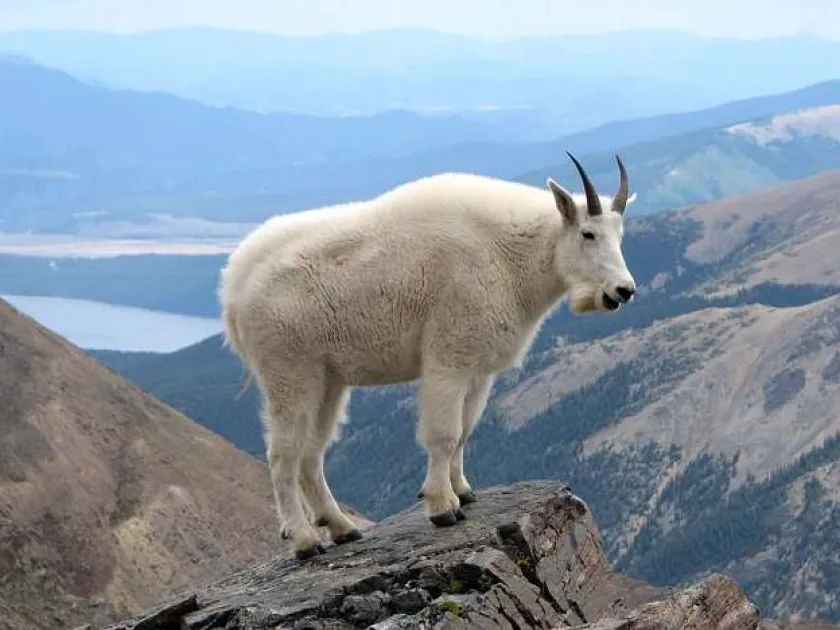
The mountain goat (Oreamnos americanus) is a large hoofed mammal belonging to the Bovidae family, native to the mountainous regions of North America.
They are characterized by their white, thick double coat and specialized hooves that provide exceptional traction on steep, rocky terrain where they spend most of their lives.
These animals are adapted to alpine and subalpine environments, but they may descend to lower elevations during severe winters in search of accessible forage.
Both males and females possess short, black, slightly curved horns, which makes them distinguishable from other North American ungulates.
Due to their habitat, human-wildlife conflict usually occurs where farmlands or orchards are established in high-altitude zones or near rugged terrain.
What it damages
Mountain goats are generalist herbivores, consuming a wide variety of alpine plants, including grasses, sedges, ferns, and various woody shrubs.
Agricultural damage occurs primarily when these animals forage in orchards or near fields, browsing on tender tree shoots and tree bark during the dormant season.
Debarking young trees can lead to significant economic loss, as it disrupts nutrient flow and leaves the trees susceptible to various diseases and insect pests.
In addition to feeding damage, the trampling of row crops and soft soil by herds can destroy irrigation systems and compact soil, negatively impacting yield.
The severity of damage is often seasonal, peaking during late winter and early spring when natural vegetation is covered by snow.
Control measures
Preventative measures are the most successful strategy for managing interactions between mountain goats and agricultural crops in sensitive regions.
The installation of perimeter fencing is the primary recommendation, with designs specifically reinforced to withstand the weight and climbing capabilities of the animals.
Bio-acoustic repellents that mimic predator vocalizations or sudden noises can discourage goats from lingering in cultivated areas during the night.
Land management practices, such as maintaining buffers of non-palatable vegetation, can help define boundaries between mountain goat habitats and commercial fields.
- Sturdy perimeter fencing
- Bio-acoustic deterrents
- Scent-based repellents
- Strategic landscape buffer zones
Taxonomy
- Latin name
- Oreamnos
- Family
- Bovidae
- EPPO code
- OREASP
Discussion
No discussions yet — be the first.