
Brimstone moth
Opisthograptis luteolata
Description
How to identify
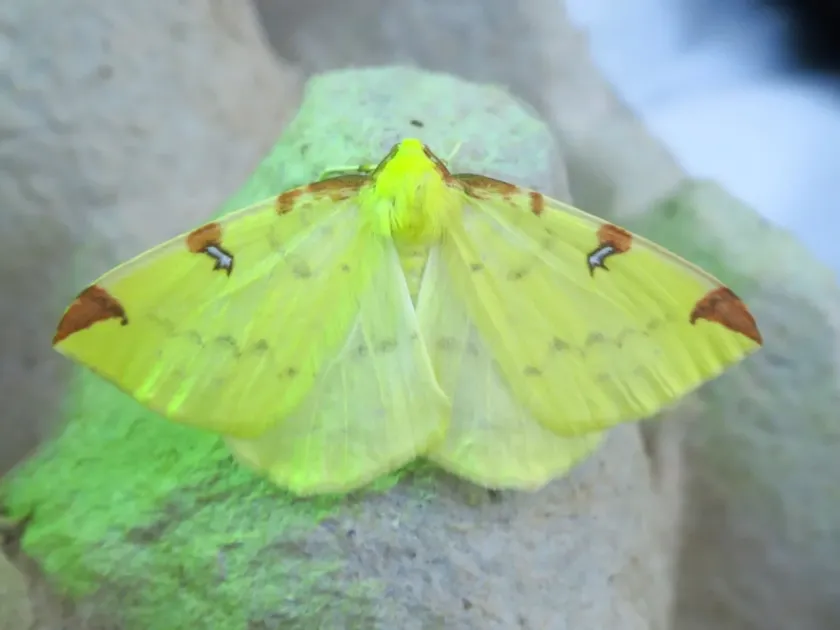
The Brimstone moth (Opisthograptis luteolata) is a member of the Geometridae family. The adult moth features a wingspan of approximately 30–40 mm, with bright yellow wings adorned with distinctive brown patches and lighter margins, providing excellent camouflage.
The larvae, known as "loopers," move by arching their bodies to bring the rear prolegs towards the thoracic legs. This characteristic movement is a hallmark of the family Geometridae and allows the caterpillars to remain inconspicuous while feeding on twigs.
The life cycle is complete, consisting of four stages: egg, larva, pupa, and adult. The pupal stage typically occurs within a silk cocoon attached to leaves or nestled in crevices on the tree bark, where metamorphosis takes place.
Adult moths are nocturnal or crepuscular, meaning they are primarily active during twilight and nighttime. During the day, they remain resting on foliage or bark, often appearing as curled or dead leaves.
This species is widely distributed across temperate regions and demonstrates high adaptability, potentially producing one or two generations per year depending on the local climate and temperature conditions.
What it damages
The primary damage is caused by the larvae, which are generalist feeders on various woody plants. Common host plants include trees and shrubs such as apple, pear, hawthorn, plum, and cherry, making them a concern for orchardists.
Larval feeding begins early in the season as soon as buds start to break. They consume the developing buds first, subsequently moving to young leaves, where they skeletonize the leaf blade or consume it entirely, leaving only major veins.
Heavy infestations can lead to significant defoliation, which impairs the tree's photosynthetic capacity. This reduces the energy storage available for fruit production, thereby affecting yield and overall plant vigor.
For young or newly planted trees, the loss of growing points and foliage can lead to stunted growth and structural deformation. This makes early detection and intervention critical to maintaining tree health.
Furthermore, the wounds left by larval feeding can serve as entry points for pathogens and opportunistic fungi, potentially leading to additional plant health complications.
When it appears
The species typically overwinters as young larvae residing on the branches of host trees or in sheltered bark crevices. As spring temperatures rise, these larvae resume their active feeding patterns.
The peak activity for larval feeding occurs during the spring, coinciding with the rapid growth of new foliage. By late spring, the larvae are fully grown and undergo pupation to emerge as the first generation of adults.
Summer months see the emergence of the second generation of moths. Eggs are deposited on the leaves, leading to a second wave of larval activity that continues throughout the summer period until autumn.
As temperatures drop in autumn, the late-instar larvae prepare for diapause, seeking out overwintering sites where they will remain dormant until the following spring season.
Understanding these seasonal dynamics is essential for orchard managers, as timing applications to coincide with the most vulnerable larval stages is key to effective control.
Signs of infestation
One of the most obvious signs is the appearance of ragged or skeletonized leaves, particularly in the outer canopy of the tree. Careful observation of these areas often reveals the caterpillars resting on branches.
Small amounts of silk webbing, used by larvae to secure leaves or construct cocoons, are often visible in the canopy. This webbing can indicate the presence of an active pest site.
Frass, or caterpillar excrement, often accumulates on leaves beneath the feeding site, acting as a clear indicator of recent larval activity in the upper branches.
Reduced terminal growth and deformed buds during early spring are also indicative of larval feeding, which can be easily overlooked if the tree is not monitored closely.
Utilizing light traps during the night can detect the presence of adult moths, providing a useful monitoring tool to determine when egg-laying is likely occurring.
Control measures
Cultural control methods involve maintaining tree health through proper pruning and cleaning of dead or diseased wood where larvae might seek refuge during winter.
Biological control, including the use of Bacillus thuringiensis sprays, is an effective and environmentally friendly approach to managing larval populations without disrupting beneficial predatory insects.
Chemical intervention should be reserved for cases where pest populations exceed economic injury thresholds. Targeted application of insecticides during the active larval feeding stage is usually the most effective approach.
Encouraging natural predators, such as insectivorous birds and parasitic wasps, can help keep Brimstone moth populations in check through natural mortality.
- Monitor tree canopy regularly during the growing season.
- Perform winter pruning to remove potential overwintering sites.
- Use pheromone or light traps for accurate pest monitoring.
- Apply biorational insecticides when young larvae are detected.
Taxonomy
- Latin name
- Opisthograptis luteolata
- Order
- Lepidoptera (butterflies)
- Family
- Geometridae
- EPPO code
- OPSGLU
Discussion
No discussions yet — be the first.