
Four-spotted lygaeid bug
Oncopeltus quadriguttatus
Description
How to identify
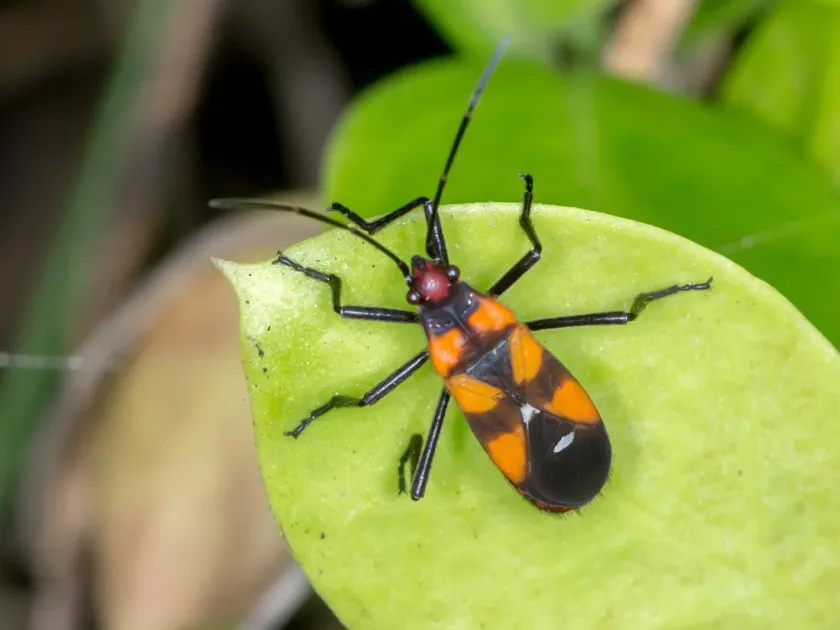
The four-spotted lygaeid bug (Oncopeltus quadriguttatus) belongs to the Lygaeidae family in the order Hemiptera. It is characterized by a distinctive pattern on the pronotum and elytra, featuring four vivid orange-red spots against a deep black background.
Adult bugs typically measure between 8 and 12 mm in length. Their body is elongated and flattened, which serves as an adaptation for hiding within tight plant crevices and flower heads.
Like other true bugs, this species possesses a piercing-sucking mouthpart designed to penetrate plant tissues to feed on cell sap, which is the primary source of their nutrition.
Nymphs undergo several developmental stages. While they resemble adults, they lack fully developed wings and exhibit a lighter, often brownish or orange-tinted coloration.
This bug is elusive and tends to stay hidden under foliage or within sheltered parts of the plant, making it difficult to detect during the early stages of an infestation.
What it damages
The primary host plants for Oncopeltus quadriguttatus are berry crops, specifically garden strawberries. They may occasionally target other plants in the Rosaceae family.
The bug primarily feeds on the generative organs of the plant, such as flower buds, open blossoms, and young berries. Feeding leads to the wilting and premature shedding of blossoms.
When feeding occurs on developing fruits, it causes localized tissue necrosis. Affected berries become deformed, stunted, and often develop an unpleasant taste, rendering them unmarketable.
A severe infestation during the flowering season can significantly reduce the overall yield, as damaged flowers fail to set fruit properly.
Furthermore, the puncture wounds created by the bug act as entry points for various secondary fungal and bacterial pathogens, leading to fruit rot.
When it appears
The life cycle commences in the spring as temperatures rise, signaling the overwintering adults to emerge from their hiding spots, such as leaf litter and plant debris.
Activity peaks during the budding and flowering phases of strawberry development, which is when the females begin laying eggs on the leaves or within the flower clusters.
Development from egg to adult takes approximately 30 to 45 days, depending on environmental factors. In favorable climates, the species may produce two generations per year.
The highest population density is typically observed during the fruit ripening period, as insects maximize their feeding intake before shifting toward overwintering sites.
As autumn approaches and temperatures drop, adult bugs seek out protected areas like mulch, dense weeds, or soil crevices to enter a state of winter dormancy.
Signs of infestation
The most prominent sign of infestation is the presence of malformed or "shriveled" strawberries that appear uneven and underdeveloped.
Small black pinpricks on flower buds and blossoms are indicative of feeding activity, often surrounded by chlorotic or withered tissue.
Observant growers can spot the adult bugs during cool morning hours when they are less active and congregate on the undersides of leaves or along the flower stalks.
The presence of fine black excrement pellets on the surface of leaves and flowers provides further evidence of a bug infestation in the patch.
The sudden wilting of flower clusters that fail to transition into fruit, despite adequate watering and care, is a strong indicator of bug pressure.
Control measures
Effective management begins with strict sanitation, including the removal of leaf litter, crop residues, and weeds, which serve as overwintering refugia for the bugs.
Tilling the soil in row spaces during early spring and late autumn can disrupt the bug’s habitat and destroy individuals preparing for or emerging from winter dormancy.
- Covering strawberry beds with horticultural fleece or row covers during the flowering period to physically exclude the insects.
- Intercropping with repellent plants such as garlic or marigolds to mask the strawberry scent and deter bug colonization.
- Manual removal of bugs during the early morning when they are sluggish, which is highly effective for small-scale garden plots.
If population thresholds are exceeded, chemical control using approved insecticides may be necessary, provided that pre-harvest intervals are strictly observed to ensure food safety.
Taxonomy
- Latin name
- Oncopeltus quadriguttatus
- Order
- Hemiptera (bugs, aphids, leafhoppers)
- Family
- Lygaeidae
- EPPO code
- ONCPQU
Discussion
No discussions yet — be the first.