
Red millipede
Ommatoiulus rutilans
Description
How to identify
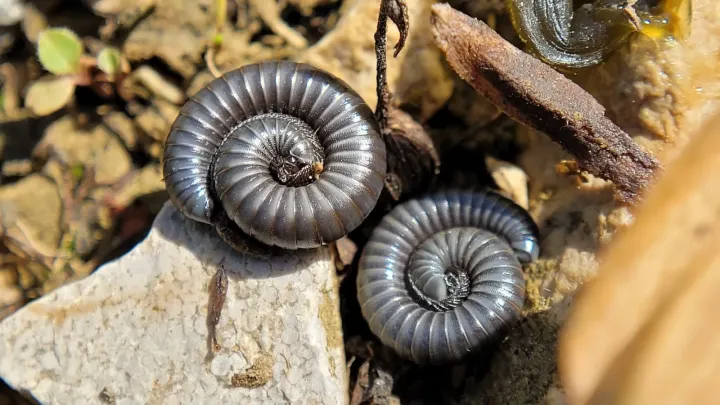
The red millipede (Ommatoiulus rutilans) belongs to the class Diplopoda and the family Julidae. They are characterized by an elongated, cylindrical, segmented body with two pairs of legs on each body segment.
Adult individuals reach a length of 20 to 45 millimeters. Their coloration typically ranges from brown to reddish-brown, allowing them to blend in with soil or decaying organic matter.
Unlike insects, they possess a hardened, calcified exoskeleton that provides protection against predators and harsh environmental conditions.
When disturbed, these millipedes exhibit a characteristic defensive behavior, curling into a tight spiral to protect their soft underside.
They are primarily saprophagous, meaning they feed on decaying matter, but they readily turn to living plant tissues when organic food sources become scarce or environmental conditions are optimal.
What it damages
These pests cause significant damage to various crops, including potatoes, carrots, beets, and strawberries. They tend to bore into root vegetables, leaving deep cavities that spoil the crop.
In greenhouses and nurseries, they are particularly dangerous to seedlings. They often chew through the stems at the soil line, causing the sudden collapse of young plants.
Strawberry fruits touching the damp ground are highly susceptible to being eaten by millipedes, which creates entry points for secondary fungal infections.
Damage to the root system and underground tissues reduces the plant's overall vigor and can lead to stunted growth or total plant mortality if the infestation is severe.
Marketability is heavily impacted because produce damaged by millipedes cannot be sold and is prone to rapid decay during storage.
When it appears
The activity of red millipedes is closely tied to soil moisture and temperature. They thrive in damp, humid environments and are most active during rainy spells.
They emerge in the spring once the soil warms up sufficiently. During the growing season, they migrate within the soil layers to find suitable food and moisture.
In mid-summer, if the weather is hot and dry, they retreat deeper into the soil profile to avoid desiccation, only emerging at night or after irrigation.
As temperatures drop in the autumn, they move deeper underground or seek shelter under piles of debris to survive the winter months.
Their life cycle involves multiple molts, meaning that the population maintains a constant pressure on crops from early spring through late autumn.
Signs of infestation
The primary symptom of infestation is the presence of small, irregular holes or craters on the surface of root vegetables and tubers.
Growers may observe wilted seedlings that, upon inspection, show chewed or severed stems near the soil surface.
Tiny black fecal pellets, often found in clusters near damaged plant tissue, are a clear indicator of the presence of millipedes.
A high density of individuals is often visible in the soil during light tillage or when lifting mulch materials that have retained excessive moisture.
In strawberries, irregular nibbling marks on the fruit are a distinct sign that millipedes are present and actively foraging in the patch.
Control measures
Effective control starts with proper cultural practices, such as maintaining well-drained soil and ensuring good air circulation within the crop rows.
Regular cultivation and hoeing of the soil surface help expose millipedes to sunlight and predators, significantly reducing their local population.
Trapping can be an effective non-chemical solution; placing damp cardboard, boards, or even melon rinds on the soil overnight can lure them out for easy collection.
Preventing the accumulation of decaying plant material and organic debris is crucial, as these provide both food and shelter for the millipedes.
- Use well-drained raised beds to keep plants away from overly wet soil conditions.
- Implement proper crop rotation to break the pest's life cycle.
- Avoid over-mulching with materials that stay consistently wet near the plant stems.
Taxonomy
- Latin name
- Ommatoiulus rutilans
- Family
- Julidae
- EPPO code
- OMMRTU
Discussion
No discussions yet — be the first.