
Blue-banded millipede
Cylindroiulus caeruleocinctus
Description
How to identify
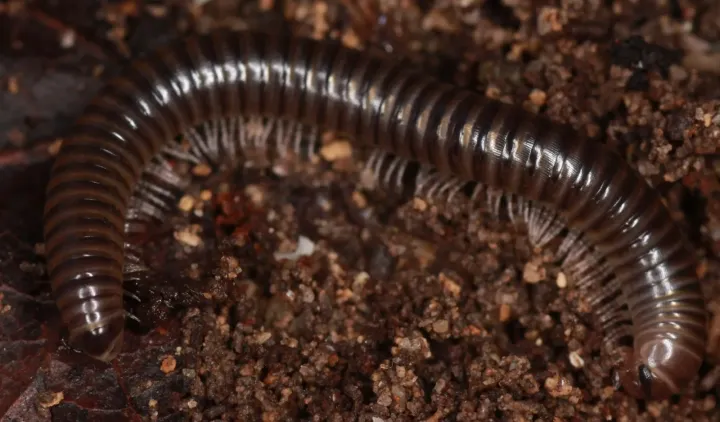
The blue-banded millipede (Cylindroiulus caeruleocinctus) belongs to the order Julida and the family Julidae. It is characterized by a long, cylindrical, worm-like body consisting of many segments.
Adult millipedes are typically 20–30 mm long. Their color varies from dark brown to a distinct bluish or grayish hue, with each body segment bearing a dark transverse band.
These arthropods move using many small legs, which allow them to navigate easily through soil crevices and tunnels. They are highly dependent on moisture to survive.
Being light-sensitive, they remain hidden in the soil, under debris, or inside rotting organic matter during the day. They come to the surface primarily in dark, humid conditions.
The life cycle involves multiple molts. Females lay eggs in moist soil, and the larvae gradually develop into adults over several months, depending on environmental factors.
What it damages
Millipedes primarily attack the roots and underground parts of vegetable crops, such as potatoes, carrots, beets, and radishes, especially during the early stages of growth.
In strawberry patches, they can cause significant damage by feeding on the fruit that is in direct contact with moist, damp soil, leading to losses in marketable yield.
The damage is particularly severe in wet years when the soil moisture remains high, allowing populations to expand rapidly across vegetable fields.
In addition to direct feeding, the wounds caused by millipedes serve as entry points for various soil-borne pathogens, including bacteria and fungi that cause root rot.
Seedlings are at high risk, as millipedes often gnaw through the stems just below the surface, causing young plants to wilt and die within a short period.
When it appears
Their activity peaks in spring during the germination and early growth phases of vegetable crops when the moisture content in the soil is optimal for them.
A second surge in activity often occurs in late summer and autumn, as the harvest approaches and roots become more succulent and nutritious for the millipedes.
They overwinter in deeper soil layers, often surviving temperatures that would be fatal to other garden pests, allowing them to restart their cycle immediately in spring.
Periods of heavy rain or excessive irrigation significantly increase their surface activity, as they move towards roots to feed or escape saturated, low-oxygen soil.
Drought conditions significantly reduce their activity, forcing them to retreat deeper into the soil where they remain dormant until conditions improve.
Signs of infestation
Signs of an infestation include small, clean-cut, round holes on the surface of root vegetables, which gradually develop into larger, irregular cavities as feeding progresses.
In crops like strawberries, you may notice pitted fruit with small, dark excrement pellets left behind in the cavities or on the surface of the fruit.
Wilting of young seedlings without obvious above-ground causes often indicates that something is feeding on the roots or the base of the stem underground.
Searching the top few centimeters of moist soil around affected plants usually reveals the millipedes, which appear in groups when the population density is high.
When harvesting potatoes, damage is identified by internal galleries or "tunnels" within the tubers, which often look similar to slug or wireworm damage.
Control measures
Cultural control, such as strict crop rotation and the removal of plant debris, is the most effective way to manage millipede populations in a home garden.
Deep cultivation of the soil in late autumn is recommended to expose the overwintering adults and larvae to birds and harsh weather conditions.
Using vegetable traps (buried pieces of potato or carrot) helps to attract and concentrate the pests, making it easier to collect and remove them manually.
Chemical control should be considered a last resort; soil-applied insecticides can be effective if the infestation is severe and threatens the entire harvest.
Improving soil drainage and avoiding over-irrigation are vital strategies to make the environment less favorable for the growth and spread of these millipedes.
Taxonomy
- Latin name
- Cylindroiulus caeruleocinctus
- Family
- Julidae
- EPPO code
- CYLITE
Discussion
No discussions yet — be the first.