
Pine tree cricket
Oecanthus pini
Description
How to identify
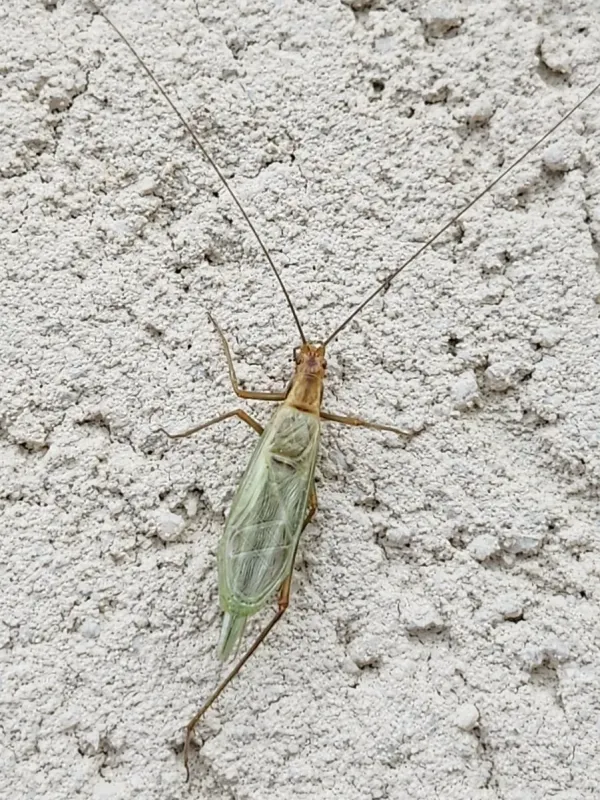
The pine tree cricket (Oecanthus pini) is a member of the tree cricket subfamily (Oecanthinae) within the Gryllidae family. These insects have a slender, pale green or brownish body, perfectly adapted for blending into the needles of pine trees.
The wings of the adult insect are clear with distinct venation, which gives them a transparent appearance. Males are known for their auditory communication, using a high-pitched chirping sound produced by stridulation to attract females.
Adults typically reach lengths of 12 to 16 millimeters. Their antennae are notably long and delicate, often exceeding the length of their body, which helps them navigate the complex environment of the pine canopy.
Nymphs resemble smaller, wingless versions of adults. As they grow, they undergo several molts, progressively increasing in size and developing more defined wing pads as they approach the final reproductive stage.
Unlike ground-dwelling crickets, the pine tree cricket is strictly arboreal. They spend their entire life cycle in trees, preferring the upper canopy where they are protected from predators and environmental extremes.
What it damages
The primary damage occurs during the egg-laying process. Females use their sharp ovipositor to create incisions in the current year's twig growth, inserting eggs deep into the plant tissue to ensure their survival.
These puncture wounds disrupt the vascular flow of the twig, often resulting in the dieback or weakening of the distal portion of the branch. The structural integrity of the twig is compromised, making it susceptible to snapping.
Furthermore, these wounds act as entry points for various pathogens, including fungi and bacteria, which can lead to secondary infections. Such infections may cause localized needle drop or discoloration around the oviposition site.
While feeding is not the primary cause of concern, adults and nymphs may browse on tender needles and bark, which can affect the aesthetic and overall health of young, sensitive saplings in nurseries.
In cases of high infestation, the cumulative effect of hundreds of oviposition scars can significantly retard the growth of terminal leaders, causing stunted or distorted branch development in young pines.
When it appears
The life cycle of the pine tree cricket is closely aligned with the seasonal cycles of their host trees. They typically complete one generation per year, overwintering as eggs within the twigs.
Nymphs emerge in the spring as temperatures rise, signaling the start of their active growth phase. Throughout the summer, they remain in the foliage, feeding and developing into sexually mature adults.
Adult activity peaks from late summer into early autumn, precisely when the temperature is warm enough for their rhythmic chirping and mating rituals, which are characteristic of this period.
Egg laying usually takes place in late autumn. Once the eggs are safely deposited within the twig, the adult crickets die off as the first frosts approach, marking the end of their activity for the year.
The timing of these seasonal events is crucial for pest management, as control measures are most effective when applied during the early nymphal stages before the adults reach maturity and oviposit.
Signs of infestation
The most distinctive sign of infestation is the presence of longitudinal scars or series of small, pinprick-like holes on the surface of young pine twigs, indicating where the female has laid her eggs.
The audible chirping sound of males in the late evening and at night is a reliable indicator of their presence. The sound is often described as a steady, high-pitched pulse that resonates through the trees.
Look for exuviae (shed skins) caught in the pine needles. These pale, translucent skins are left behind after the crickets molt, serving as a clear physical sign that a population is developing within the tree.
Localized needle yellowing or wilting at the ends of twigs can indicate damage from oviposition, which disrupts the nutrient and water supply to the tip of the affected branch.
In managed landscapes, observing the physical deformities of the tree's leader or branches during winter pruning is a common way to confirm historical infestation levels from the previous season.
Control measures
Pruning and removal of heavily infested twigs is the most effective mechanical control method. This should be done in late winter, ensuring the twigs containing eggs are destroyed before hatching occurs.
Chemical control should be reserved for nursery settings with high infestation levels. Systemic or contact insecticides applied during the early nymphal stage can significantly reduce the population size.
Encouraging natural predators such as birds, spiders, and predatory beetles in the landscape can help keep cricket populations at manageable levels without the need for intensive pesticide intervention.
Light traps can be utilized for monitoring purposes to assess the peak adult activity, which helps in timing the applications of control measures more precisely.
Maintaining optimal tree vigor through proper irrigation and nutrition can help trees better withstand the stress caused by cricket feeding and oviposition, allowing for faster recovery from minor damage.
Taxonomy
- Latin name
- Oecanthus pini
- Order
- Orthoptera (locusts)
- Family
- Gryllidae
- EPPO code
- OECAPI
Discussion
No discussions yet — be the first.