
Tree cricket
Oecanthus pellucens
Description
How to identify
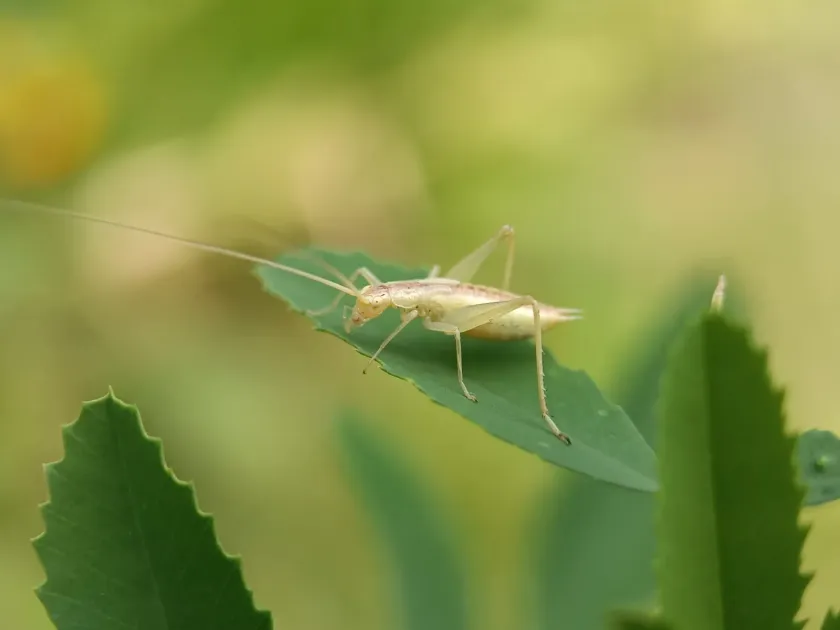
The tree cricket (Oecanthus pellucens) is a member of the Gryllidae family within the order Orthoptera. These insects are slender, measuring approximately 12-15 mm in length, and possess delicate, pale, translucent wings.
Their coloration typically ranges from light green to pale yellow, providing excellent camouflage against leaves and stems. They have long, thread-like antennae that are significantly longer than their body, which is a distinguishing feature of the species.
Males are well-known for their continuous, rhythmic chirping, which is heard mostly at night during the summer months. This acoustic signal is the primary method used to locate their presence in a garden or vineyard.
They are generally shy and nocturnal insects, preferring to hide deep within foliage or inside the pithy stems of plants. Their slender bodies allow them to navigate dense vegetation with ease.
Being highly mobile, these insects can spread easily across agricultural fields, making them a persistent pest in various horticultural environments where host plants are abundant.
What it damages
Tree crickets cause damage primarily to woody plants, including grapevines, fruit trees, and various ornamental shrubs. The injury is caused by the female's oviposition behavior.
The female uses her sharp ovipositor to make deep, linear incisions into young shoots to insert her eggs. These internal wounds disrupt the plant's vascular system, hindering the transport of water and nutrients.
Stems damaged by oviposition become weakened and are prone to breaking under wind pressure or heavy foliage weight. Furthermore, these incisions serve as entry points for fungal pathogens and bacteria.
The distal part of the shoot often withers, yellows, and dies back from the site of the puncture. This is particularly harmful to young nursery stock or vines undergoing structural training.
While individual damage may seem minor, severe infestations can lead to significant structural compromise of the plant, resulting in reduced yields and stunted growth over time.
When it appears
The tree cricket has an annual life cycle, overwintering as eggs securely embedded within the woody tissues of their host plants. This protects them from the harsh winter climate.
Nymphs hatch in late spring or early summer, depending on local temperatures. They undergo several molts as they grow, gradually developing the characteristics of the adult cricket.
Adults reach peak activity in mid-summer, typically from July through September. During this period, the singing of males becomes very prevalent in agricultural areas.
Mating and egg-laying activity are concentrated in the late summer and early autumn. Females actively select suitable stems to ensure their offspring survive until the following spring.
With the onset of autumn frost, adult activity declines significantly. The adults eventually die, leaving the next generation as eggs inside the plant material to survive the winter dormancy period.
Signs of infestation
The most reliable sign of a tree cricket presence is the persistent chirping sound heard during twilight and night hours. A chorus of chirps in the vineyard is an indicator of a substantial population.
Physical evidence of infestation includes rows of small, clean-cut punctures along the length of young branches or stems. These marks are often accompanied by slight dark discoloration around the incision site.
Wilting of shoot tips is a visible symptom that something is obstructing the flow of sap. When checked, these tips often show signs of being structurally compromised or hollowed out by the insect's activity.
Branches might display unusual bending or scarring. In some instances, plant sap may exude from the puncture sites, which may later harden or darken due to secondary infections.
When dissecting a suspected damaged shoot, one can often find the elongated eggs arranged longitudinally inside the central pith, confirming the presence of the pest.
Control measures
The primary control method involves mechanical removal, specifically pruning and destroying infested shoots during the dormant season. This significantly reduces the overwintering egg population.
- Cleaning up weeds and debris in the garden to remove alternative host sites.
- Tilling the soil around trees and vines to disrupt the life cycle.
- Using light traps to reduce the number of adult crickets in the area.
- Applying systemic or contact insecticides during the early nymph stage if infestations are severe.
Integrated Pest Management (IPM) practices, such as maintaining healthy plant growth and proper vineyard sanitation, can make plants less susceptible to egg-laying.
Monitoring the orchard or vineyard for the first signs of chirping or shoot damage allows for timely intervention before the population reaches an uncontrollable level.
In addition to chemical measures, encouraging natural predators like birds and spiders can help keep tree cricket populations in balance naturally within the ecosystem.
Taxonomy
- Latin name
- Oecanthus pellucens
- Order
- Orthoptera (locusts)
- Family
- Gryllidae
- EPPO code
- OECAPE
Discussion
No discussions yet — be the first.