
Long-tailed tree cricket
Oecanthus longicauda
Description
How to identify
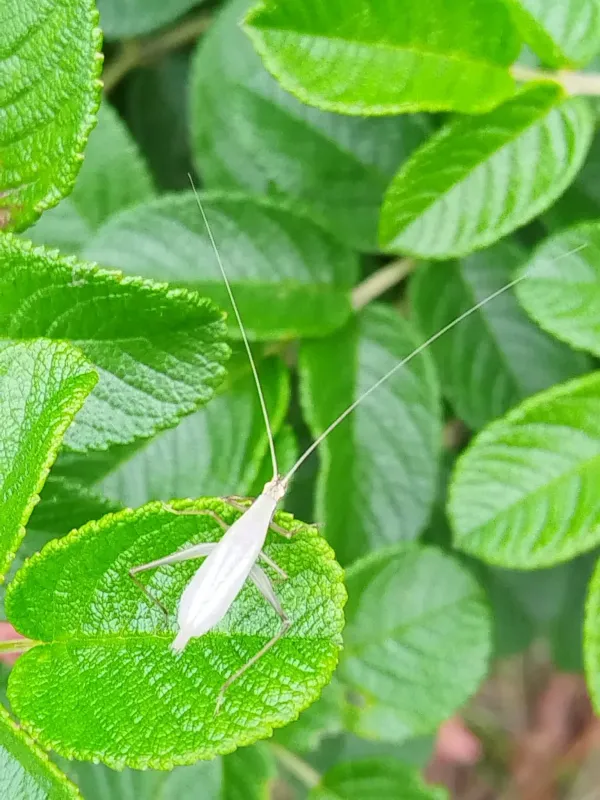
The long-tailed tree cricket Oecanthus longicauda belongs to the Gryllidae family within the order Orthoptera. These insects have a slender, pale green or yellowish-green body that allows them to blend perfectly with plant foliage and stems.
Adults have long, delicate, often transparent wings that lie flat against their backs. Their body length ranges from 15 to 20 mm, and they are easily recognized by their long, thread-like antennae, which significantly exceed their body length.
Male tree crickets are known for their rhythmic chirping at night, which they use to attract mates. This auditory signal is a reliable indicator of their presence in orchards or crop fields during the late summer months.
Nymphs resemble smaller versions of adults but lack fully developed wings and have less intense pigmentation. They go through several molting stages, gradually increasing in size throughout the season.
Due to their secretive lifestyle, these crickets prefer to hide within dense foliage or deep inside bushes, making them quite difficult to spot during routine garden inspections.
What it damages
The primary damage is caused by females when they insert their eggs into the soft tissues of plant stems. To do this, they gnaw deep holes, which physically damages the plant and disrupts nutrient transport.
This pest frequently targets grapes, berry bushes, and young fruit trees with tender stems. These injuries not only weaken the shoot but also create entry points for various fungal and bacterial pathogens.
As a result, the affected shoot tips may turn yellow and wither. In cases of high infestation, the overall vitality and growth of the plant are significantly impaired, reducing its productivity.
The egg-laying sites often become centers for decay, especially in humid conditions. Pathogens can spread through the stem, causing the death of entire branches and increasing the plant's susceptibility to diseases.
Damage to the vascular system of young saplings can be particularly dangerous, as it reduces their ability to store nutrients properly, potentially leading to plant mortality during the winter season.
When it appears
Adult activity peaks in late summer and early autumn. During this period, the insects mate and the females lay their eggs inside plant stems, which is how they survive the winter.
The species overwinters as eggs buried within plant tissue. As the weather warms up in the spring, the nymphs hatch and begin their development phase.
Nymphs feed on the soft tissues of young plants throughout the warmer months, going through several development stages before reaching adulthood. The life cycle takes approximately one year.
The chirping of males in August and September serves as an excellent monitoring tool for agronomists, signaling the start of the egg-laying season and the need for immediate action.
With the arrival of the first heavy frosts, the adult population dies off, leaving the eggs protected within the stems to start the cycle again the following spring.
Signs of infestation
The most distinct sign of infestation is a series of small, perfectly aligned holes in the stems of plants. These marks indicate where the female inserted her ovipositor to deposit eggs.
Yellowing or premature wilting of shoot tips that cannot be explained by irrigation issues or root diseases is a common indicator of cricket activity. Closer inspection often reveals egg clusters within the pith.
Persistent nocturnal chirping is a clear indication that a significant population is established in your area. This sound is often louder in areas where the crickets are most concentrated.
Dieback of young shoots in late summer is another symptom. Upon inspecting such stems, one can usually find traces of damage on the bark or small holes leading to the center of the stem.
Sometimes, the site of the egg-laying process causes slight swelling or discoloration on the stem, which can help in identifying which branches have been compromised.
Control measures
Sanitary pruning is the most effective cultural method to control this pest. Removing and burning affected shoots in the fall or early spring destroys the eggs before they hatch, drastically reducing the next generation.
Maintaining a clean garden by removing weeds is crucial, as weeds can serve as alternative hosts and sources of food for nymphs in the early stages of their development.
If the infestation levels are high, targeted applications of insecticides during the nymph hatching period can be effective. Follow label instructions carefully to protect beneficial insects.
Light traps installed at night can help reduce the population of adults, effectively capturing them and preventing further egg-laying activity in the vicinity.
- Monitor young plants carefully starting in mid-summer.
- Prune and destroy all damaged stems before spring hatching occurs.
- Implement proper agronomic practices to strengthen plant resistance.
- Consult local extension services for specific pesticide timing based on regional development.
Taxonomy
- Latin name
- Oecanthus longicauda
- Order
- Orthoptera (locusts)
- Family
- Gryllidae
- EPPO code
- OECALO
Discussion
No discussions yet — be the first.