
California tree cricket
Oecanthus californicus
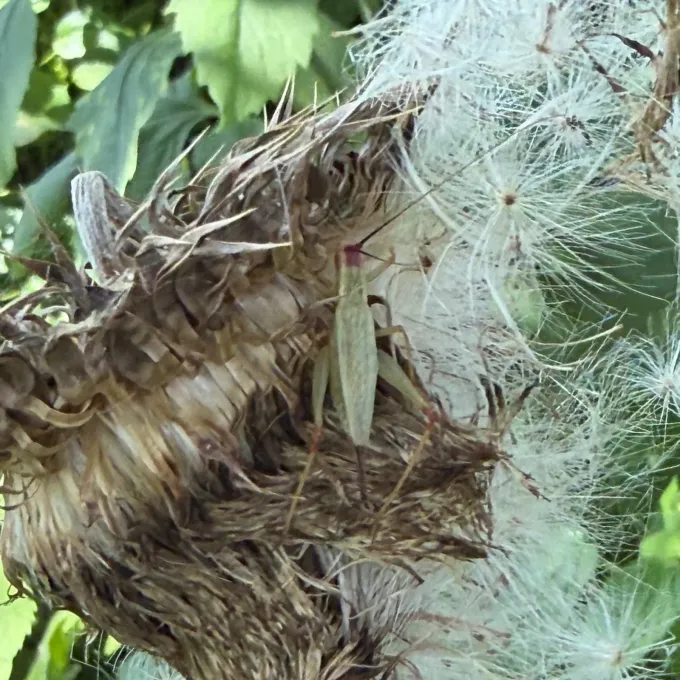
Description
How to identify
The California tree cricket (Oecanthus californicus) belongs to the order Orthoptera and the family Gryllidae. These insects are distinguished by their pale green to light brown coloration, which provides excellent camouflage among foliage and green stems.
Adults possess long, thread-like antennae and well-developed wings, allowing them to fly. Males are famous for their rhythmic chirping at night, produced by rubbing their wings together, which often serves as the primary sign of their presence in a garden.
The life cycle involves an egg stage that survives the winter protected within the woody tissue of host plants. Nymphs, which look like miniature versions of the adults, hatch in the spring and undergo several molts before reaching maturity.
This species is strictly arboreal, meaning it lives in the canopy of shrubs and trees rather than on the ground. They are widely distributed in orchards and forests, preferring dense vegetation where they can hide and feed.
Maturity and mating peak during late summer and early autumn. During this time, adult females search for suitable succulent stems to deposit their eggs, ensuring they are well-insulated and secure throughout the winter months.
What it damages
The primary damage is caused not by feeding, but by the female's oviposition process. Using a sharp, saw-like ovipositor, the female cuts deep rows of holes into the stems and twigs of various woody plants to insert her eggs.
Preferred hosts include apples, pears, peaches, and grapes, though various ornamental shrubs are also susceptible. These oviposition punctures weaken the stems, often causing them to snap under the weight of fruit or during strong winds.
The rows of punctures interfere with the plant's vascular system, disrupting the flow of water and nutrients. This damage leads to leaf chlorosis, stunted growth of the distal part of the branch, and often premature wilting of the shoots.
These puncture sites are notorious for becoming infection points for secondary pathogens. Fungi and bacteria frequently colonize the wounds created by the crickets, leading to cankers or necrosis that can jeopardize the health of the entire branch.
In cases of heavy infestation, the cumulative impact of multiple egg-laying sites can effectively girdle a young branch, resulting in the death of the twig and a significant reduction in the tree's overall fruit-bearing capacity.
Control measures
The most effective management strategy is rigorous winter pruning. Gardeners should identify and remove branches showing signs of oviposition punctures and dispose of them immediately, preferably by burning, to eliminate the eggs before spring hatch.
Monitoring using light traps can help track adult activity during the summer months. Capturing adults before they can mate and lay eggs is a highly effective way to prevent future population spikes in the orchard.
Chemical control with insecticides is generally reserved for high-population scenarios. Treatments should be applied during the early nymph stage to stop the pests before they can cause widespread damage to the new growth.
Promoting natural biological controls is essential for long-term management. Encouraging predatory insects, spiders, and insectivorous birds in the orchard ecosystem helps keep the tree cricket population within manageable limits naturally.
Maintaining high plant vigor through proper fertilization and irrigation is a key cultural practice. Healthy, well-nourished trees demonstrate better wound healing capabilities and are generally more resilient to the stresses caused by insect infestations.
Taxonomy
- Latin name
- Oecanthus californicus
- Order
- Orthoptera (locusts)
- Family
- Gryllidae
- EPPO code
- OECACA
Discussion
No discussions yet — be the first.