
Tree cricket
Oecanthus
Description
How to identify
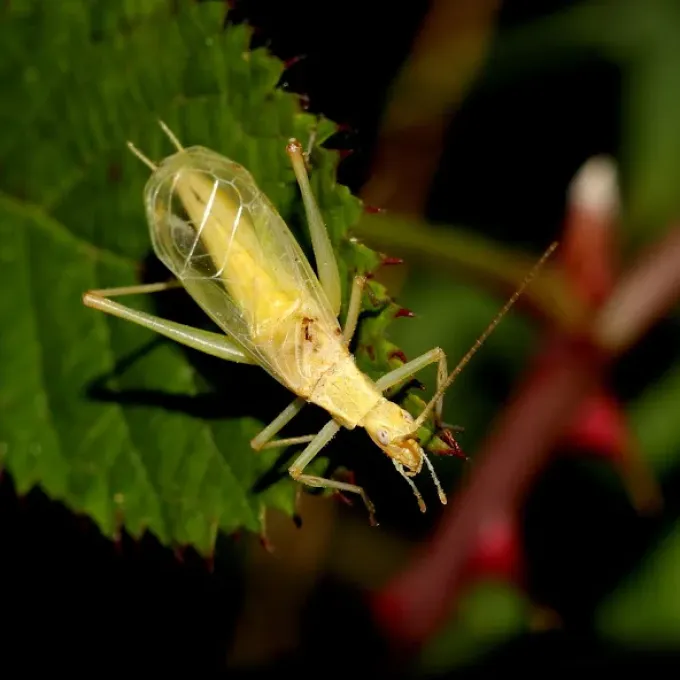
The Tree cricket (genus Oecanthus) belongs to the family Gryllidae within the order Orthoptera. These insects are characterized by a slender body, usually measuring 15–20 mm in length, and a pale green or yellowish coloration that acts as effective camouflage.
They possess long, transparent wings that lie flat against their bodies, allowing for agile flight. A distinct feature is their exceptionally long and sensitive antennae, which are much longer than the body itself, used for sensory navigation.
Females are equipped with a strong, specialized ovipositor designed for piercing plant stems. While they share a general appearance with grasshoppers, tree crickets are much more delicate and tend to remain hidden within the plant canopy.
The life cycle encompasses the egg stage (overwintering inside stems), nymphal stages, and adulthood. Nymphs resemble miniature versions of the adults but lack developed wings, making them harder to spot during inspections.
They are primarily nocturnal insects, remaining inactive during the day. Their cryptic behavior means they are often heard rather than seen, as males produce a distinct rhythmic chirping to attract mates in the evenings.
What it damages
The primary damage is caused by the female during oviposition. Using her ovipositor, she creates a series of punctures or long, narrow slits in the soft stems of plants, which disrupts the vascular system and sap flow.
Host plants commonly affected include various berry bushes (raspberries, blackberries), grapevines, fruit tree saplings, and several ornamental shrubs. The stems often break at the point of the puncture due to mechanical weakness.
These puncture wounds serve as entry points for various pathogens, including fungi and bacteria. This frequently leads to secondary infections such as stem blight, necrosis, or localized decay, further weakening the plant.
Young, succulent shoots are the most vulnerable, and extensive egg-laying can result in the complete death of these branches. In mature plants, this leads to reduced vigor and lower yields for the affected season.
While nymphs may feed on leaves and flower buds, the mechanical impact of the egg-laying process remains the most significant economic concern for commercial growers and home gardeners alike.
When it appears
Tree crickets overwinter exclusively as eggs, which are safely deposited within the pith of plant stems. The hatching of nymphs occurs in late spring as temperatures consistently rise to favorable levels.
Nymphs undergo a series of molts throughout the summer months while feeding on foliage and floral parts. By late summer, they reach maturity and begin the cycle of mating and egg-laying that continues into autumn.
The peak period for egg-laying is late summer through early autumn. It is during this time that agronomists and gardeners should be most vigilant, as fresh damage to new growth is most likely to occur.
Adult populations decline as temperatures drop with the first frosts, effectively concluding their life cycle. A long, warm autumn can extend their activity, potentially leading to higher pest pressure in the following year.
Monitoring the presence of adults can be done by listening for their synchronized chirping at night. This auditory signal is a reliable indicator that the population has established itself on the site.
Signs of infestation
The most diagnostic sign of an infestation is the appearance of a row of small punctures or a longitudinal crack along the bark of young shoots. Cutting into the stem at this point often reveals the small, light-colored eggs.
Wilting or yellowing of shoot tips, even with adequate irrigation, is a common secondary symptom. This indicates that the internal damage to the stem is preventing proper nutrient transport to the upper parts of the branch.
Frequent stem breakage during wind events is another major indicator. If the breakage consistently occurs at similar points on multiple stems, it is a strong signal that the structural integrity has been compromised by insect activity.
Small, irregular holes in the leaves are often found in areas where nymphs are present, though this damage is less specific and can easily be confused with that of other minor leaf-feeding insects.
Finally, the rhythmic, high-pitched chirping emanating from the garden at night is an unmistakable sign of the presence of adult tree crickets and suggests the need for management before the egg-laying phase peaks.
Control measures
The primary control measure is rigorous sanitary pruning. Removing and destroying infested stems in autumn or late winter eliminates the eggs before they can hatch, significantly reducing the next generation's population.
Cultural practices such as weed management are vital. Weeds can act as secondary hosts or shelters, so maintaining a clean environment around the base of plants helps discourage colonization by these crickets.
If population levels are high and causing significant damage, targeted application of systemic insecticides may be necessary during the peak nymph activity phase. Always consult local regulations for appropriate chemical use.
Promoting a garden ecosystem that supports natural predators, including birds and predatory insects, can naturally suppress cricket populations. Providing bird habitat is a simple and effective strategy for long-term control.
- Sanitary pruning of infested shoots.
- Proper disposal of plant debris.
- Regular weed control around host plants.
- Monitoring using light traps or auditory cues.
Taxonomy
- Latin name
- Oecanthus
- Order
- Orthoptera (locusts)
- Family
- Gryllidae
- EPPO code
- OECASP
Discussion
No discussions yet — be the first.