
Issiki's Casebearer Moth
Odites issikii
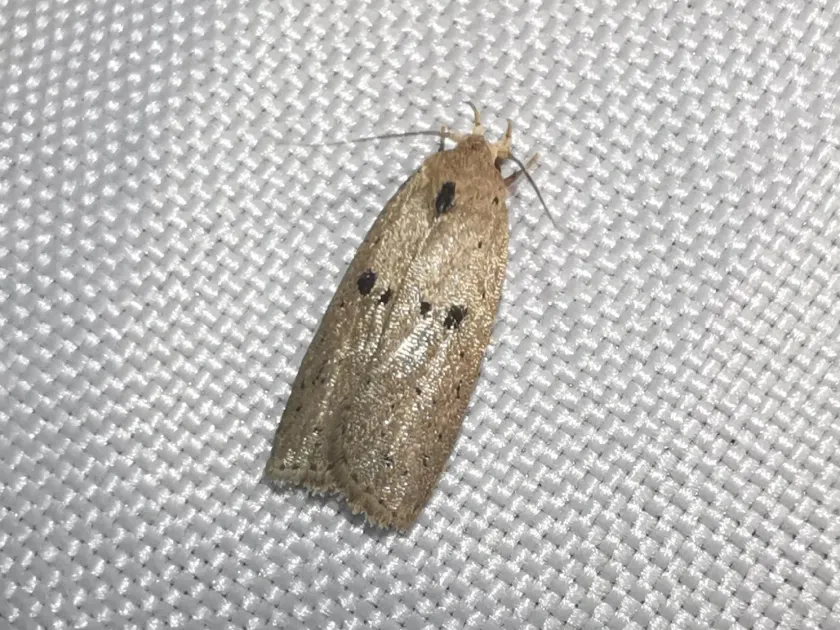
Description
How to identify
Issiki's Casebearer Moth (Odites issikii) is a member of the Depressariidae family within the order Lepidoptera. This small moth is characterized by a cryptic larval stage, making it a challenging pest to identify in orchards during the early infestation phases.
Adult moths are small with slender wings. The most notable feature of this species is the behavior of its larvae, which construct protective cases out of plant debris, silk, and excrement. These cases serve as both a refuge and a mobile feeding station.
The larvae possess well-developed chewing mouthparts that allow them to consume the parenchyma of leaves while leaving the epidermis intact, creating a unique type of leaf damage. Their bodies are typically pale, allowing them to remain camouflaged within their portable shelters.
Pupation occurs either on the host plant or within the soil surface, depending on environmental conditions. The pupal stage is protected by a sturdy cocoon, reinforced with silk threads and small particles from the environment.
Accurate identification of the pest is often complicated by its mimicry of other leaf-mining insects. Precise confirmation usually requires microscopic examination of the larval morphology and the structure of the silken case it produces.
What it damages
The primary hosts of this moth are a wide variety of fruit trees. It causes significant damage in both commercial orchards and backyard gardens, affecting trees of all ages, from young saplings to mature, fruit-bearing specimens.
Larvae feed by consuming leaf tissues, creating windows or narrow mines. This leads to premature yellowing, leaf curling, and early leaf drop, which significantly reduces the tree's photosynthetic capacity and overall vigor.
Infestations typically occur during the spring and summer months when trees are actively producing foliage. Trees weakened by the moth become more susceptible to secondary infections, such as fungal pathogens, which enter through the damaged tissues.
In addition to foliage damage, the larvae can sometimes attack fruitlets and young shoots, negatively impacting fruit quality and reducing the number of flower buds for the following season. Substantial yield losses can occur under high population densities.
Economic threshold levels depend on the crop type and tree age. Ongoing monitoring is essential to detect early infestations and implement control measures before populations reach outbreak levels.
When it appears
The life cycle of Issiki's Casebearer Moth is closely linked to the phenological stages of host trees. The emergence of the first larvae coincides with bud burst and the beginning of active foliage development in the spring.
Throughout the growing season, the species can produce multiple generations. The number of generations is highly dependent on regional temperatures and the accumulation of heat units (degree-days) during the spring and summer.
Peak activity generally occurs in June and July, when adult flights and egg-laying are most intense. During this period, orchard managers should focus on inspecting the undersides of leaves for the presence of the characteristic cases.
The moth overwinters as a larva or pupa in protected sites, such as bark crevices, fallen leaf litter, or the upper layers of the soil. This overwintering strategy allows the species to survive the harsh conditions of winter.
Climate change and milder winter temperatures are expanding the geographical range of this pest, as survival rates for overwintering individuals have increased in regions where temperatures were previously a limiting factor.
Signs of infestation
The first sign of infestation is the appearance of distinct feeding windows on leaves, where the larvae have consumed the inner tissue while leaving one layer of the epidermis untouched. Soon after, small, mobile cases can be observed attached to the leaf surfaces.
The presence of silken threads, used by the larvae to anchor their cases or pull leaf edges together, is a clear indicator of their activity. This can lead to leaf deformation and noticeable rolling or folding of the foliage.
Observation of the leaf undersides often reveals larval excrement, which the larvae frequently accumulate near their cases. This accumulation is a useful diagnostic feature for rapid field identification of the pest.
Premature leaf drop that cannot be attributed to diseases is another indicator of moth activity. Damaged leaf areas eventually become necrotic, turning brown and brittle as the plant tissue dries out.
Pheromone traps are highly recommended for professional monitoring. They provide early warning of adult moth flights, allowing growers to time their pest control interventions effectively before the next generation of larvae hatches.
Control measures
Effective management of Odites issikii relies on an integrated pest management (IPM) approach. Relying on a single control method is rarely sufficient to keep population numbers below the economic threshold.
Cultural control is a cornerstone of management. This includes the regular removal and destruction of fallen leaves and plant debris to eliminate overwintering sites, as well as soil cultivation around the base of the trees to disrupt pupation sites.
Biological control methods involve the use of entomopathogenic bacteria, such as Bacillus thuringiensis. These products are generally safe for non-target beneficial insects and pollinators while effectively targeting the young, feeding larvae.
Chemical control should be implemented during the peak periods of larval hatching. Growers should select systemic or contact insecticides that are approved for use on the specific fruit crops being managed.
Rotating active ingredients between different chemical classes is essential to prevent the development of insecticide resistance in the moth population. Always strictly follow label instructions, particularly regarding pre-harvest intervals (PHI) to ensure food safety.
Taxonomy
- Latin name
- Odites issikii
- Order
- Lepidoptera (butterflies)
- Family
- Depressariidae
- EPPO code
- ODITIS
Discussion
No discussions yet — be the first.