
Odezia
Odezia
Description
How to identify
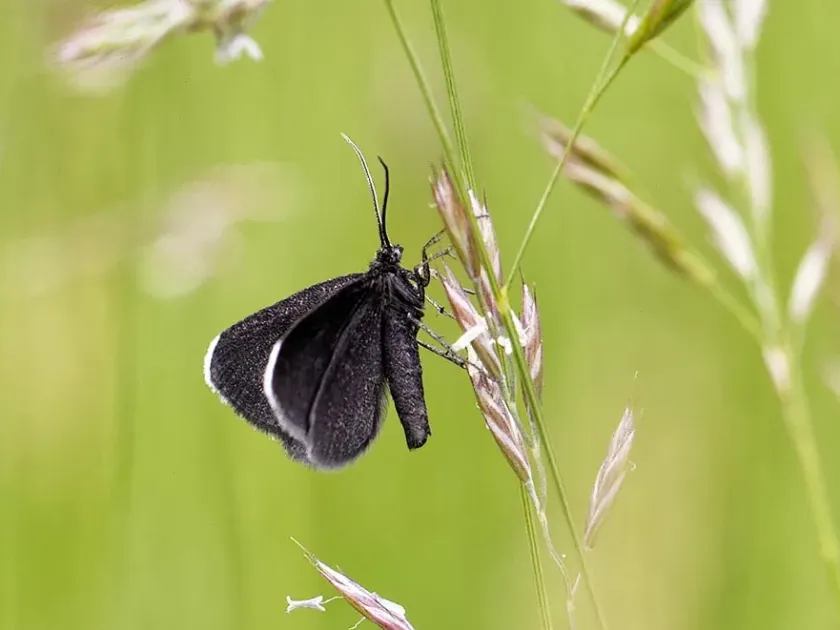
Odezia (scientific name Odezia atrata) belongs to the family Geometridae, the order Lepidoptera. The adult insect is a small day-flying moth with a wingspan ranging from 25 to 30 mm.
The wings have a distinct uniform dark brown or blackish color, which explains the common name "chimney sweeper". Most specimens feature a narrow white border on the tips of the forewings, which serves as a reliable diagnostic feature.
The moth has a slender body covered with dense hairs. Unlike many other geometer moths, the Odezia is diurnal and exhibits high activity during sunny weather, frequently visiting flowers for nectar.
The larvae, known as inchworms, have a characteristic structure with fewer prolegs than other caterpillars. This anatomy forces them to move in a unique "looping" manner by bending their bodies.
The caterpillars are typically greenish with light longitudinal stripes, providing excellent camouflage against the stems and leaves of their host plants within dense vegetation.
What it damages
The primary food source for Odezia larvae consists of plants from the family Apiaceae. While they commonly inhabit wild meadows and woodland edges, they can pose a threat to cultivated umbelliferous crops.
In agricultural settings, the pest often migrates to fields from surrounding wild Apiaceae, which act as natural reservoirs for the population throughout the growing season.
The larvae feed primarily on leaves and buds, consuming leaf tissue down to the veins or completely destroying young inflorescences, which inhibits the plant's photosynthetic capacity and development.
Damage caused by Odezia is usually localized, as the moths tend to concentrate their egg-laying in sheltered, favorable spots within the field or along the borders.
Under conditions of high population density, the pest can significantly weaken young crops, leaving them susceptible to opportunistic infections or secondary pest infestations.
When it appears
The lifecycle of Odezia comprises a single generation per year. Adult moths emerge in early summer, with peak flight activity observed throughout June and July.
Following mating, the females deposit eggs on host plants, and the larvae emerge shortly thereafter to feed actively during the remainder of the summer period.
The species overwinters in the pupal stage. The pupae remain buried in the soil or within sheltered plant debris, where they are protected from harsh winter temperatures.
In spring, as soil temperatures rise, the pupae develop and emerge as adults of the next generation, completing the annual biological cycle.
For agronomists, monitoring the crop during the mid-summer larval development phase is crucial for assessing potential damage and determining the necessity of intervention.
Signs of infestation
The primary sign of an Odezia infestation is the presence of characteristic "shot-hole" damage on the foliage, often accompanied by frass (larval excrement) left on leaf surfaces.
When young flower heads are attacked, signs of premature wilting and deformation become visible, which directly impacts the yield of seed crops.
During early morning or late evening inspections, the larvae themselves can be found, though they often remain motionless to evade detection due to their cryptic coloration.
A high density of moths flying in the field during daylight hours serves as a warning sign of a significant infestation that may require immediate management actions.
Heavy feeding on apical buds leads to stunted growth of the central stalk and disrupts the typical architectural development of the Apiaceae plant.
Control measures
Effective management of Odezia relies on an integrated approach, combining cultural practices with targeted chemical or biological interventions.
- Deep autumn plowing to disturb the soil and destroy overwintering pupae.
- Active weed management to remove wild Apiaceae hosts from field margins and adjacent areas.
- Application of biological insecticides based on entomopathogenic bacteria during the early larval stage to minimize impact on beneficial insects.
- Use of approved systemic insecticides if population thresholds are exceeded, ensuring compliance with local application regulations.
- Strategic crop rotation with non-host species to interrupt the lifecycle and reduce the pest pressure in the following season.
Taxonomy
- Latin name
- Odezia
- Order
- Lepidoptera (butterflies)
- Family
- Geometridae
- EPPO code
- ODEZSP
Discussion
No discussions yet — be the first.