
Japanese stem borer
Oberea japonica
Description
How to identify
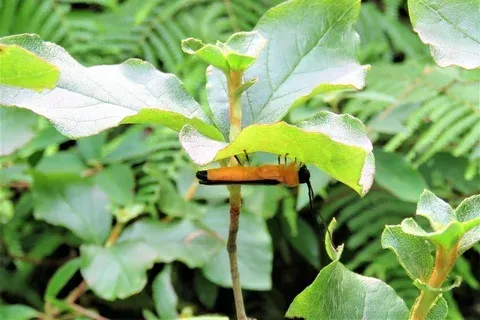
The Japanese stem borer (lat. Oberea japonica) belongs to the longhorn beetle family (Cerambycidae), which is part of the order Coleoptera. Adults have an elongated, slender body typical of the subfamily Lamiinae.
The imago is usually colored in dark or yellowish-brown tones, often featuring longitudinal stripes on the elytra. The head and pronotum have a specific structure characteristic of this genus of beetles.
The larvae are legless, whitish, and equipped with a well-developed head capsule adapted for feeding on woody tissues. They pass through several instars, gradually increasing in size while developing inside the plant shoots.
The pupa develops within the tunnel bored by the larva, often inside a specially prepared chamber, where it remains protected from external environmental factors and predators.
The life cycle of this insect is closely linked to the condition of the wood of its host plants, which makes it a dangerous specialized pest in regions where it is established.
What it damages
The primary hosts for the Japanese stem borer include various fruit crops, particularly those belonging to the Rosaceae family.
The insect causes the most significant damage to crops such as apples, pears, quince, and various ornamental shrubs and trees grown in gardens.
Larvae bore into young shoots and branches, consuming internal tissues, destroying the plant's vascular system, and disrupting the natural flow of nutrients and water.
Mass infestations can lead to the weakening of entire trees, premature aging, and a decrease in the overall productivity of the orchard.
Young saplings and trees in their active growth phase are particularly vulnerable, as damage to the main leader shoot can lead to crown deformation and even tree death.
When it appears
The flight of adult beetles usually occurs during the warm season, corresponding to the period of active vegetation of woody plants, most commonly in late spring and the first half of summer.
Immediately after mating, females begin laying eggs, placing them singly or in small groups on the surface of young shoots or into previously gnawed holes.
Larval development begins in the summer and can continue until autumn, during which time they actively feed on wood, moving downwards through the shoot or branch.
Overwintering usually occurs at the larval stage inside the damaged wood, allowing the pest to successfully survive unfavorable winter conditions.
In spring, as temperatures rise, the larvae complete their development, pupate, and the cycle repeats with the emergence of a new generation of adult beetles.
Signs of infestation
One of the earliest signs of the pest's presence is the appearance of characteristic paired circular girdling incisions on shoots, which the female creates before laying eggs.
Once larval feeding begins, shoots often start to wilt, yellow, and wither, which is easily noticeable during a routine inspection of the tree crown in mid-summer.
Near the entry or exit points of the larvae, small holes may be visible on the bark surface, from which frass (fine sawdust-like excrement) often spills out.
When cutting into a damaged branch or shoot, long winding tunnels filled with frass can be found, containing either larvae or signs of their activity.
Prolonged infestation causes branches to become brittle and easily break in strong winds, which serves as a secondary indicator of severe damage.
Control measures
The foundation of management for the Japanese stem borer is agrotechnical: regular sanitary pruning and the destruction of infested shoots along with the larvae inside.
Collected infested plant material must be burned immediately or buried deeply to prevent the emergence of the next generation of beetles.
During the adult flight period, protective spraying with contact-stomach insecticides is effective in preventing egg-laying.
Maintaining overall tree health through balanced nutrition, proper irrigation, and correct pruning is an important element of control, as vigorous trees are less attractive to pests.
- Preventive crown inspection in June-July.
- Timely removal of wilting branches.
- Use of biological pesticides during the period of high pest activity.
- Encouraging natural predators of wood-boring insects.
Taxonomy
- Latin name
- Oberea japonica
- Order
- Coleoptera (beetles)
- Family
- Cerambycidae
- EPPO code
- OBERJA
Discussion
No discussions yet — be the first.