
Tiger snake
Notechis scutatus
Description
How to identify
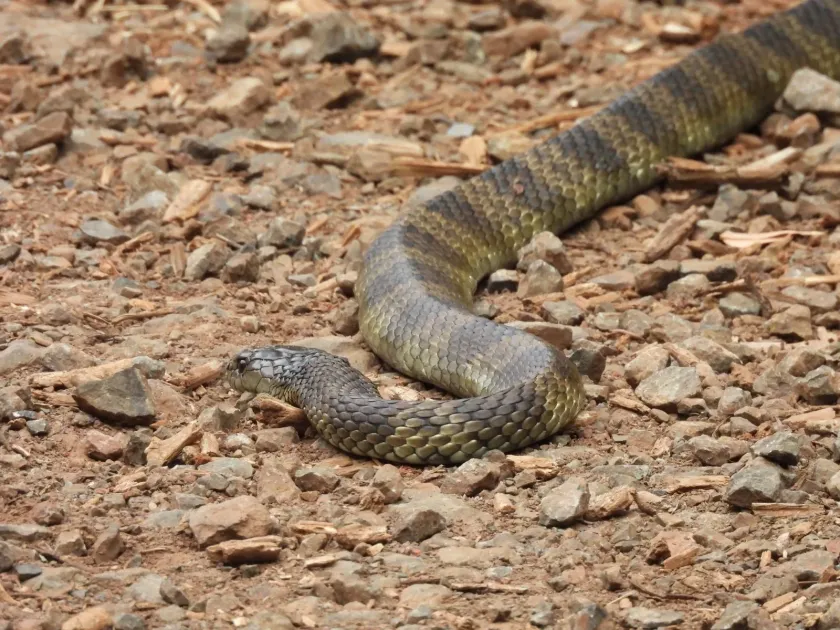
The tiger snake (Notechis scutatus) is a highly venomous elapid species native to Australia. Its coloration is highly variable, typically displaying olive to black scales with distinct yellowish cross-bands.
Adult individuals generally reach lengths between 1.2 and 1.5 meters. They possess a broad, flattened head which they inflate when threatened to appear larger and more intimidating to potential predators.
These snakes are primarily found in moist habitats, such as wetlands, irrigation ditches, and areas with dense vegetation, which are common landscapes in agricultural regions.
Biology is characterized by live birth, with females producing large litters ranging from 30 to 60 offspring, leading to high local population densities in favorable conditions.
They are known for their defensive behavior, which includes flattening the neck and emitting a loud, warning hiss before striking if they feel cornered or threatened.
What it damages
The tiger snake is not a herbivore and does not feed on crops, meaning it causes no direct economic damage to plant tissues, fruits, or roots during the growing season.
The primary concern for the agricultural sector is the significant threat to human health and the safety of field workers navigating densely planted areas or irrigation zones.
The presence of these venomous snakes on a farm disrupts standard operational workflows, such as manual harvesting, pruning, and infrastructure maintenance, due to the constant risk of encounter.
Agricultural businesses face increased costs related to the implementation of mandatory safety protocols, specialized gear, and training, which are required to mitigate the danger.
In regions with high tiger snake activity, land management practices often have to be modified to maintain visibility and prevent snakes from establishing habitats near equipment.
When it appears
Activity is dictated by temperature, with peak movement occurring during the warmer spring and summer months in the Southern Hemisphere.
During these active seasons, snakes are frequently observed on open fields or access roads, as they require solar heat for proper thermoregulation.
In the height of summer, they tend to be most active during the cooler parts of the day, specifically at dawn and dusk, when they search for food among crops.
As temperatures begin to drop in autumn, their metabolism slows down, reducing movement until they eventually enter a state of brumation for the winter months.
Field managers should remain particularly vigilant during the early morning hours, as snakes may use agricultural rows as pathways for movement across the field.
Signs of infestation
Direct sightings are the most common sign of presence, especially near water sources or in piles of debris where they seek shelter during the heat of the day.
The presence of shed skins (exuviae) in fields or irrigation sheds is a clear indicator that a local population is established in the area.
Unexpected reactions from livestock or domestic animals, such as nervous pacing or vocalizing, can often reveal the presence of a predator nearby.
Audible hissing is a major warning sign that an individual is nearby and has been disturbed by human activity or machinery movement.
- Characteristic wavy tracks left on soft soil or sand near irrigation channels.
- Increased rodent activity or sudden disappearance of small game in specific areas.
- Defensive neck-flattening observed by field workers at a distance.
Control measures
Effective control begins with habitat modification: keeping field borders and irrigation banks clear of tall grass and debris eliminates necessary hiding spots.
Active pest control targeting rodent populations is essential, as mice and small mammals act as a primary food source, drawing snakes toward farm buildings.
Workers must wear appropriate Personal Protective Equipment (PPE), specifically puncture-resistant boots and heavy-duty clothing, when walking through high-risk areas.
Rigorous safety training for all farm staff is critical to ensure that employees know how to act in the event of an encounter or a suspected snake bite.
If snake density becomes unmanageable, farmers should contact licensed snake removal specialists to relocate the animals safely and legally away from active work zones.
Taxonomy
- Latin name
- Notechis scutatus
- Family
- Elapidae
- EPPO code
- NTCESC
Discussion
No discussions yet — be the first.