
Black mamba
Dendroaspis polylepis
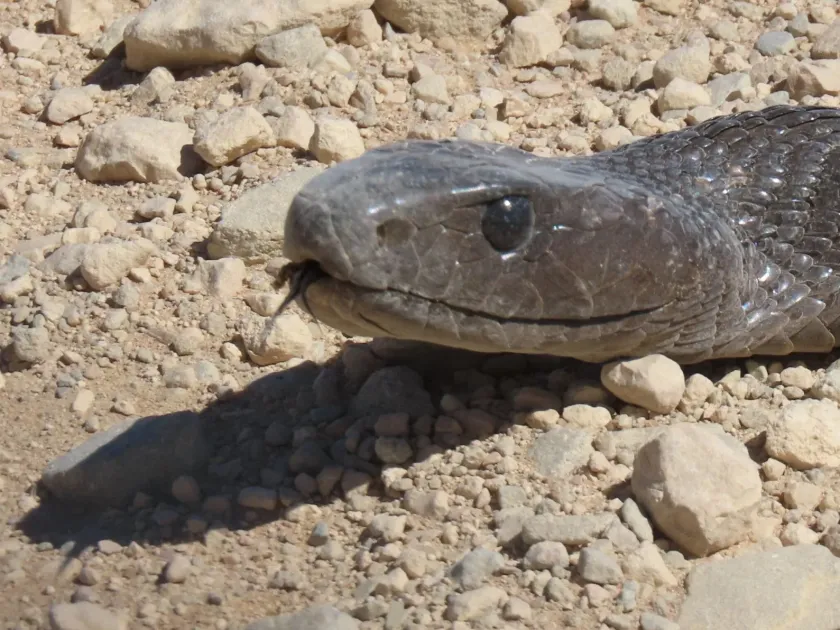
Description
How to identify
The black mamba (Dendroaspis polylepis) is one of the world's most venomous snakes, native to parts of sub-Saharan Africa, belonging to the Elapidae family.
Adult specimens typically reach lengths of 2.5 to 3 meters, featuring a slender but muscular build and a distinctive coffin-shaped head.
The snake's name derives not from its skin color, which ranges from olive to grey, but from the jet-black lining inside its mouth, exposed when threatened.
It is remarkably fast and agile, capable of striking repeatedly with high accuracy, making it one of the most formidable reptiles in its habitat.
They prefer diverse habitats including savanna and woodland, often occupying abandoned termite mounds or hollow trees that may be located near agricultural fields.
What it damages
The black mamba is not an agricultural pest; it does not feed on crops, nor does it cause direct physical damage to plants, roots, or yield.
However, it is a major workplace hazard that significantly impacts agricultural operations due to the high risk it poses to field workers and manual laborers.
Its presence necessitates a cessation of field work, as a single encounter with this snake can result in life-threatening situations for staff members.
In regions where the black mamba is prevalent, farming enterprises must include biological hazard management in their operational safety plans.
The economic impact manifests as a loss of productivity during safety pauses and the requirement for professional wildlife removal services from farming premises.
When it appears
Activity patterns of the black mamba are closely tied to ambient temperatures, as they rely on external heat to regulate their metabolism.
They are most active during the warmer months, when they emerge from their shelters to hunt, bask, and engage in reproductive behaviors.
Agricultural workers are at higher risk during peak season when the snakes are moving through tall crops or dense vegetation which provides them with cover.
They generally lead a diurnal lifestyle, meaning they are most likely to be encountered by field workers during the early morning and afternoon hours.
During extreme heat or winter months, they may retreat to deep underground shelters, significantly reducing the probability of human-snake interactions.
Control measures
Mitigation efforts focus entirely on safety protocols and the prevention of human encounters rather than population control or elimination.
Workers must wear appropriate personal protective equipment (PPE), specifically puncture-resistant boots and long-sleeved clothing, to reduce the risk of venom inoculation.
Habitat management around fields, such as removing tall weeds, debris piles, and brush, is critical to reducing potential nesting or hiding sites for the snakes.
All agricultural staff should be trained in safety awareness, including recognizing the snake's warning signs and the correct emergency response protocol for bites.
If a black mamba is identified in a working area, the professional approach is to isolate the site and contact local authorities or experts for relocation.
Taxonomy
- Latin name
- Dendroaspis polylepis
- Family
- Elapidae
- EPPO code
- DNDAPO
Discussion
No discussions yet — be the first.