
Western green mamba
Dendroaspis viridis
Description
How to identify
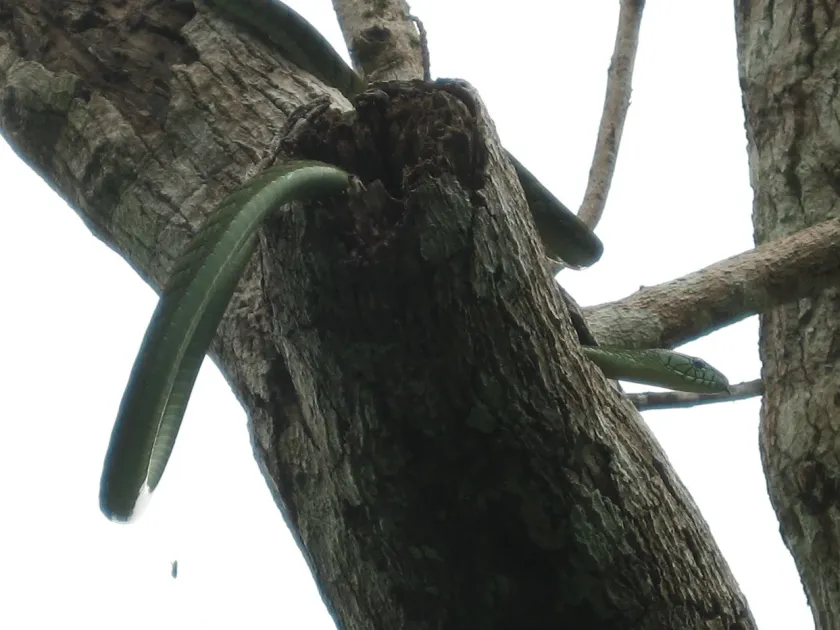
The Western green mamba (Dendroaspis viridis) is a venomous snake species belonging to the family Elapidae. It is a strictly arboreal reptile from the order Squamata, native to the tropical rainforests of West Africa.
Adult specimens typically reach lengths of 1.5 to 2.5 meters. The body is slender and agile, featuring bright green or olive scales often edged with black, which creates a distinct lattice pattern along the dorsal surface.
The head is elongated and narrow with large eyes and round pupils. The scales are smooth and highly iridescent, which provides effective camouflage amidst the dense foliage of the forest canopy.
Dendroaspis viridis is diurnal, spending the majority of its life cycle in trees. Its muscular build and long, prehensile-like tail allow it to move swiftly between branches with ease.
It is an apex predator within its micro-habitat, preying exclusively on small vertebrates. It does not possess any morphological traits associated with plant feeding or agricultural destruction.
What it damages
The Western green mamba causes no damage to crops or agricultural vegetation. It is a carnivorous predator and is entirely uninterested in consuming or damaging any parts of plants, fruits, or roots.
Its role in an agricultural environment is strictly incidental. Because its diet consists of rodents, lizards, and birds, it may inadvertently assist in pest control by reducing the population of crop-eating rodents.
There is no economic harm associated with this species in the context of agriculture. It does not infest, tunnel, or consume plant tissues, and it does not use crops for oviposition.
The species should not be categorized as a plant pest. Any presence of this snake on agricultural land is merely due to the overlap of farming practices with its natural habitat.
Therefore, classifying it as a pest represents a misunderstanding of its biological niche and ecological function as a predatory reptile.
Control measures
No agricultural control methods, such as insecticides or traps, should be directed against this snake. It is a wild animal that plays a role in local biodiversity and is not a target for pest management.
Safety protocols for field workers are the only recommended approach. Maintaining clear paths and pruning dense vegetation near work areas reduces the likelihood of snakes inhabiting areas frequented by humans.
Personal protective equipment, such as sturdy boots and long-sleeved clothing, provides a significant level of protection against potential accidental encounters while working in forest-adjacent zones.
Education is key; personnel should be trained to recognize the species and understand that it only displays defensive behavior when cornered or physically threatened.
By preventing the accumulation of prey-attracting waste near fields, farmers can naturally discourage the presence of snakes without the need for harmful eradication efforts.
Taxonomy
- Latin name
- Dendroaspis viridis
- Family
- Elapidae
- EPPO code
- DNDAVI
Discussion
No discussions yet — be the first.