
Blue-spot hairstreak
Nordmannia acaciae
Description
How to identify
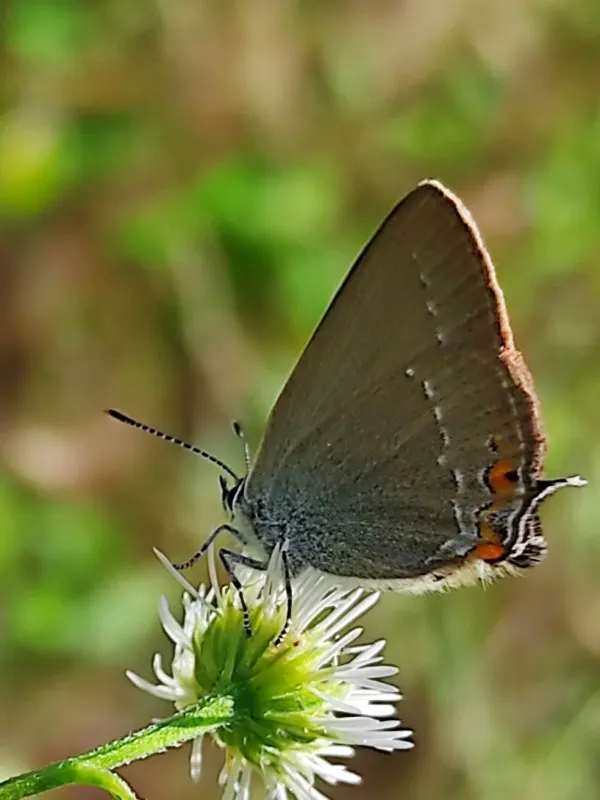
The Blue-spot hairstreak (Nordmannia acaciae) is a butterfly belonging to the Lycaenidae family. Adult butterflies typically have a wingspan of 25–30 mm.
The upper side of the wings is a uniform dark brown, while the hindwings feature small, thin tails, which is a classic characteristic of hairstreak species.
The underside of the wings is light gray with a thin white line running across them, accompanied by distinct orange spots near the outer edge of the hindwings.
The body is covered with fine hair, and the butterfly usually rests with its wings folded vertically to camouflage itself.
The larvae (caterpillars) are slug-shaped and bright green, often featuring lighter diagonal markings that mimic leaf veins.
What it damages
The primary host plants for the larvae include members of the Rosaceae family, such as species of the genus Prunus (plums, blackthorn) and hawthorns.
While the name suggests an association with acacia, the species is not a specialized pest for these trees, but rather favors temperate deciduous shrubs.
Caterpillars feed on developing buds and young leaves, causing irregular holes or completely consuming the leaf margins.
Heavy infestations can significantly reduce the foliage surface area, impacting the tree's photosynthesis and overall seasonal health.
While usually considered a minor pest in mature orchards, high populations can stunt the growth of young nursery stock or newly planted saplings.
When it appears
Adult butterflies are active during the mid-summer months, primarily observed flying in June and July in sunny, warm conditions.
The species overwinters in the egg stage, which are laid singly or in small groups on the bark of host trees, typically near buds or twig junctions.
Larval emergence coincides with the early spring bud break, as the caterpillars begin to feed on the most nutrient-rich parts of the plant.
The larval stage lasts for approximately six weeks, during which they grow steadily before finding a suitable site for pupation.
Pupae are formed on the twigs or in the leaf litter, where they remain until the adult butterfly emerges to complete the cycle.
Signs of infestation
Early spring damage often appears as chewed or partially destroyed buds, which can hinder the uniform development of the tree canopy.
As the season progresses, leaves may show ragged edges or internal holes, characteristic of larval feeding activity during the night or day.
Pupae can sometimes be spotted attached to the underside of branches, disguised by their shape and color to resemble dried plant matter.
The presence of adult butterflies near flowering shrubs in early summer is an indicator of the potential for a new egg-laying cycle.
- Damaged spring leaf buds
- Irregular feeding holes in foliage
- Green slug-like larvae on leaves
- Presence of pupae on bark or branches
Control measures
Targeted insecticidal applications during the larval emergence period in early spring are the most effective chemical control method.
Pruning of infested or dead wood during the dormant season helps remove overwintering eggs, reducing the total population size.
Encouraging natural biodiversity, such as nesting sites for insectivorous birds, provides effective long-term suppression of the pest.
For small-scale gardening, manual removal of caterpillars during the active feeding phase is a safe and environmentally friendly alternative.
Monitoring the flight activity of adult butterflies can help predict when to inspect young trees for the next generation of larvae.
Taxonomy
- Latin name
- Nordmannia acaciae
- Order
- Lepidoptera (butterflies)
- Family
- Lycaenidae
- EPPO code
- NORDAC
Discussion
No discussions yet — be the first.