
Nepytia semiclusaria
Nepytia semiclusaria
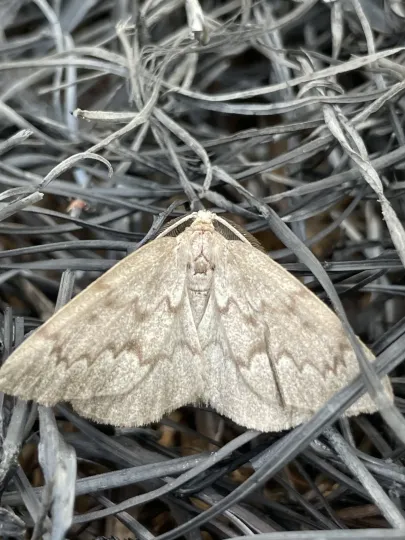
Description
How to identify
The adult Nepytia semiclusaria is a small moth belonging to the Geometridae family. The wingspan typically ranges from 25 to 35 millimeters, with coloration varying from grayish-brown to ochre-brown, featuring characteristic dark patterns resembling stripes or wavy lines.
The larvae of this species possess the typical build of geometrid moths, with well-developed thoracic legs and a pair of ventral prolegs, which results in their specific looping movement. The caterpillar coloration is often cryptic, greenish or brown, allowing them to blend in with the needles.
The biology of the species is closely linked to forest ecosystems, where adults are primarily active at twilight and night. Females lay eggs in small groups on needles or tree bark, providing young larvae with direct access to food immediately after hatching.
The insect development passes through a pupal stage, which is most often found in a loose cocoon among needles or in bark crevices. Pupation occurs in summer or autumn depending on the climatic conditions of the distribution region.
For accurate species identification, specialists use pheromone traps or conduct visual inspections of tree crowns for characteristic damage, as the moths are largely nocturnal and secretive.
What it damages
The primary food source for Nepytia semiclusaria larvae is coniferous tree species. They most frequently damage various types of pine and spruce, and are occasionally found on other conifers within their natural range.
The pest prefers young needles, which is especially dangerous for young trees and seedlings in nurseries, where the loss of a significant portion of the photosynthetic apparatus leads to weakening and eventual plant death.
Damage to the integrity of the needles hinders normal photosynthesis, which drastically reduces the tree's growth rate. Severe crown defoliation makes coniferous species susceptible to secondary pests, such as bark beetles or wood borers.
Mass outbreaks of this species can cause epiphytotics in forest stands, leading to significant timber losses and reducing the resilience of forest stands to adverse environmental factors.
In forest park areas and private landscapes, damage appears as untidy chewing on the edges of the needles, which lowers the aesthetic value of the trees and renders them unsuitable for ornamental use.
When it appears
The flight period for Nepytia semiclusaria adults traditionally occurs from late summer to early autumn. During this time, the insects mate and lay eggs, which overwinter in a state of diapause until favorable spring temperatures arrive.
Larvae appear in the spring, synchronized with the start of the active vegetation period of coniferous trees. During this time, they feed most actively, rapidly gaining mass by consuming succulent young needles.
The larval development process lasts for several weeks, after which they transition to the prepupal and pupal stages. The duration of each life cycle phase depends heavily on temperature regimes and precipitation levels during the current season.
In warmer years, the development cycle may accelerate, triggering an increase in population density by the end of the season. Conversely, cold and wet weather limits adult activity and increases mortality among first-instar larvae.
Monitoring of seasonal activity is conducted by foresters using light traps, which allow for the assessment of pest density dynamics and the forecasting of potential damage for the following year.
Signs of infestation
The first visual sign of the pest's presence is the accumulation of excrement, appearing as small dark granules on the forest floor beneath trees, which often precedes the discovery of the caterpillars themselves.
Upon inspecting branches, one can observe characteristic chewed needle tips, which look like bitten or truncated sections. In areas of active larval feeding, silk webbing accumulates as they bind damaged needles together.
Gradual yellowing and needle drop, caused by larval activity, lead to a "thinning" of the crown. In cases of severe infestation, the tree appears stunted, with visible signs of branch desiccation.
The presence of moths attracted to artificial light sources during the evening serves as an indirect signal of the start of their flight season and a potential threat to nearby coniferous plantings.
- Thinning of needles in the upper part of the crown.
- Traces of excrement on branch surfaces.
- Presence of silk webs connecting needle remnants.
- Change in needle color from dark green to brownish-yellow.
Control measures
Chemical control methods include the use of systemic and contact insecticides, which are applied via crown spraying during the period of active larval feeding in early instars.
Biological preparations based on bacteria, such as Bacillus thuringiensis, show high efficacy against looper larvae while remaining relatively safe for beneficial insects and birds.
Agronomic measures include maintaining high stand vitality, timely sanitary felling, and the removal of heavily infested trees that serve as breeding grounds for the pest population.
Attracting natural enemies, including insectivorous birds, ants, and parasitic Hymenoptera (entomophages), is a key element of integrated pest management, allowing for population suppression without the use of pesticides.
In nurseries and young plantations, regular monitoring of needle condition is recommended, allowing for early detection of the pest and the localization of its spread before it reaches mass outbreak proportions.
Taxonomy
- Latin name
- Nepytia semiclusaria
- Order
- Lepidoptera (butterflies)
- Family
- Geometridae
- EPPO code
- NEPYSE
Discussion
No discussions yet — be the first.