
Nepytia nigrovenaria
Nepytia nigrovenaria
Description
How to identify
Nepytia nigrovenaria belongs to the Geometridae family, commonly known as inchworm moths. The adult moth is distinguished by its wing pattern featuring prominent dark, black veins, which makes identification relatively straightforward for experts.
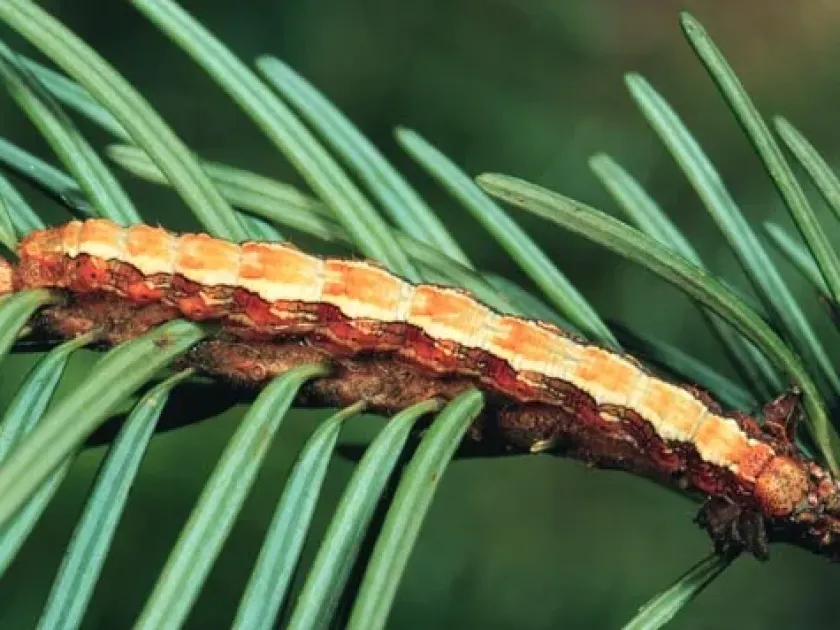
The larvae, typical of geometer moths, possess a characteristic looping movement. Their coloration is adapted to blend in with conifer needles and bark, making them difficult to detect at a glance.
The life cycle encompasses four stages: egg, larva, pupa, and adult. Hibernation occurs primarily in the egg stage, which enhances the species' survival during harsh winter conditions.
Entomologists often use pheromone or light traps to monitor adult population density and predict potential outbreaks in forest stands.
Pupation generally takes place in protected areas such as bark crevices or the leaf litter, providing a refuge from predators and extreme weather events.
What it damages
The larvae of Nepytia nigrovenaria feed exclusively on the foliage of coniferous trees, particularly species like pine and fir. Their impact can be devastating in susceptible forest stands.
By consuming needles, the caterpillars drastically reduce the tree's photosynthetic capacity, which causes severe physiological stress and growth stunting.
Repeated or severe defoliation often leads to the death of the tree, or makes it highly vulnerable to secondary pests like bark beetles and various fungal pathogens.
In large-scale outbreaks, entire forest areas may show significant discoloration and thinning of the canopy, leading to economic losses in timber production.
The damage is most severe in homogenous plantations, where a lack of tree diversity facilitates the rapid spread of the moth population from tree to tree.
When it appears
The development of Nepytia nigrovenaria is tightly linked to the phenology of its host plants. Larval emergence typically coincides with the bud break in spring, ensuring immediate access to food.
The summer months constitute the peak feeding period for the caterpillars. During this time, they rapidly accumulate biomass, which is crucial for their transition to the pupal stage.
After finishing their feeding phase, the larvae pupate. Adult moths emerge later in the summer to mate and lay eggs, completing the generation cycle.
Eggs laid in late summer or autumn remain dormant on the tree surface throughout the winter until the next spring season begins.
Monitoring efforts focus on the flight period of the adults to establish a baseline for infestation risk assessment in the following year.
Signs of infestation
The most visible sign of infestation is the presence of partially consumed needles. Larvae often chew the needles from the edges, leaving behind frayed or skeletonized remnants.
Significant amounts of frass (caterpillar excrement), appearing as small dark pellets, under the trees indicate a high density of larvae feeding in the upper canopy.
Fine silk webbing is frequently observed between needles and small twigs, as larvae use it for stability and movement throughout the tree structure.
Widespread needle discoloration, turning yellowish-brown, is a hallmark of severe defoliation and indicates that the tree is under heavy nutritional stress.
- Frayed or clipped needles on the forest floor.
- Dark frass pellets covering the soil under infested trees.
- Webbing strands visible on twigs.
Control measures
Biological control, including the use of Bacillus thuringiensis or specific viral agents, is considered the most sustainable and environmentally friendly management tactic.
Chemical control involving selective insecticides is implemented only when population thresholds are exceeded, ensuring minimal impact on non-target beneficial insect species.
Promoting forest health through diverse tree planting and the conservation of natural predators, such as birds and parasitic wasps, helps maintain the moth population at sub-economic levels.
Sanitation cutting, which involves the removal of severely infested or dead trees, is a critical step in limiting the spread of the moth in high-risk areas.
Strategic monitoring and early detection remain the most effective tools for preventing large-scale outbreaks and mitigating potential damage to coniferous resources.
Taxonomy
- Latin name
- Nepytia nigrovenaria
- Order
- Lepidoptera (butterflies)
- Family
- Geometridae
- EPPO code
- NEPYNI
Discussion
No discussions yet — be the first.