
Grey spruce looper
Nepytia canosaria
Description
How to identify
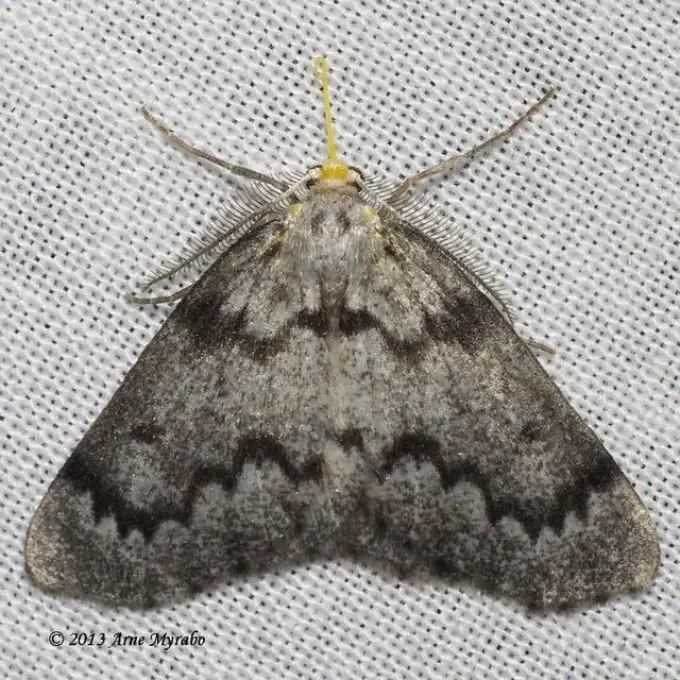
The Grey spruce looper (Nepytia canosaria) is a moth species belonging to the family Geometridae. Adults have a wingspan of approximately 25–30 mm and possess a greyish-brown coloration with distinctive darker, zigzagging lines on the forewings, providing excellent camouflage against bark.
The larvae, known as loopers, exhibit the characteristic inchworm movement. They vary in color from light green to brown, featuring longitudinal light-colored stripes that blend perfectly with the needles of host trees, making them difficult to spot during the early stages of development.
Taxonomically, this species is classified within the subfamily Ennominae. The life cycle consists of a complete metamorphosis, including egg, larval (caterpillar), pupal, and adult stages, which is typical for lepidopteran pests in forest environments.
The species generally overwinters in the egg stage. Eggs are typically laid in clusters on the bark or needles of host trees, ensuring that the next generation is synchronized with the availability of fresh foliage in the spring.
Widely distributed across coniferous regions in North America, this pest thrives in diverse forest conditions, where it can occasionally experience population explosions that pose a significant threat to timber and nursery stock.
What it damages
The primary hosts for Nepytia canosaria are various coniferous tree species, most notably spruce (Picea) and pine (Pinus), although it may also affect hemlock and fir. It is a specialist defoliator that focuses its feeding efforts on the foliage.
Larvae feed primarily on current-year needles but will consume older needles if their population density is high. This defoliation significantly impairs the photosynthetic capacity of the tree, leading to growth reduction and weakened physiological health.
Severe infestations often result in heavy needle drop, branch dieback, and, in extreme cases, the total mortality of the tree. The weakening of the tree's defenses makes it highly susceptible to secondary attacks by bark beetles and wood-boring insects.
Damage symptoms include skeletonized or partially chewed needles that turn yellow or brown, giving the tree a sickly appearance. In large populations, the crown may look transparent as most needles are stripped away by the feeding larvae.
The economic impact is substantial, particularly in forestry plantations and Christmas tree farms, where the loss of foliage directly reduces the market value and health of the crop.
When it appears
Adult moths are typically active in late summer and early autumn, specifically from August to September. During this flight period, mating occurs, followed by egg-laying, which marks the initiation of the next generation's lifecycle.
Larval emergence happens in the spring, timed closely with bud break and the initial growth of new needles. The peak period of larval feeding occurs during May and June, which is the most critical time for damage to occur.
Pupation takes place in mid-to-late summer. Larvae spin loose, silken cocoons among the needles or within bark crevices, where they develop into pupae for several weeks before the emergence of the adult moth.
Environmental conditions, particularly warm spring temperatures and moderate rainfall, play a crucial role in the survival rate of the larvae. High survival rates during these windows often lead to outbreak conditions in subsequent seasons.
Effective monitoring involves inspecting branches for early-stage larvae in late spring and deploying pheromone traps or light traps during the adult flight season to track population trends.
Signs of infestation
The presence of fine silk webbing between needles is one of the earliest signs of infestation. The larvae use these threads to anchor themselves and move safely between branches as they feed on the foliage.
Accumulation of frass (larval excrement) on the forest floor or on lower branches is a strong indicator of an active population. A high volume of frass beneath a tree usually correlates with high larval density in the canopy.
Defoliation becomes visually apparent as needles yellow, die, or are completely eaten. This often starts at the top of the canopy and progresses downwards, leaving behind characteristic dry, skeletal remains of needles.
Disturbing a branch often causes the caterpillars to drop down on thin silk threads. This behavioral characteristic is a quick and reliable diagnostic method used by foresters to identify the presence of the looper.
An increased presence of insectivorous birds, spiders, or parasitic wasps in a specific stand can also be a biological sign that a population of Grey spruce loopers is present, as these predators congregate where food is abundant.
Control measures
Biological control is the preferred method for managing this pest in forest stands. Formulations based on Bacillus thuringiensis (Bt) are highly effective at suppressing larval populations while remaining safe for beneficial insects and wildlife.
Chemical intervention is reserved for severe infestations where there is an immediate threat to tree survival. Registered insecticides should be applied as a foliar spray during the early larval development stage for maximum effectiveness.
Cultural management focuses on forest health, including the removal of heavily infested or weakened trees, which helps reduce the overall density and breeding potential of the looper population.
- Regular monitoring using pheromone-baited traps.
- Encouraging natural predators such as birds and parasitoid wasps.
- Timely application of biological insecticides during the peak of larval feeding.
- Maintaining tree vigor through proper irrigation and thinning in nursery settings.
Integrated Pest Management (IPM) strategies ensure that control efforts are ecologically sound, minimizing environmental impact while protecting the long-term health of coniferous forest resources.
Taxonomy
- Latin name
- Nepytia canosaria
- Order
- Lepidoptera (butterflies)
- Family
- Geometridae
- EPPO code
- NEPYCA
Discussion
No discussions yet — be the first.