
Elm leaf miner
Nepticula ulmivora
Description
How to identify
The elm leaf miner, known scientifically as Stigmella ulmivora (syn. Nepticula ulmivora), belongs to the Nepticulidae family. These are extremely small moths with a wingspan of only a few millimeters.
Adult moths are dark-colored and rarely seen, as they remain mostly inactive during the day. The larvae are the stage of the insect that causes visible damage to the trees.
Systematically, this moth is part of the Lepidoptera order. It is a specialized pest that thrives in environments where elm trees are prevalent and widely planted.
Identification is best achieved by inspecting leaves for specific mining patterns rather than searching for the adults themselves. Entomologists often use light traps to survey populations.
The biology of this species is perfectly synchronized with the phenology of its host, ensuring the larvae have a fresh food supply as soon as they emerge.
What it damages
The elm leaf miner exclusively targets trees within the genus Ulmus. It shows a preference for specific elm varieties, which can lead to localized outbreaks in urban landscapes.
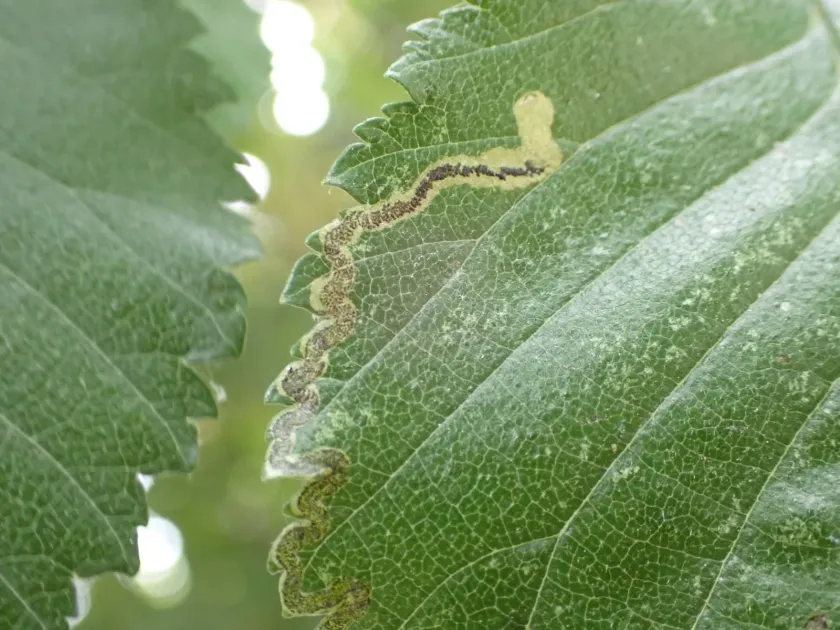
The larvae live inside the leaf, mining the mesophyll tissue between the upper and lower epidermis. This feeding pattern creates distinctive paths that are clearly visible on the leaf surface.
Heavy infestation reduces the tree's photosynthetic efficiency, which can lead to stress, particularly in urban environments where trees already face heat and drought.
While a single infestation rarely kills a mature tree, the cumulative stress over several years can make the tree susceptible to secondary pests and fungal infections.
In ornamental settings, the aesthetic value of the trees is severely compromised as foliage turns brown and drops prematurely during the summer months.
When it appears
The life cycle typically begins in early spring, synchronized with the bud break of the elm tree. Adults emerge, mate, and begin the first generation cycle.
Females lay eggs singly on the underside of the leaves. Upon hatching, the tiny larvae immediately bore into the leaf tissue, which serves as both food and shelter.
Larval activity is at its peak during the mid-summer months when the serpentine mines reach their maximum size and complexity on the leaf blades.
By late summer, the larvae emerge from the mines to pupate. They typically overwinter in the soil or protected crevices of the bark, completing their cycle.
Depending on local climate, there might be one or two generations per year, with the second generation appearing later in the season.
Signs of infestation
The most reliable sign of an elm leaf miner presence is the unique appearance of the foliage, characterized by wandering mine patterns.
- Serpentine, white-colored mines that curve across the leaf blade.
- A central dark line of frass (waste) deposited by the larva as it feeds.
- Wilting or browning of the area directly affected by the larval feeding.
- Premature leaf drop in severe cases of infestation.
- Small exit holes at the end of the mines where larvae emerged to pupate.
Control measures
Cultural control is a primary method, focusing on the removal and destruction of fallen leaves in autumn to disrupt the overwintering pupae.
Systemic insecticides are the most effective chemical intervention, as they are absorbed by the plant and kill the larvae hidden within the leaf mines.
Timing is crucial; applications should be coordinated with the peak egg-laying period to prevent larvae from successfully establishing themselves in the leaves.
Monitoring populations using pheromone traps can help arborists make informed decisions about whether chemical intervention is necessary for a specific site.
Maintaining tree vigor through proper irrigation and soil management helps the elm withstand and recover from the loss of photosynthetic tissue caused by the miners.
Taxonomy
- Latin name
- Nepticula ulmivora
- Order
- Lepidoptera (butterflies)
- Family
- Nepticulidae
- EPPO code
- NEPTUL
Discussion
No discussions yet — be the first.