
Oak leaf miner moth
Nepticula regiella
Description
How to identify
The oak leaf miner moth (Stigmella regiella, formerly Nepticula regiella) belongs to the family Nepticulidae, a group of very small moths. These insects are among the smallest lepidopterans, typically with a wingspan of only 5-6 mm.
Adult moths are generally dark-colored, often exhibiting a metallic sheen, which makes them difficult to observe against the bark of trees during the day.
The larvae are specialized leaf miners. They possess flat, legless bodies perfectly adapted for living between the upper and lower surfaces of the leaf epidermis.
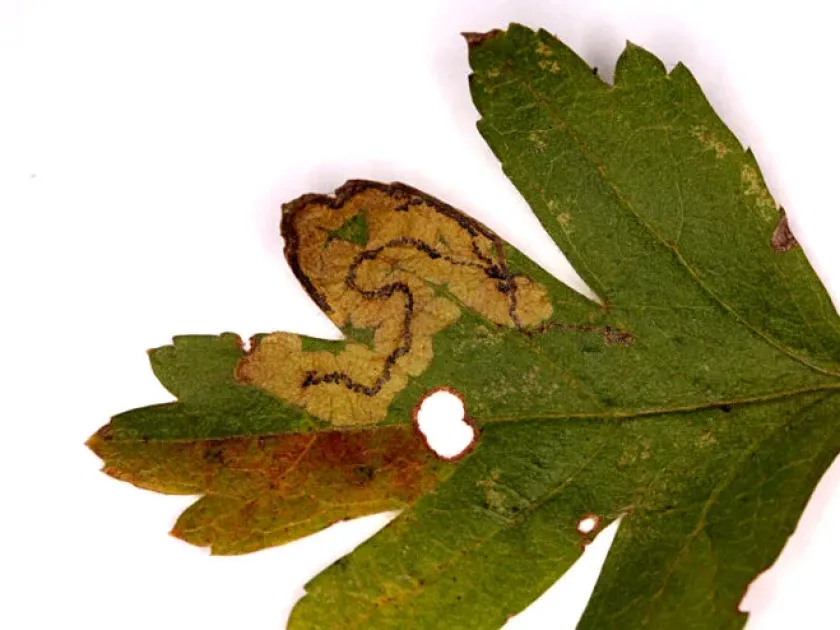
Identification is primarily performed by examining the distinctive larval mines. The pattern and trajectory of these mines are specific to the species, aiding entomologists in diagnosis.
Because of their miniature size, these moths are often overlooked until the damage to the leaves becomes noticeable throughout the tree canopy.
What it damages
The primary host for this species is the pedunculate oak (Quercus robur). The moth is highly host-specific, rarely affecting other broadleaf species.
Damage is caused exclusively by the larvae. By mining the leaf tissues, they destroy the palisade parenchyma, which is crucial for the tree's photosynthesis.
Severe infestations lead to a significant reduction in the tree's energy production, causing physiological stress and making the tree more susceptible to secondary pathogens.
Heavy damage results in the premature browning and shedding of leaves. In urban environments, this greatly diminishes the aesthetic value of public parks and residential landscapes.
Young trees are especially vulnerable. Continuous mining can stunt their growth and, in extreme cases of consecutive infestations, lead to the weakening of the entire specimen.
When it appears
The emergence of the first generation of adults coincides with the budding and initial leaf development of oak trees in late spring.
Females deposit eggs on the leaves, and the newly hatched larvae immediately penetrate the epidermis to begin feeding.
Depending on the climatic zone, the moth can have one or two generations per year. Warmer summers typically favor a more rapid lifecycle and higher population density.
Pupation occurs in specialized cocoons. These are often attached to the bark or hidden within the leaf litter beneath the host tree, where they overwinter.
The timing of emergence for the second generation is often extended, which helps the species persist even during adverse weather conditions during the summer months.
Signs of infestation
The most prominent sign of infestation is the appearance of winding, thread-like mines on the leaves. These often begin near the midrib or the leaf edge.
As the larva grows, the mine widens. A characteristic dark, central line of frass (larval waste) is visible within the mine, which is a key diagnostic feature.
- Winding, light-colored tunnels on the leaf surface.
- Premature yellowing or browning of leaf tissues.
- Increased leaf drop during the summer season.
- Small emergence holes on the leaf surface where the adult moth has exited.
When infestation levels are high, individual mines may coalesce, leading to large, necrotic patches that eventually cause the entire leaf to die and fall off.
Control measures
Sanitation is a vital control method. Raking and destroying fallen leaves in the autumn reduces the number of pupae that would otherwise survive the winter.
For large-scale infestations, systemic insecticides are effective. These are absorbed by the tree and reach the larvae inside the mines, providing better control than contact pesticides.
Biological control includes the preservation of natural predators, such as parasitoid wasps that feed on the larvae within the mines, helping to keep populations in check.
Monitoring using pheromone traps is recommended to determine the peak flight periods, which helps in timing control measures for maximum efficiency.
Maintaining tree vigor through proper irrigation and soil care ensures that oak trees remain resilient and capable of compensating for minor defoliation caused by mining moths.
Taxonomy
- Latin name
- Nepticula regiella
- Order
- Lepidoptera (butterflies)
- Family
- Nepticulidae
- EPPO code
- NEPTRE
Discussion
No discussions yet — be the first.