
Oak leaf miner
Nepticula quinquella
Description
How to identify
The oak leaf miner (Nepticula quinquella) belongs to the Nepticulidae family, a group of very small moths known for their leaf-mining larvae. They are among the smallest lepidopterans in nature.
Adult moths are characterized by a very small wingspan, usually measuring only a few millimeters. They are often dull-colored with iridescent scales, which provides camouflage on tree bark.
Larvae are specialized to feed internally within the leaf tissue. They have a flattened body structure that allows them to navigate the space between the upper and lower leaf surfaces with ease.
The life cycle undergoes complete metamorphosis, including egg, larva, pupa, and adult stages. Each developmental stage is highly adapted to the host plant environment.
Overwintering typically occurs in the pupal stage, protected within a tough, flattened cocoon hidden in bark crevices or the leaf litter at the base of the tree.
What it damages
The primary host for this pest is the English oak (Quercus robur). The larvae consume the green parenchyma tissue of the leaves, which is crucial for photosynthesis.
By creating serpentine mines, the larvae interrupt the transport of nutrients and water within the leaf. This damage weakens the overall vigor of the host tree.
Heavy infestations can lead to premature leaf drop, which deprives the tree of energy reserves needed for the following season. This is particularly harmful to young saplings.
Frequent attacks make the trees more susceptible to secondary stressors, including prolonged drought and various pathogenic fungi that target weakened wood.
In nursery settings, damage caused by the oak leaf miner can significantly stunt the growth of young oaks, affecting both height and diameter increments.
When it appears
The emergence of the first generation of adults coincides with the bud break of oak trees in late spring. Females promptly lay eggs on the newly formed leaves.
Larval development is rapid, typically lasting a few weeks depending on ambient temperatures. Under warm summer conditions, the pest can complete two generations per year.
The summer generation is often the most noticeable, as the cumulative damage to the canopy becomes apparent due to higher insect population densities.
Environmental factors, such as sustained warmth and moderate humidity, are essential for successful larval survival and the rapid progression of the life cycle.
As autumn approaches, the final generation of larvae reaches maturity, pupates, and enters the overwintering phase, waiting for the return of favorable spring conditions.
Signs of infestation
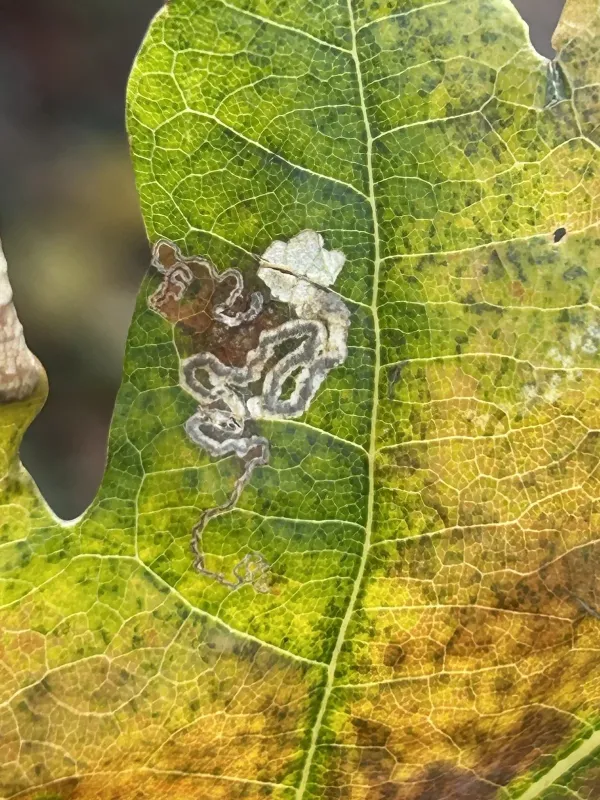
The most distinctive symptom is the presence of winding, narrow trails on the leaves. These "mines" expand as the larva increases in size throughout its development.
Within the mine, a dark line of frass (larval excrement) is typically visible, running continuously along the center of the tunnel. This is a key diagnostic feature.
As the infestation progresses, the surrounding leaf tissue may discolor, often appearing pale or yellowish, creating a mottled pattern on the foliage.
In cases of severe infestation, leaves may become distorted, crinkled, or brittle. The affected leaves often fall from the tree prematurely before the typical autumn season.
- Serpentine, widening tunnels within the leaf.
- Central dark line of frass inside the mines.
- Premature browning and abscission of leaves.
Control measures
Sanitation practices, such as the removal and destruction of fallen leaves in autumn, are highly effective in reducing the number of pupae overwintering near the tree.
Biological control, using specific bacterial pathogens like Bacillus thuringiensis, can be applied to manage larval populations without harming beneficial insects.
Chemical control is rarely necessary but may be used in high-value ornamental landscapes. Systemic insecticides are preferred to reach larvae feeding protected within the leaf tissue.
Maintaining tree health through proper fertilization and watering increases the tree's resilience to mining damage, allowing it to tolerate minor infestations.
Encouraging biodiversity in forest stands by protecting natural predators, such as parasitic wasps, creates a sustainable balance that keeps pest populations in check.
Taxonomy
- Latin name
- Nepticula quinquella
- Order
- Lepidoptera (butterflies)
- Family
- Nepticulidae
- EPPO code
- NEPTQU
Discussion
No discussions yet — be the first.