
Pear leaf miner
Nepticula pyri
Description
How to identify
The pear leaf miner (Nepticula pyri) is a member of the Nepticulidae family, known as the smallest moths in the world. Adult moths have a wingspan of only about 5 mm, making them extremely difficult to spot in the orchard.
The adults are typically dark grey or blackish with a metallic sheen. The larvae, which are the stage responsible for the damage, are small, yellowish-green caterpillars that spend their entire growth cycle inside the leaf tissues.
The life cycle involves four distinct stages: egg, larva, pupa, and adult. The insect usually overwinters as a pupa, enclosed in a dense, dark-colored cocoon located in the soil surface or hidden within leaf debris beneath the pear trees.
Adult emergence generally occurs in the spring, coinciding with the flowering of pear trees. Being nocturnal creatures, these moths remain inactive during the day, resting on bark or deep within the foliage.
Females deposit their eggs individually on the underside of the leaves. A single female can produce several dozen eggs during her short lifespan, leading to localized infestations if not managed correctly.
What it damages
The primary host for this pest is the pear tree. While it occasionally affects other Rosaceae plants, the pear tree suffers the most significant damage when population levels are allowed to rise.
The damage is caused exclusively by the larvae. Upon hatching, the larva bores directly into the leaf, feeding on the internal leaf tissue (parenchyma) without breaking through the upper or lower epidermis.
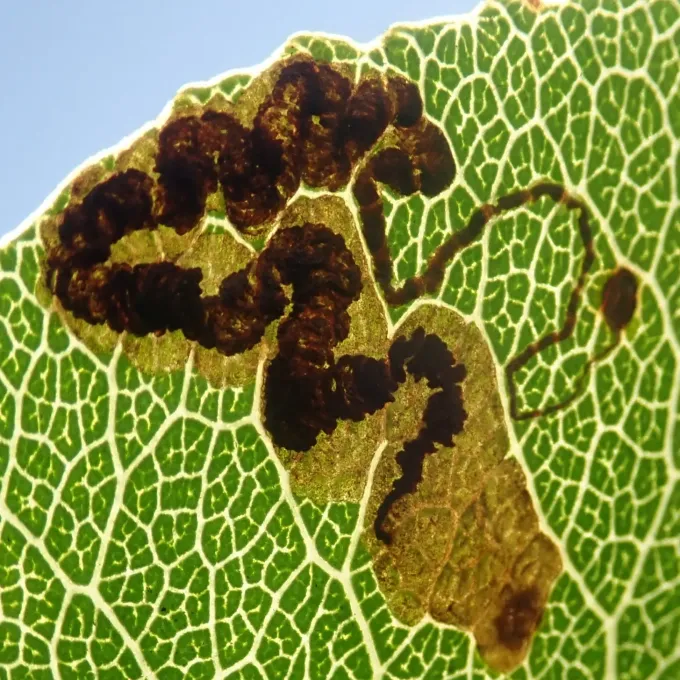
This feeding behavior creates winding, serpentine tracks known as "mines." As the larva grows, the mine widens, resulting in brown, necrotic patches on the leaves that severely hinder the tree's photosynthetic capability.
Severe infestations lead to premature leaf drop, which significantly weakens the tree. This loss of vitality reduces the tree's ability to store energy for the following season and can lead to poor fruit quality.
By compromising the leaf integrity, the pear leaf miner makes the tree more susceptible to secondary fungal and bacterial infections, compounding the overall damage to the orchard's health.
When it appears
The life cycle is closely synchronized with the phenology of the pear tree. Depending on the climate, the pest can complete two or three generations per year, with activity peaking in mid-summer.
The first signs of damage, appearing as thin, light-colored lines, are typically visible starting in late May or early June as the first generation of larvae begins feeding on the newly developed foliage.
July and August are the months of most intense activity. During these warm months, the developmental rate of the larvae is at its highest, leading to rapid expansion of the mines across the canopy.
Adult activity ceases as autumn approaches. The late-season generation prepares for dormancy, transitioning into the pupal stage, which will wait in the soil or ground litter until the following spring.
Monitoring for the start of moth flight is crucial for timing, as it is the period just before the eggs hatch that determines the success or failure of preventative control measures.
Signs of infestation
The most distinctive sign of a pear leaf miner infestation is the presence of winding, narrow trails on the leaves. These "mines" often contain dark deposits of larval excrement arranged in lines.
When held up to the sunlight, the leaf shows translucent pathways. Over time, these mines turn brown and shrivel, causing the leaf tissue around the track to wither and sometimes deform.
In heavy infestations, the foliage takes on a mottled, marbled appearance. The leaves may curl, dry out, and drop prematurely, which is a significant indicator of a late-summer infestation.
While the moths themselves are rarely seen, the impact on the canopy is undeniable. Orchardists should inspect the leaves regularly, especially the interior of the tree where the microclimate is more favorable for the pest.
- Winding, serpentine tracks on the leaves.
- Presence of tiny dark pellets (excrement) within the mines.
- Leaf necrosis and premature yellowing.
- Widespread leaf drop occurring before the natural autumn senescence.
Control measures
Effective management begins with sanitation. Collecting and destroying fallen leaves during the autumn is a critical step, as these contain the overwintering pupae that would otherwise emerge next spring.
Tilling or plowing the soil in the orchard during late autumn disrupts the pupation environment, exposing the cocoons to predators and harsh winter temperatures, which significantly reduces the population.
Chemical control should be timed to match the egg-hatching period. Systemic insecticides are generally preferred as they penetrate the leaf tissue, reaching the larvae protected within the mines.
Integrated Pest Management (IPM) practices suggest using pheromone traps to track the population density and determine the precise timing for targeted insecticide applications, minimizing unnecessary spraying.
Encouraging natural predators, such as parasitic wasps, is a sustainable way to keep leaf miner populations below the economic injury level, ensuring the long-term health of the pear orchard.
Taxonomy
- Latin name
- Nepticula pyri
- Order
- Lepidoptera (butterflies)
- Family
- Nepticulidae
- EPPO code
- NEPTPY
Discussion
No discussions yet — be the first.