
Apple leaf miner
Nepticula pygmaeella
Description
How to identify
The apple leaf miner (Stigmella malella, formerly known as Nepticula pygmaeella) is a tiny moth belonging to the family Nepticulidae. It is considered one of the smallest lepidopteran pests affecting orchards.
Adult moths have a wingspan of approximately 5 millimeters. Their forewings are dark with a metallic sheen and a distinct pale transverse band, while the hindwings are narrow and heavily fringed.
The larvae are small, yellowish-green caterpillars with dark heads. They spend their entire feeding stage hidden within the leaf tissues, which defines their unique morphology and lifestyle.
Pupation occurs within dense, resilient cocoons. These cocoons are typically attached to the leaf surface or hidden in the crevices of the tree bark, providing protection during the winter.
The life cycle of the moth is closely synchronized with the phenology of the host plant, and the number of generations per season depends on the local climate and temperature.
What it damages
The primary host for this pest is the domestic apple tree, although it can occasionally be found on pear, quince, and hawthorn trees within the Rosaceae family.
Larvae consume the leaf parenchyma while leaving the upper and lower epidermal layers intact. This feeding behavior creates winding, narrow tunnels known as mines.
These mines damage the photosynthetic tissue of the leaf, which directly impacts the tree's energy production, growth rate, and fruit quality in the current season.
In cases of heavy infestation, leaves may turn yellow prematurely and drop, significantly weakening the tree and reducing its winter hardiness.
High levels of infestation in apple nurseries can stunt the growth of young trees, leading to long-term developmental issues if the infestation is not addressed.
When it appears
The first flight of the adults usually begins during the apple blossom period. Mating occurs shortly after, and females lay eggs on the underside of leaves.
Larvae hatch after about one week and immediately begin mining into the leaf tissue. As the season progresses, generations often overlap, leading to continuous activity.
The peak of damage often occurs in mid-to-late summer when the second and third generations are highly active and numerous across the orchard canopy.
By autumn, larvae complete their development, exit the leaves, and pupate. Monitoring the foliage during this period is essential to evaluate the total population size.
Using pheromone traps is the most reliable way to monitor the adult flight, allowing growers to time their insecticide applications with high precision.
Signs of infestation
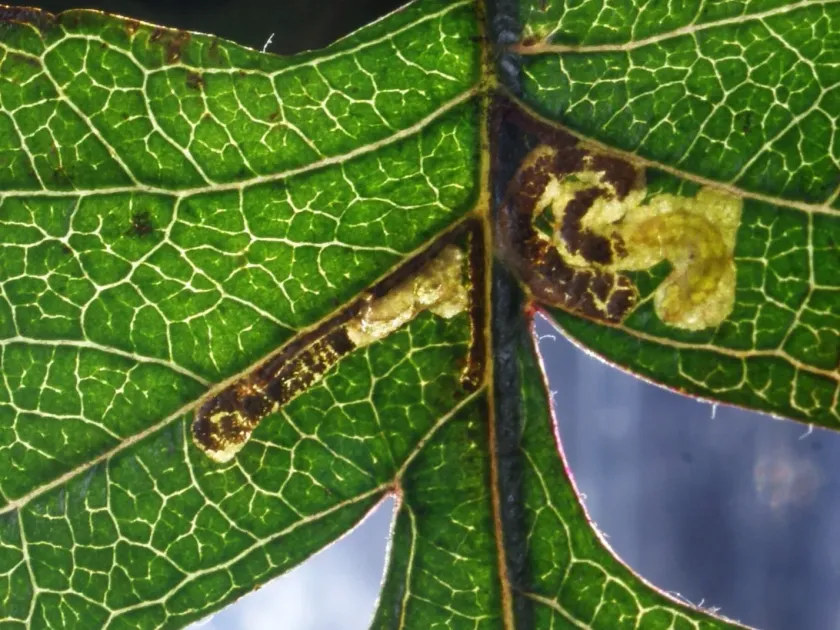
The most distinctive sign of infestation is the appearance of narrow, serpentine, whitish lines on the leaves, which represent the tunnels created by the larvae.
Inside these tunnels, one can observe a continuous or broken dark line of excrement, which serves as a definitive characteristic for identifying the miner.
When held against the light, the leaves show a clear pattern of these tunnels. Over time, the mined areas may become necrotic, dry out, and cause leaf deformation.
Premature leaf drop in mid-summer, combined with visual evidence of mines on the remaining foliage, confirms the presence of an active apple leaf miner population.
Early detection involves inspecting the undersides of leaves for eggs or small, newly formed mines, which allows for earlier and more effective intervention.
Control measures
Cultural practices are the first line of defense. This includes removing and destroying fallen leaves in autumn to eliminate overwintering pupae and cleaning bark crevices.
Biological control involves supporting natural enemies, such as parasitic wasps, which can significantly suppress miner populations without the use of synthetic chemicals.
Chemical control is most effective when systemic insecticides are used. Because the larvae live inside the leaf, contact sprays are often ineffective unless timed perfectly.
- Apply systemic insecticides during the peak larval emergence phase.
- Utilize insect growth regulators to disrupt the metamorphosis process.
- Monitor pest density using pheromone traps to minimize unnecessary chemical applications.
Strategic management requires balancing the need for pest suppression with the protection of beneficial insects, ensuring the long-term health of the orchard ecosystem.
Taxonomy
- Latin name
- Nepticula pygmaeella
- Order
- Lepidoptera (butterflies)
- Family
- Nepticulidae
- EPPO code
- NEPTPG
Discussion
No discussions yet — be the first.