
Elm leaf miner
Nepticula marginicolella
Description
How to identify
The elm leaf miner (Stigmella marginicolella) is a tiny moth belonging to the family Nepticulidae. These insects are among the smallest lepidopterans in existence, with adult specimens having a wingspan typically ranging from only 4 to 6 millimeters.
Adult moths are inconspicuous, featuring dark, grayish, or brownish scales often with a metallic sheen. Due to their minute size and cryptic coloration, they are rarely seen by the naked eye as they rest on the bark or foliage of elm trees.
The larvae are specialized leaf-miners. They possess a flattened body structure and lack true thoracic legs, adaptations that allow them to reside and feed exclusively between the upper and lower epidermis of the leaf throughout their development.
Pupation occurs within small, dense cocoons. These cocoons are constructed either within the leaf mine or, more commonly, in the soil and leaf litter beneath the tree, which is a critical aspect of their life cycle.
This species is highly host-specific, primarily infesting various species of elm (Ulmus). Its evolutionary development is closely tied to the host tree, making it a persistent resident in ecosystems where elms are common.
What it damages
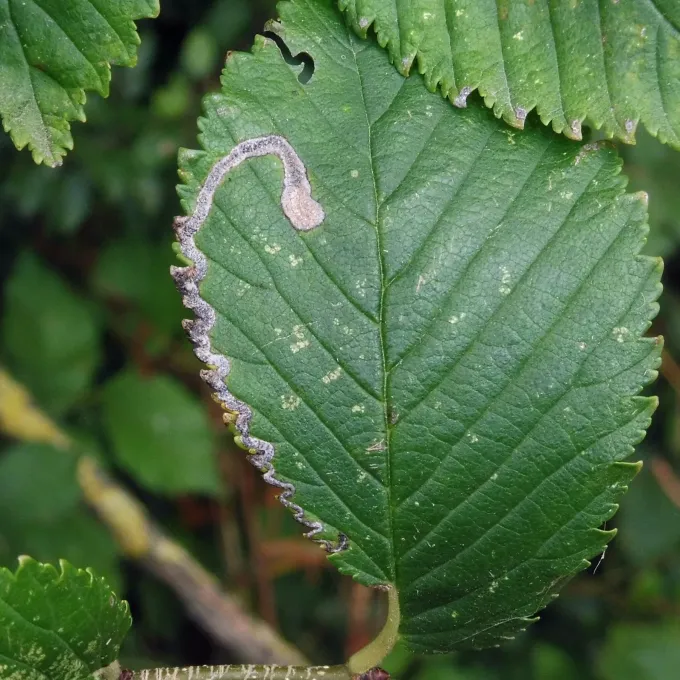
Damage is exclusively caused by the larvae, which create long, winding galleries (mines) inside the leaf blade. As they feed on the parenchyma tissue, they leave the leaf cuticle intact, resulting in a visible, often yellowish or whitish trail.
Severe infestations can lead to significant defoliation or loss of functional leaf area. This reduction in photosynthetic capacity weakens the tree, potentially predisposing it to secondary stressors such as fungal pathogens or environmental extremes.
In urban landscapes, the aesthetic damage is often more concerning than the physiological impact. The foliage can become unsightly, turning brown or mottled, which detracts from the ornamental value of elm trees in parks and street plantings.
Young elm trees are particularly vulnerable to growth reduction. Constant larval feeding can inhibit proper crown development and reduce the tree's vigor, making it less resilient against other pests or drought conditions.
While an isolated mine may seem insignificant, the cumulative effect of thousands of larvae on a single tree can lead to canopy thinning and premature leaf senescence during the summer months.
When it appears
The seasonal activity begins in late spring, corresponding with the bud-break and initial leaf growth of the elm trees. This timing ensures that young larvae have immediate access to fresh, nutritious plant tissue.
Depending on the climatic region, the elm leaf miner can produce one or two generations per year. The first generation typically appears in early summer, with the second generation appearing later in the season.
Adult moths emerge, mate, and lay eggs on the undersides of the leaves. The incubation period is relatively short, and the larvae begin mining immediately upon hatching, which protects them from environmental factors and contact predators.
Temperature significantly influences the life cycle duration. Warmer summers accelerate larval development, potentially resulting in larger population spikes as the season progresses towards autumn.
The species overwinters in the pupal stage. Most individuals reside in the leaf litter at the base of the elm, meaning that the presence of detritus is a significant factor in the pest's annual recurrence in a specific area.
Signs of infestation
The most diagnostic sign is the appearance of serpentine mines on the leaves. These galleries look like thin, winding white or yellowish lines that stand out clearly when the leaf is held up to the light.
A distinctive feature of these mines is the central dark line formed by the larva's frass (excrement). This linear pattern helps distinguish elm leaf miner damage from that of other leaf-mining insects on the same host.
As the larva grows, the mine widens, often forming complex spirals or irregular patterns across the leaf surface. The leaf tissue itself may appear slightly blistered where the larva has consumed the inner layers.
- Winding, light-colored trails on leaf blades.
- Central dark streaks of frass within the mines.
- Premature yellowing or browning of affected leaves.
- Small exit holes where mature larvae have emerged to pupate.
When infestation levels are high, the crown of the tree may look prematurely thin or scorched, with a significant portion of the foliage showing signs of internal tissue loss and necrosis.
Control measures
The most effective cultural practice is the sanitation of the area under the trees. Removing and composting or destroying leaf litter in the fall removes the primary overwintering sites for the pupae, significantly reducing the next spring's population.
In cases where infestations are heavy, systemic insecticides are recommended. Because the larvae feed internally, contact sprays are often ineffective; systemic products absorbed by the leaves provide better control.
Monitoring with pheromone traps can help arborists time treatments accurately. Applying controls during the adult flight period is the most effective way to prevent egg-laying and minimize damage to the foliage.
Promoting tree vigor through proper watering and soil fertilization is vital. Healthy trees have a better capacity to compensate for leaf loss and are generally more resistant to the stressors that attract mining insects.
Biological control, involving the encouragement of natural predators like parasitic wasps, can help keep population numbers in check. Maintaining a diverse landscape can support these beneficial insects and naturally mitigate outbreaks.
Taxonomy
- Latin name
- Nepticula marginicolella
- Order
- Lepidoptera (butterflies)
- Family
- Nepticulidae
- EPPO code
- NEPTMC
Discussion
No discussions yet — be the first.