
Birch leaf miner
Nepticula luteella
Description
How to identify
The birch leaf miner (Stigmella luteella, formerly Nepticula luteella) is a tiny moth belonging to the family Nepticulidae. These insects are among the smallest moths, with a wingspan of only 5 to 6 millimeters.
Adults are inconspicuous, often possessing a metallic sheen, making them difficult to spot against the bark of birch trees. The larvae, which are responsible for the damage, have a yellowish, slender body and live exclusively inside the leaf tissue.
This species is native to birch forests and urban parklands, thriving wherever its host plants are present. Its life cycle is perfectly adapted to the phenological stages of the birch tree's growth.
The insect undergoes complete metamorphosis: egg, larva, pupa, and adult. It typically overwinters as a pupa, protected within a dense cocoon located in the leaf litter or crevices of the tree bark.
Identifying this pest usually involves spotting the unique mining patterns left on the leaves, which are telltale signs of their presence in the canopy.
What it damages
The primary host for this pest is the birch tree (Betula). Both young saplings and mature trees can be infested, often resulting in significant aesthetic and physiological impact.
Larvae consume the leaf parenchyma as they tunnel through the leaf, which directly interferes with the tree's ability to perform photosynthesis efficiently.
Widespread infestation leads to premature yellowing and dropping of leaves, which weakens the tree's overall vigor and makes it more susceptible to environmental stress.
While an otherwise healthy tree is rarely killed by this pest, consistent annual damage can lead to reduced biomass production and poor growth rates in nurseries.
In landscaping, heavy infestations can cause the canopy to look sparse and sickly, which is a major concern for garden owners and foresters alike.
When it appears
Adult moths typically emerge in late spring, coinciding with the period when birch trees produce fresh, young leaves, which are ideal for egg-laying.
Females deposit eggs on the undersides of leaves, and larvae hatch soon after to begin their feeding cycle by tunneling into the leaf structure.
The larval feeding phase lasts several weeks, during which the tunnels grow wider in proportion to the size of the developing larva.
Pupation usually occurs in early to mid-summer, after which the next generation may emerge or enter a state of dormancy depending on regional climatic conditions.
Monitoring for the first signs of leaf mines should commence as soon as daily temperatures consistently stay above 15 degrees Celsius.
Signs of infestation
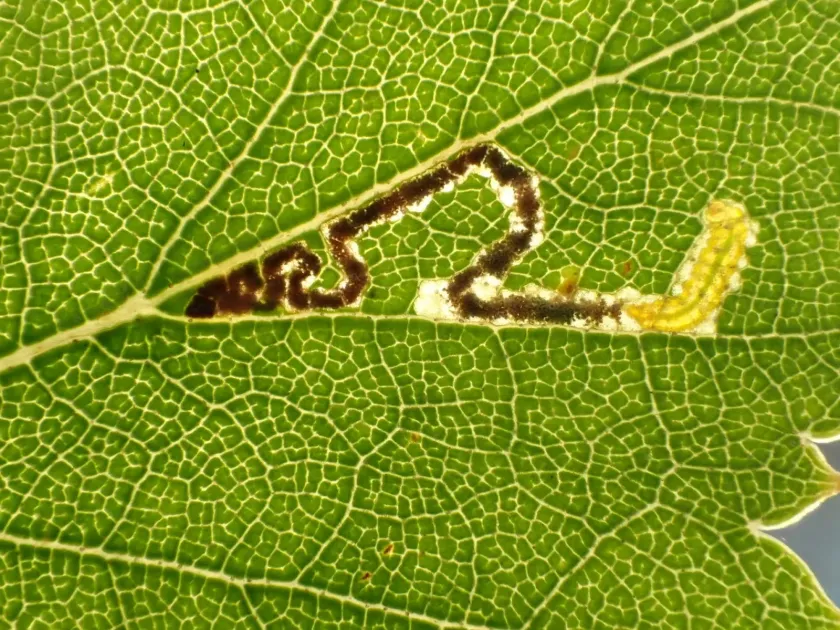
The most prominent sign of an infestation is the presence of "mines"—winding, light-colored tunnels that track through the leaf tissue.
Unlike other insects, the tunnels of the birch leaf miner have a characteristic shape: they start thin and gradually widen, reflecting the growth of the larva inside.
Inside the tunnels, one can often see a dark, broken line representing the larva's excrement, which serves as a definitive identification mark for this species.
In cases of severe damage, the leaf blade may become distorted, curl, or wither around the edges, making the damage visible from a distance.
Holding an infested leaf up to the light reveals the larva or its vacated tunnel, confirming that the tree is being attacked by the birch leaf miner.
Control measures
Effective management of the birch leaf miner relies on a combination of cultural practices and chemical interventions when necessary.
Removing and destroying fallen leaves in the autumn is a critical step, as it eliminates many overwintering pupae and reduces the next year's population.
If the infestation is severe, systemic insecticides can be applied to the foliage during the period when larvae are actively hatching and starting to tunnel.
Encouraging natural predators, such as insectivorous birds and parasitic wasps, is a sustainable way to keep the moth population under control naturally.
- Applying contact insecticides during the adult moth flight period.
- Utilizing systemic treatments when mines are first spotted.
- Pruning and disposing of heavily infested branches to limit spread.
Taxonomy
- Latin name
- Nepticula luteella
- Order
- Lepidoptera (butterflies)
- Family
- Nepticulidae
- EPPO code
- NEPTLU
Discussion
No discussions yet — be the first.