
Pigmy moths
Nepticula
Description
How to identify
Pigmy moths, belonging to the family Nepticulidae, represent one of the smallest groups of lepidopterans in the world. Adult moths have a wingspan typically ranging between 3 and 6 millimeters.
They are characterized by narrow, scaled wings that often exhibit a metallic luster. A distinct morphological feature is the tuft of hair-like scales covering the head, which helps in identifying these tiny insects.
Systematically, they belong to the order Lepidoptera, family Nepticulidae. Their microscopic size often leads to them being overlooked during routine field inspections until damage becomes visible.
The larvae are specialized leaf miners, possessing flattened bodies without developed abdominal legs. This anatomy is perfectly adapted for living and feeding between the leaf epidermal layers.
Understanding their taxonomy is essential for selecting effective control strategies, as their life cycle is highly specialized compared to other foliage-feeding pests.
What it damages
Pigmy moths cause significant damage to various fruit trees and shrubs, including apple, pear, plum, and cherry trees. They are also known to affect various ornamental trees like oak and birch.
The larvae feed on the leaf parenchyma, creating intricate, winding galleries (mines) under the epidermis. This feeding behavior reduces the photosynthetic capacity of the plant.
Heavy infestations result in premature leaf drop, which weakens the trees and negatively affects fruit bud development for the following season. This is particularly problematic for young trees in nurseries.
In addition to physiological stress, the aesthetic damage to nursery stock can lead to significant economic losses for producers. Weakened trees are also more susceptible to winter frost and secondary pathogens.
While an individual mine may seem minor, the collective damage from hundreds of larvae per tree can drastically reduce overall tree vigor and production quality.
When it appears
The flight of adult moths typically begins in the spring, coinciding with the bud burst and initial leaf development of host plants. This allows for immediate oviposition on fresh foliage.
Depending on the climatic zone, these insects can complete several generations per year. Warmer climates often lead to more frequent breeding cycles, increasing the pressure on crops.
The period of most intensive mining occurs throughout the first half of the summer, as larvae consume plant tissues rapidly to reach the pupation stage.
Pupation generally occurs either in the soil or within protective cocoons attached to the bark or within dried leaf litter, where the insects remain during the winter months.
Agronomists use phenological monitoring to time protective interventions, ensuring that treatments are applied when the moths are most vulnerable to control agents.
Signs of infestation
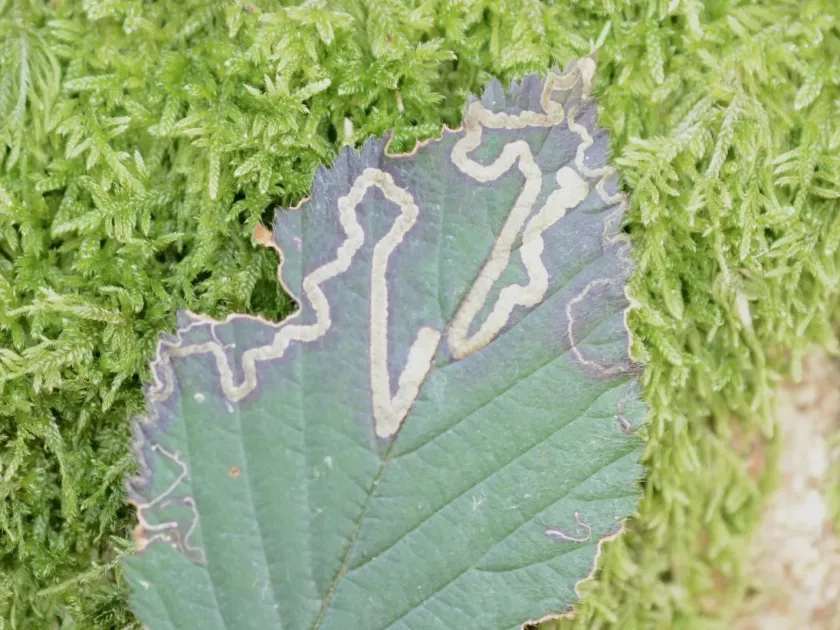
The primary symptom of an infestation is the presence of winding or zigzagging "mines" on the leaves. These often appear as translucent, light-colored trails across the leaf surface.
A central, thin dark line is usually visible within each mine; this consists of the larvae's frass, which serves as a reliable diagnostic sign of the pigmy moth.
Affected leaves may show yellowing, curling, or necrosis along the margins as the damage progresses and the leaf tissue dies back.
- Visible serpentine trails on the upper or lower leaf surfaces.
- Dark, continuous lines of frass inside the mines.
- Premature yellowing and leaf abscission in summer.
- Small holes in bark where moths have emerged.
Checking leaves against light allows for easier identification of the larvae moving inside the mines, confirming the presence of an active infestation.
Control measures
Cultural control methods involve the thorough removal and destruction of fallen leaves in autumn, which helps eliminate overwintering pupae and larvae from the orchard floor.
Tilling the soil beneath the canopy during late autumn or early spring can disrupt the life cycle of species that pupate in the soil, significantly reducing the next generation's population.
Chemical control is most effective when targeted at the egg-laying or early larval stage. Systemic insecticides are often required to reach the larvae protected within the leaf tissue.
The use of pheromone traps is an excellent tool for monitoring the flight patterns of adult moths, allowing for precise timing of pesticide applications to minimize environmental impact.
Integrated pest management (IPM) programs should also incorporate biological control agents, such as parasitoid wasps or entomopathogenic fungi, to keep populations under control naturally.
Taxonomy
- Latin name
- Nepticula
- Order
- Lepidoptera (butterflies)
- Family
- Nepticulidae
- EPPO code
- NEPTSP
Discussion
No discussions yet — be the first.