
Golden silk orb-weaver
Nephila pilipes
Description
How to identify
Nephila pilipes, known as the giant golden silk orb-weaver, is a prominent member of the Araneidae family characterized by its massive size.
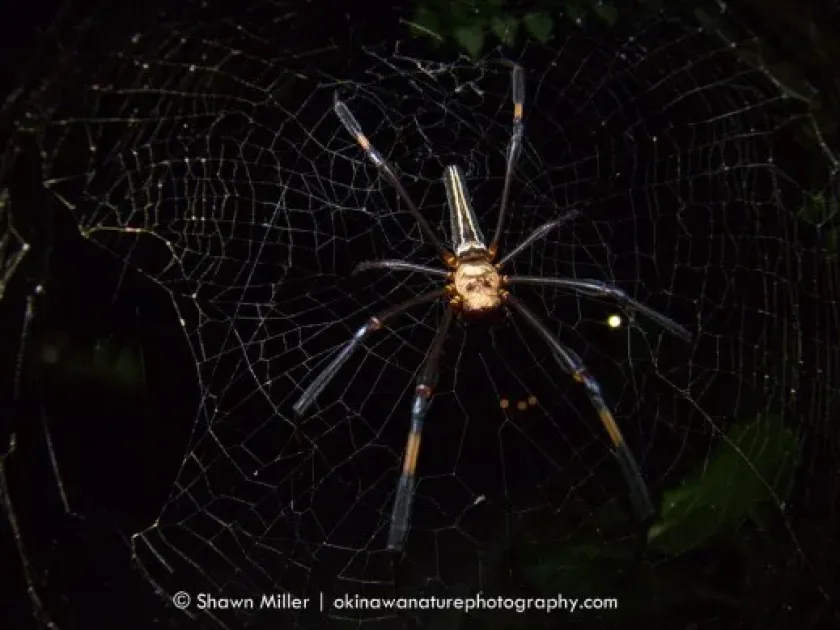
Females are significantly larger than males, often measuring over 5 cm in body length with long, distinct legs covered in tufts of hair on the tibiae.
The coloration of these spiders ranges from dark yellow to black, providing them with excellent camouflage against the foliage in their habitat.
They are famous for spinning golden-colored, extremely strong silk webs that can span over a meter in diameter, capable of catching large prey.
Males are much smaller and usually reside on the perimeter of the female's web, playing a minor role in the overall architectural structure.
What it damages
Nephila pilipes is not considered an agricultural pest because it does not feed on any parts of plants, whether foliage, stems, or fruits.
As a predatory spider, it plays a vital role in natural pest control by capturing various insects that might otherwise damage agricultural crops.
There is no evidence of phytophagous behavior, meaning the spider does not cause direct economic loss to farmers through feeding activity.
The presence of these spiders is often an indicator of a healthy, biodiverse environment where natural predator-prey relationships are maintained.
The only minor issue is the structural interference of their large webs with human labor during harvesting or routine field inspection tasks.
When it appears
These spiders are most active during warm and humid periods, which are essential for their metabolic processes and prey availability.
The vegetative season provides the ideal conditions for the spiders to construct their massive webs due to the abundance of insect activity.
Reproduction cycles are generally synchronized with the end of the warm season to ensure the survival of offspring in suitable conditions.
In greenhouses or controlled environments, Nephila pilipes can remain active year-round if temperatures are maintained above the threshold.
They are most visible during the peak of the insect season when their webs are continuously being repaired and expanded for hunting.
Signs of infestation
The primary sign of a Nephila pilipes presence is the discovery of large, golden, sticky webs stretched between trees, shrubs, or tall crops.
One can identify the spider by its central position in the web, especially during low light conditions in the early morning or evening.
The accumulation of insect remains or chitinous shells trapped in the web is a clear indication of a healthy, active predator in the area.
Unlike pest-infested crops, the host plants in the area of the web remain physically undamaged with no signs of consumption or leaf necrosis.
The structural layout of the web, often consisting of a primary orb with supporting tension lines, is characteristic of the golden silk orb-weaver.
Control measures
Management practices for Nephila pilipes are rarely required in professional agriculture as the spider acts as a beneficial entomophage.
If physical obstruction occurs, simple mechanical removal of the webs is sufficient to clear paths for machinery or personnel without harming the spider.
Avoiding the use of broad-spectrum pesticides is highly recommended to protect these beneficial spiders and maintain the ecological balance of the field.
Integrated Pest Management (IPM) strategies encourage the preservation of spiders to naturally reduce the population of harmful agricultural insects.
- Mechanical removal of webs obstructing equipment paths.
- Prevention of broad-spectrum insecticide overuse.
- Maintaining biodiversity to support natural predator populations.
Taxonomy
- Latin name
- Nephila pilipes
- Family
- Araneidae
- EPPO code
- NEPLMA
Discussion
No discussions yet — be the first.